
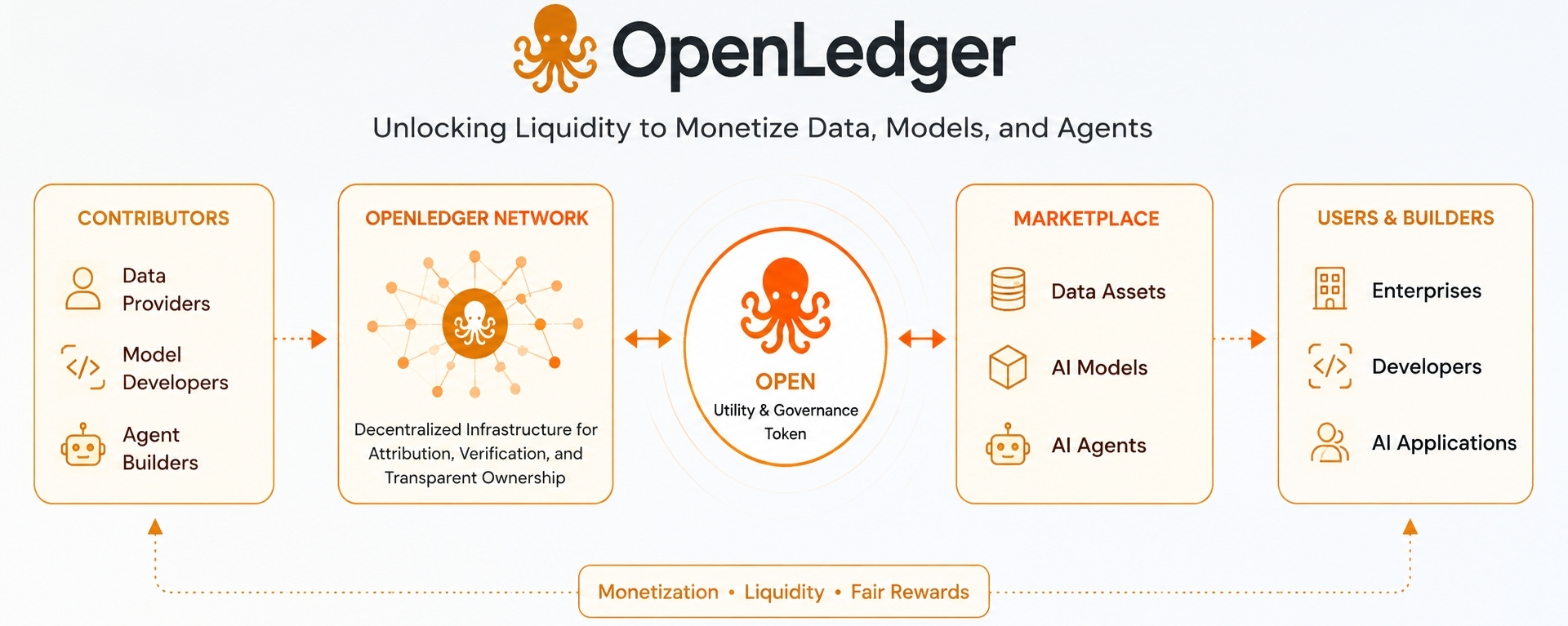

OpenLedger feels like one of those projects that quietly sits underneath several larger conversations happening in AI right now.
Most people are focused on who is building the smartest models, who is launching the newest AI agent, or which company is moving fastest. OpenLedger seems more interested in something that receives far less attention: where the underlying value comes from in the first place.
The project is built around a simple observation that becomes harder to ignore the longer AI develops. Models do not create intelligence from nothing. They learn from data. They depend on information that somebody collected, organized, labeled, or contributed. Yet once a model becomes successful, the people and resources that helped create it often fade into the background while most of the economic value flows elsewhere.
What makes OpenLedger interesting is that it treats this as a market problem rather than a technical one.
The project is trying to create an environment where data, models, and AI agents can become economic participants instead of isolated resources. The idea is that contributors should have a clearer path to monetization, builders should have access to specialized datasets, and AI applications should be able to operate inside a system where value can be tracked and distributed more transparently.
I find myself returning to this idea because it touches something that many AI discussions conveniently avoid.
Everyone agrees that high-quality data is valuable. Very few systems are designed to reward the people responsible for producing it.
That gap becomes more noticeable as AI becomes more commercialized. The better the models become, the more valuable the underlying inputs appear. Yet there is still uncertainty around who captures that value and how those incentives should work over time.
OpenLedger is essentially betting that this uncertainty will eventually create demand for a different structure.
Whether that happens is where things become more complicated.
The project's vision depends on the assumption that contributors will be willing to participate because ownership and monetization opportunities exist. That sounds reasonable until you start thinking about how difficult it is to create incentives around quality.
Not all data is equally useful. Some information can dramatically improve an AI system while other contributions add very little. Creating a marketplace is one challenge. Creating a marketplace that consistently rewards valuable contributions is a much harder one.
If rewards become too easy to earn, the network risks attracting volume without substance. If rewards become too selective, participation can narrow and growth slows. Somewhere between those extremes is a sustainable balance, but finding that balance is rarely straightforward.
What I appreciate about OpenLedger is that it is attempting to solve a problem that actually exists rather than inventing one.
The AI industry already has models.
It already has users.
It already has enormous amounts of capital.
What remains less developed is the infrastructure connecting contributors to the value they help create.
That does not automatically mean OpenLedger succeeds, but it does mean the project is operating in a space where demand could emerge naturally if the ecosystem evolves in the direction many people expect.
The role of AI agents makes this even more interesting.
There has been a tendency across both crypto and AI to treat agents as the next inevitable layer of the internet. Maybe they will be. Maybe they won't. But regardless of how sophisticated these systems become, they still depend on access to useful information and reliable resources.
An intelligent agent operating with poor inputs remains limited.
OpenLedger seems to recognize this by focusing on the assets that support AI rather than only the applications that sit on top of it. In some ways, the project feels less interested in intelligence itself and more interested in the economy surrounding intelligence.
That distinction may seem subtle, but it changes how I think about the opportunity.
Infrastructure projects often look less exciting in the beginning because their value emerges through adoption rather than attention. Their success depends on whether builders decide the system is worth integrating, whether contributors believe participation is worthwhile, and whether the resulting ecosystem becomes more useful as it grows.
Those are difficult things to manufacture through marketing alone.
They require genuine network effects.
The strongest version of OpenLedger is one where contributors provide valuable data because they are rewarded fairly, builders continue using the network because the data improves outcomes, and new participants join because the ecosystem becomes increasingly useful. If that cycle develops naturally, the project could create a defensible position over time.
The weaker version is one where incentives attract activity without creating meaningful utility. Crypto has seen plenty of networks generate participation through rewards only to discover that the activity disappears once the rewards become less attractive. OpenLedger will ultimately need to prove that the value created inside the ecosystem is real enough to survive beyond incentive-driven growth.
That is probably the question I keep coming back to.
Not whether the idea makes sense.
Not whether AI remains a powerful narrative.
But whether the behavior OpenLedger is encouraging creates lasting economic value for everyone involved.
After spending time looking at the project, I come away with the impression that it is trying to address a genuine structural issue inside the AI economy. The vision is ambitious, but the challenge is not technological alone. It is behavioral, economic, and deeply dependent on adoption from people who have alternatives.
There is enough substance here to justify attention, yet enough uncertainty to avoid easy conclusions.
OpenLedger is attempting to build a marketplace around resources that AI systems increasingly depend on. If the future of AI becomes more open, collaborative, and attribution-driven, the project could find itself in a meaningful position. If convenience, centralization, and existing platforms continue dominating the industry, the path becomes more difficult.
For now, it feels less like a project chasing the AI trend and more like a project trying to understand where value originates within that trend. Whether that insight becomes a durable advantage remains unanswered, but it is precisely the kind of question that makes OpenLedger worth following beyond the initial excitement.