
I've been in crypto long enough to recognize when a narrative starts making the rounds.
It usually begins the same way. A real problem exists somewhere beneath the surface, people start paying attention to it, and before long the industry convinces itself that the solution is just one protocol away.
I've watched this happen more times than I can count.
That's probably why I've become careful whenever I hear a new phrase repeated everywhere.
Recently, one of those phrases has been "liquidity for data."
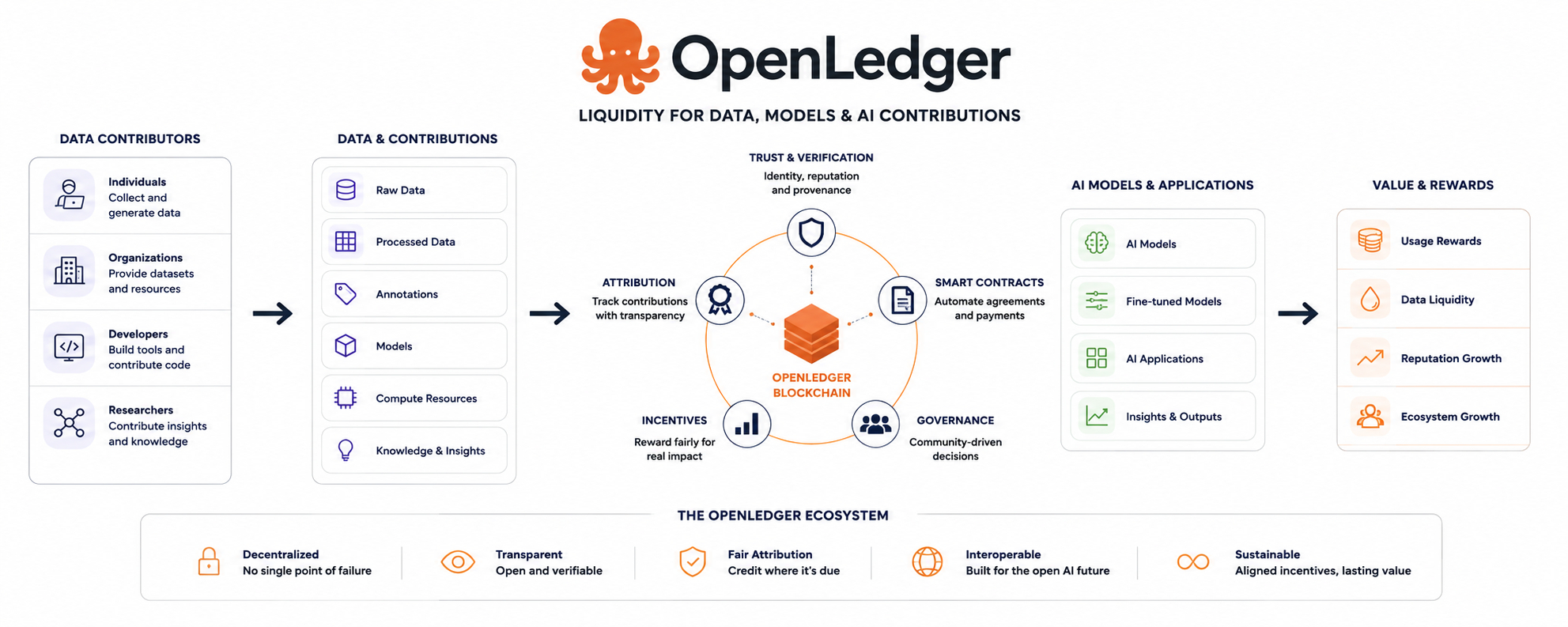
On the surface, it sounds reasonable. AI is becoming a larger part of the technology landscape, data is becoming more valuable, and projects like OpenLedger are exploring ways to make data, models, and AI contributions part of an open economic system.
None of that sounds crazy to me.
What gives me pause is how simple people make it sound.
The older I've gotten in this market, the more I've learned that the hardest part of any system is usually the part nobody wants to talk about.
Data is a perfect example.
People talk about it as if it's a clean asset waiting to be traded. But when I look at how data actually exists in the real world, it feels much messier than that.
Some data is valuable because it's rare.
Some is valuable because it's current.
Some becomes useful only when combined with thousands of other pieces of information.
And a lot of data that looks valuable today becomes almost worthless tomorrow.
That's not how most people imagine liquidity.
When traders hear the word liquidity, they think about assets changing hands efficiently. They think about markets. Buyers. Sellers. Price discovery.
Data doesn't behave that way.
I've always felt that data is closer to labor than people realize.
Behind every useful dataset, there's usually someone who collected it, organized it, cleaned it, verified it, or maintained it.
Most of that work is invisible.
The internet became very good at extracting value from information while making the people behind that information almost disappear.
Now AI has pushed that issue into the spotlight.
Suddenly everyone is asking questions that probably should have been asked years ago.
Who created the data?
Who contributed to the model?
Who deserves compensation when value is generated?
Those questions sound simple until you try to answer them.
That's where my skepticism usually begins.
Not because I think the idea is bad.
Because I've seen how difficult attribution becomes once money enters the conversation.
Everybody agrees contributors should be rewarded.
The disagreement starts when you ask how much.
I've seen projects spend years building systems designed to create fair incentives, only to discover that fairness is one of the hardest things to measure.
What happens when thousands of people contribute small pieces to a system?
What happens when one person's data matters more than another's?
What happens when nobody can agree on how influence should be calculated?
These aren't technical problems alone.
They're human problems.
And human problems tend to be the ones that survive every market cycle.
That's one reason OpenLedger caught my attention.
Not because I think it has all the answers.
Honestly, I don't think anybody does.
But at least it's focused on a question that feels real.
For years, crypto has been exceptionally good at creating financial systems around digital assets.
The challenge now is figuring out whether similar systems can exist around knowledge, information, and AI contributions.
That sounds straightforward until you sit with it for a while.
The more I think about it, the stranger it becomes.
Information isn't like a token.
Two identical tokens are interchangeable.
Two datasets rarely are.
One tiny collection of data can completely change a model's performance while a massive dataset might add almost nothing.
How do you price that?
How do you track it?
How do you reward it fairly?
I don't know.
And honestly, I'm suspicious of anyone who claims they do.
One thing I've learned from watching crypto over the years is that reality usually arrives much later than the narrative.
At first, everything sounds smooth.
Then users show up.
Then incentives start interacting with human behavior.
Then all the edge cases appear.
That's when the real work begins.
People often think innovation is about building something new.
Sometimes it's about dealing with all the problems that appear after you've built it.
That's why I find myself paying attention to ideas like this without getting overly excited.
Something about it feels important.
Not because it's guaranteed to succeed.
Because it touches a problem that isn't going away.
AI keeps growing.
Data keeps becoming more valuable.
The questions around ownership, contribution, and attribution aren't disappearing anytime soon.
Whether OpenLedger becomes part of that solution remains to be seen.
I'm not ready to make that call.
I've watched too many confident predictions age badly.
What I do know is that "liquidity for data" sounds much easier than the reality behind it.
The phrase fits neatly into a headline.
The actual challenge feels far less neat.
It's a mix of incentives, trust, ownership, contribution, and human behavior.
And in my experience, those are exactly the kinds of problems that take much longer to solve than anyone expects.
Maybe that's why I keep thinking about it.
Not because I see certainty.
But because after all these years in crypto, I've learned that the most interesting ideas are usually the ones that leave me with more questions than answers.
