
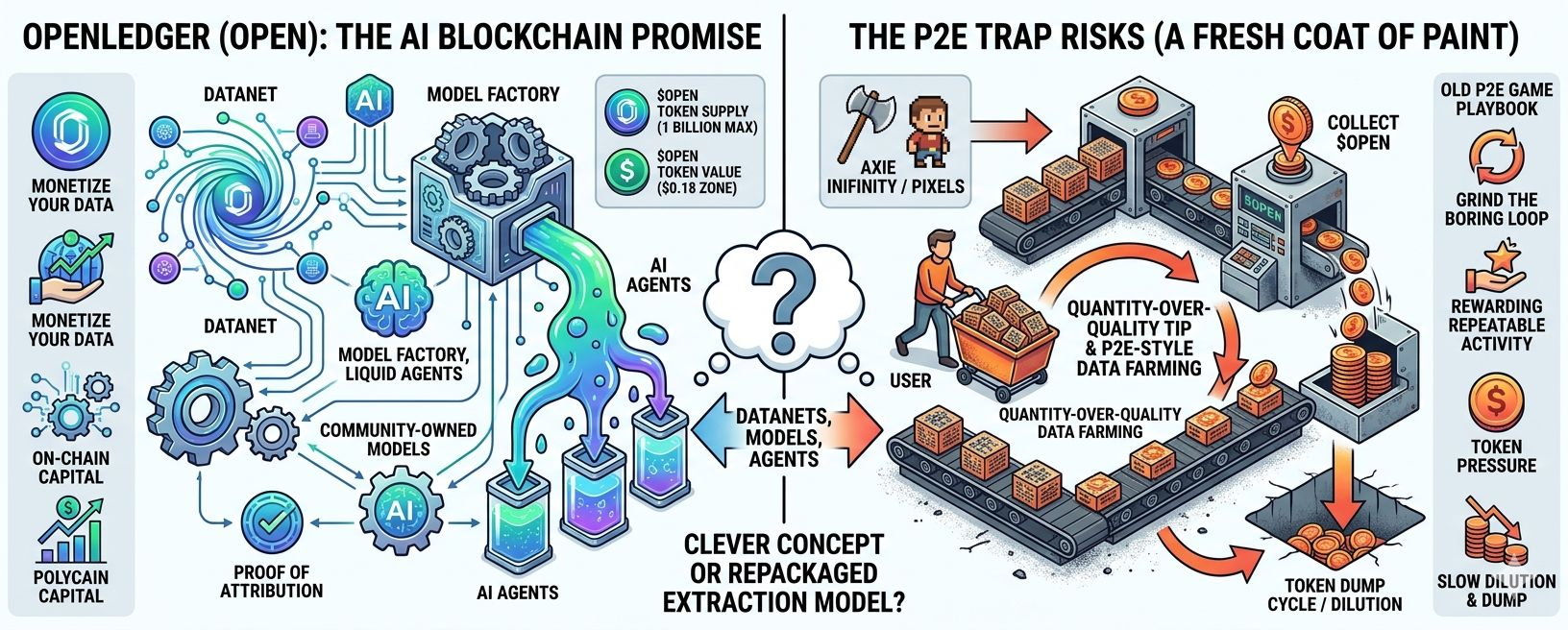

I was lying in bed the other night scrolling through crypto Twitter, and this one popped up again. OpenLedger (OPEN), the “AI Blockchain” that finally makes data, models, and agents liquid on-chain. Datanets, Proof of Attribution, Model Factory, all that stuff. It’s got Polychain money and some EVM rails. On paper it feels like the logical next step after everything else in the AI space.
But the more I kept turning it over in my head, the more I kept hearing the same old song underneath the new labels.
Let me just say it straight: I’m not a hater. I get why people are excited. The problem of siloed data is real. Models are hoarded. Agents need somewhere to actually live. So monetizing all of that on-chain feels… necessary. But when I zoom out, it starts to look a lot like the old crypto gaming playbook, just with a fresh coat of paint.
The real issue, in my opinion, is incentive design. Every play-to-earn game tried the same thing: make the activity that’s easiest and most repeatable the way that actually pays. Grind the same boring loop, collect tokens, sell. OpenLedger is doing the exact same thing in data form. “Contribute a dataset, get verified, farm $OPEN.” It sounds helpful. It’s not. It’s still rewarding the quantity-over-quality behavior that broke most games. People will farm datasets the same way they farmed resources in Pixels or Axie—until the novelty dies and the token pressure hits.
And that token pressure is the part that keeps me up at night. $OPEN has a 1 billion max supply, trading right around the low $0.18 zone right now. The whole model is built on “Payable AI”—every time your data or model gets used, you get paid. That sounds fair. But fair in crypto almost always means slow, or it means the token has to print more to keep up. If the AI economy doesn’t grow fast enough to actually absorb all that reward flow, we’re looking at the same slow dilution and dump cycle we’ve seen in half the chain games before. No brutal vesting, no real burns, just ongoing emissions for participation. I’m not saying it’s impossible, but I’m also not betting on it staying sustainable yet.
What Pixels got right (and OpenLedger seems to be copying) was flipping the script: game first, economy later. Data-driven rewards instead of generic farming. That publishing flywheel where actually playing built something real. OpenLedger wants to be the network underneath it all—community-owned models, on-chain agents, true liquidity for AI. That’s the part that excites me. It’s trying to become infrastructure, not just another game.
But infrastructure without usage is just expensive whitepaper. Right now this thing is still early—testnets, leaderboards, demos. AI adoption is patchy. High-quality data doesn’t flow in automatically. Models don’t get used just because someone posted a dashboard. Agents need real demand, not just hype. And the biggest risk of all: will regular people actually keep contributing once the first reward wave passes? Or will it become another project that rode the AI narrative, extracted its token, and quietly faded?
It sounds good on paper. Turns data and models into tradable, on-chain assets and finally gives contributors real skin in the game. But I keep feeling the same tension I felt with every P2E project before it: the incentives might work for the launch, but they rarely survive the first quiet period.
So yeah… I like the direction. I really do. It’s clever, it’s ambitious, it’s trying to solve something that actually needs solving. But the history of this space is littered with projects that looked revolutionary until the token started bleeding. OpenLedger has the concepts to be different. It just hasn’t shown me the version that feels alive yet.
Interesting. Time will tell. What do you think—building the real thing or just repackaging the same old extraction model in smarter wrapping?
