

Most blockchains are very good at one thing: keeping financial memory. They remember who sent money, who received it, which wallet owns what, and how value moved across a network. That system changed crypto because it removed the need to trust a central bookkeeper.
But AI creates a different kind of problem.
When you use an AI model, the final answer looks simple. You type a prompt, get a response, and move on. What you do not see is the invisible chain behind that output. Somewhere in the background, a niche dataset may have improved accuracy. A fine-tuned model may have made the answer more specialized. A lightweight adapter may have lowered inference costs. An agent may have connected the result to a real action. The output feels instant, but the value behind it came from many layers of unseen contribution.
That is the first time I started understanding what projects like OpenLedger are actually trying to solve.
I do not think the important part is “AI on blockchain.” That phrase has already been repeated too many times in crypto. The more interesting idea is that OpenLedger is trying to build economic visibility for AI itself. Not just ownership, but contribution.
A normal blockchain can show that someone paid for inference. It can show that a model was bought or deployed. But it usually cannot explain why the output was useful or who quietly helped make it better. In most AI systems today, the interface gets all the attention while the deeper contributors disappear into the background.
That feels increasingly unsustainable.
The current AI economy reminds me of early social media platforms. A few visible layers captured most of the value while the people producing the underlying substance struggled to monetize their contribution directly. AI is starting to drift toward the same imbalance. Everyone talks about the chatbot, the assistant, or the application. Very few people talk about the domain-specific data, the tuning layers, or the infrastructure that actually improved performance.
OpenLedger seems to understand that hidden gap.
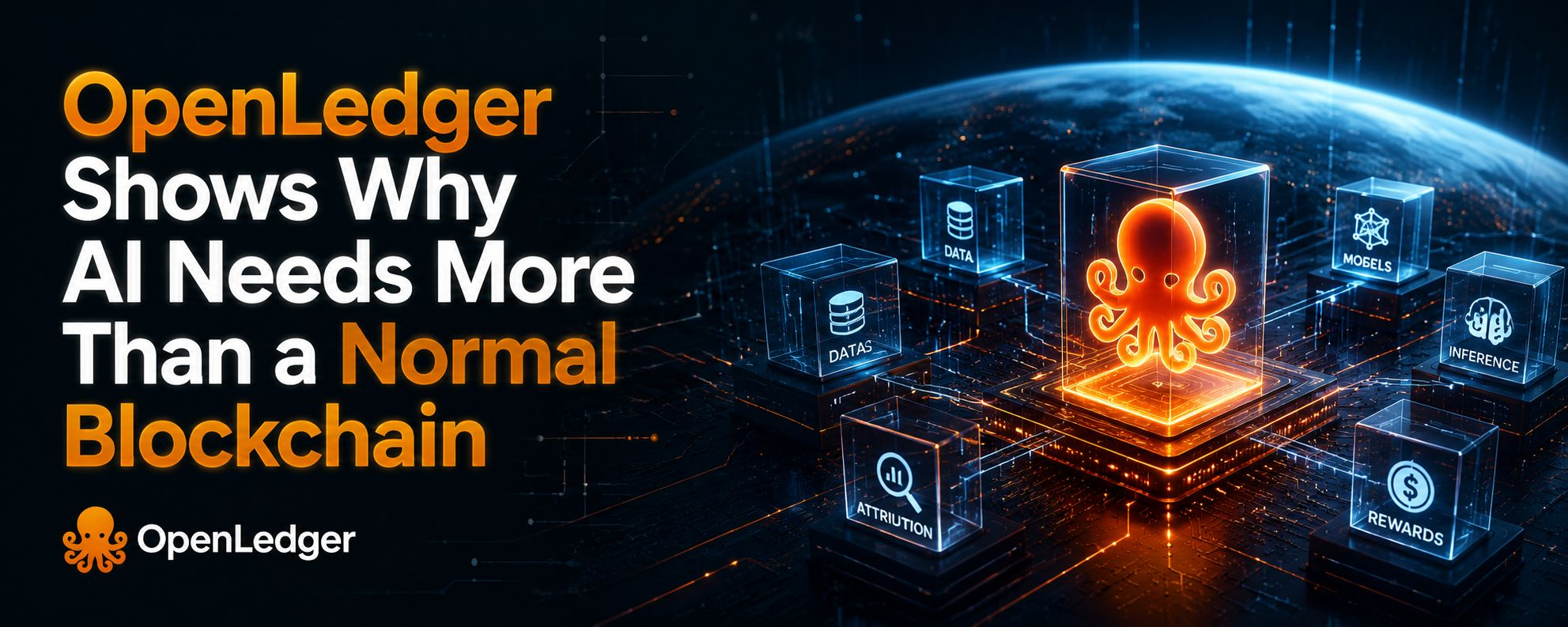
When you look at things like Datanets, ModelFactory, OpenLoRA, AI Studio, and the growing focus on agents, the bigger picture becomes clearer. These are not random ecosystem products stitched together for marketing. They are attempts to create an economy where intelligence can be tracked across its full lifecycle. Data gets structured. Models get specialized. Inference becomes cheaper. Agents become executable. Contributors become measurable.
The important word there is measurable.
Crypto solved ownership before it solved usefulness. AI blockchains may need to solve usefulness before ownership matters. A dataset is worthless if nobody uses the model it trained. A model has no economic gravity if inference is too expensive. An agent means nothing if it never performs real tasks. OpenLedger only works if it can connect usage back to contribution in a way that feels fair enough for people to participate.
That is what normal blockchains were never designed to handle.
Traditional chains were built around transactions and balances. AI systems are built around probabilistic outputs and layered influence. The value is harder to isolate because intelligence is compositional. One useful answer may come from ten invisible contributors working across different parts of the stack. Without attribution, the market naturally rewards whoever owns the final interface.
That is why I think OpenLedger’s direction matters more than people realize.
The recent push toward mainnet activity, staking, AI Studio, and agent infrastructure is not interesting because it creates more announcements. It is interesting because AI contribution cannot be measured in theory forever. Eventually the system needs real usage, real inference demand, and real economic feedback. Otherwise attribution becomes decoration instead of infrastructure.
And honestly, this is where the real challenge begins.
Reward systems sound good on paper, but rewards alone do not create quality. We already learned that lesson in earlier crypto cycles. Paying for activity does not automatically create meaningful output. OpenLedger still has to prove that specialized AI contributors can earn because their work genuinely improves intelligence, not because the network is temporarily subsidizing participation.
But the core idea still feels important to me because it changes the way blockchain interacts with AI.
Most people think blockchains are about storing value. AI blockchains may end up being more about tracing value creation itself.
That difference sounds subtle, but it changes everything. A normal blockchain tells you where money moved. An AI blockchain tries to tell you why intelligence became valuable in the first place.
And if AI becomes one of the defining economic layers of the internet, that missing layer of accountability may end up mattering far more than people expect today.