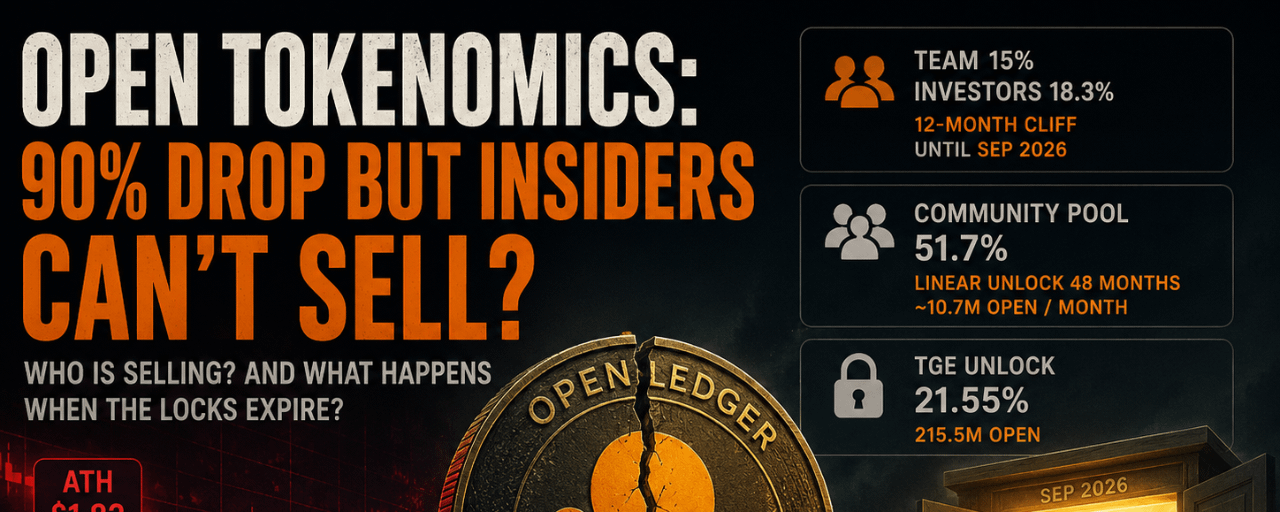
There’s one small detail in OPEN’s tokenomics that I keep coming back to: the token has dropped more than 90% from its ATH, yet none of the team or investors has been able to sell a single token. So where is the sell pressure coming from?
OpenLedger built an L2 on OP Stack, using EigenDA as its data availability layer, positioning itself in the AI blockchain direction. It raised $8M from Polychain and Borderless Capital, not small names in the industry. The TGE happened in September 2025, with 21.55% unlocked immediately, or 215.5 million OPEN. Since then, the vesting structure has kept most of the supply behind lockup conditions. Sounds familiar.
The design looks reasonable at first glance: the 15% team allocation and 18.3% investor allocation are both under a 12-month cliff, meaning none of them can touch their tokens until September 2026. Most people read that and nod, long cliff, committed. But if it is not the team selling, then who sold the token from $1.82 down to $0.178?
The answer lies in the least noticed line: the community pool makes up 51.7% of total supply, unlocking linearly over 48 months starting from the month after TGE. That works out to about 10.7 million OPEN entering the market each month, steady, quiet, with no headline. Add to that the 215.5 million unlocked at TGE, handed to the earliest entrants at the lowest cost basis. The entire path from $1.82 to $0.178, more than $450 million in market cap evaporated, was absorbed by retail during a period when not a single insider token was allowed to leave a wallet. It is ironic in a very structural way: the vesting lock protected insiders from selling into the collapse, but it did nothing to protect the people who bought after TGE.
The asymmetry goes deeper than what the surface suggests. Team and investors entered the project at prices far below $0.178, for many of them, even the current price is still profitable. When the cliff ends in September 2026, the 333 million OPEN held by this group begins unlocking linearly over 36 months, or about 9.25 million more tokens each month, layered on top of the ongoing flow from the community pool. The market is currently pricing the FDV at $175M, with a market cap of $51.7M and 290M tokens circulating. Maybe the market has already seen that risk, or maybe it has not really calculated what September means for the supply structure.
What matters is not “whether the team will sell” because mechanically, they do not even have that option right now. What matters is the incentive structure that forms after the cliff. In game theory, when multiple parties each hold a large amount of an asset and all know the gate will open at the same time, the individually optimal behavior, getting out before everyone else, is also the behavior that destroys collective value. Nobody expects Polychain or Borderless to crash their own price on purpose, but in a structure where everyone’s lockup opens in the same wave, the pressure does not come from greed but from uncertainty about each other’s intentions. Each side knows that the 36-month vesting after the cliff is long enough to sell gradually without shocking the market, but no one knows whether the others will actually be that patient.
I think there is a real strength in this design that deserves credit. A 51.7% community pool vesting over 48 months is a relatively controlled way to distribute supply. Not many projects are willing to leave such a large share for the long term instead of front-loading unlocks. If their AI blockchain ecosystem gains real traction and the broader market revalues the AI L2 narrative, then this supply structure is not something it cannot overcome. Polychain and Borderless are not the kind of funds that enter a project because of a pretty slide deck.
To be honest, none of that answers the core question: in September 2026, when the gate opens for 333 million tokens, will the market have enough liquidity and demand to absorb them, or is this design that looks like a long-term commitment really just delaying a decision that everyone involved already knows they will have to make, only not yet.
@OpenLedger $OPEN #OpenLedger