
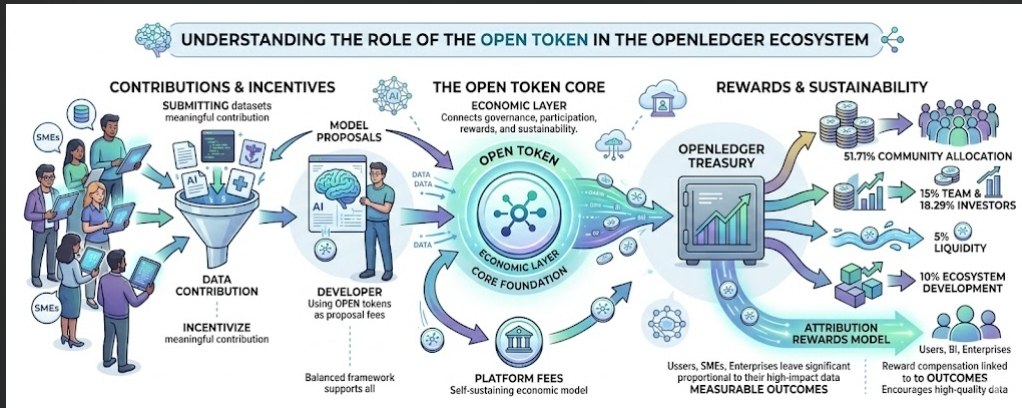
The success of any decentralized ecosystem depends on how effectively it aligns incentives among its participants. Whether contributors provide valuable data, developers create innovative applications, or model builders develop advanced AI solutions, there must be a mechanism that rewards participation while supporting long-term growth. Within the OpenLedger ecosystem, this role is fulfilled by the OPEN Token.
The OPEN Token serves as the core economic layer of the network. It is more than just a digital asset used for transactions; it acts as the foundation for governance, participation, rewards, and ecosystem sustainability. By connecting incentives to meaningful contributions, the token helps create an environment where users are encouraged to add value while being compensated fairly for their efforts.
The Purpose of the OPEN Token
OpenLedger is designed around the idea that contributors should be rewarded according to the value they bring to the ecosystem. Traditional AI development often relies on centralized organizations that collect data, build models, and capture most of the resulting value. OpenLedger introduces a different approach by enabling a broader range of participants to contribute and benefit.
The OPEN Token is the mechanism that makes this possible. It allows the platform to distribute rewards, collect fees, support governance processes, and maintain economic balance across the network. Every major activity within the ecosystem is connected to the token in some way, making it a crucial component of OpenLedger’s infrastructure.
By establishing a common unit of value, OpenLedger creates a system where incentives are transparent and participants can clearly understand how their contributions are recognized and rewarded.
Token Distribution Structure
A well-designed token allocation model plays a significant role in determining the long-term health of a blockchain ecosystem. The OPEN Token follows a distribution framework that aims to support community participation while providing resources for development and growth.
The largest allocation is reserved for the community, which receives 51.71% of the total token supply. This reflects the project's focus on rewarding contributors and encouraging active participation. By dedicating more than half of the supply to community-related activities, OpenLedger emphasizes the importance of user involvement in building and expanding the ecosystem.
Investors receive 18.29% of the total allocation. This portion supports those who provide financial backing and resources that help accelerate the project's development and adoption. Investor participation can contribute to ecosystem growth by supplying capital and supporting strategic initiatives.
The team behind OpenLedger is allocated 15% of the token supply. This allocation helps ensure that the individuals responsible for developing, maintaining, and improving the platform remain aligned with its long-term success. A dedicated team allocation also provides incentives for continuous innovation and platform advancement.
Liquidity receives 5% of the total supply. Maintaining liquidity is essential for healthy market activity, as it allows users to buy, sell, and interact with the token efficiently. Adequate liquidity supports smoother transactions and helps create a more accessible ecosystem.
The remaining 10% is allocated to ecosystem development. These tokens can be used to support partnerships, growth initiatives, research efforts, and other activities that strengthen the network over time.
Together, these allocations create a balanced framework that supports contributors, investors, developers, and ecosystem expansion while maintaining a strong focus on community participation.
Proposal and Platform Fees
One of the key functions of the OPEN Token is its role in proposal submissions and platform fees.
Within OpenLedger, model creators can propose new AI models for development and deployment. Rather than allowing unlimited proposals without accountability, the ecosystem requires the use of tokens as part of the proposal process. This creates a structured environment where participants are encouraged to submit meaningful and well-prepared ideas.
The proposal mechanism serves multiple purposes. First, it helps maintain quality by ensuring that model creators have a stake in the process. Second, it reduces spam and discourages low-value submissions. Third, it establishes a direct connection between ecosystem participation and token utility.
In addition to proposal-related usage, platform fees are collected and directed to the OpenLedger Treasury. The Treasury plays an important role in supporting the long-term sustainability of the network. As the ecosystem grows, operational requirements, reward distribution systems, and development initiatives require ongoing resources.
By collecting platform fees through the OPEN Token, OpenLedger creates a self-sustaining economic model. Rather than relying entirely on external funding sources, the ecosystem can generate internal support mechanisms that contribute to its continued development.
The Role of the OpenLedger Treasury
The Treasury functions as a central economic component within the ecosystem. Funds collected through platform activities are managed and allocated to support network operations and contributor incentives.
A significant responsibility of the Treasury is the distribution of attribution rewards. These rewards ensure that individuals and organizations who contribute valuable resources receive compensation based on their impact.
The Treasury helps create a transparent relationship between value creation and reward distribution. As more participants contribute useful data and support model development, the Treasury can allocate rewards in a way that reflects the significance of those contributions.
This structure encourages long-term engagement because contributors can see a direct connection between their efforts and the benefits they receive.
Data Contribution and Attribution Rewards
Data is one of the most important resources in modern AI development. High-quality datasets improve model performance, increase reliability, and enable specialized applications across different industries. OpenLedger recognizes this importance by creating an incentive system centered around data contributions.
Users, Subject Matter Experts (SMEs), and enterprises can all participate by providing data that supports AI model training and improvement. Rather than treating all contributions equally, OpenLedger focuses on attribution-based rewards.
Attribution rewards are designed to measure the impact of contributed data. If a dataset significantly improves model quality or contributes meaningful value to a project, the contributor can receive rewards that reflect that impact.
This approach differs from traditional systems where contributors may receive fixed compensation regardless of the usefulness of their data. Instead, OpenLedger seeks to establish a merit-based reward structure where compensation is linked to measurable outcomes.
For individual users, this creates opportunities to participate directly in the AI economy. For Subject Matter Experts, it provides a way to monetize specialized knowledge and expertise. For enterprises, it offers incentives to contribute valuable datasets that can support the development of advanced AI solutions.
By rewarding contributors according to the effectiveness of their data, OpenLedger encourages higher-quality participation and helps improve the overall quality of AI models built within the ecosystem.
Creating a Sustainable Incentive Model
The strength of the OPEN Token lies in its ability to connect different parts of the ecosystem through a unified incentive framework. Model creators use tokens to introduce new ideas, contributors earn tokens through valuable participation, and platform activities generate resources that support ongoing development.
This creates a circular economic system where value flows between participants rather than remaining concentrated within a single group. Contributors are rewarded for their efforts, developers gain access to resources for innovation, and the ecosystem benefits from continuous growth and improvement.
A sustainable incentive model is particularly important in decentralized environments because participation is voluntary. By ensuring that contributors receive fair compensation, OpenLedger encourages long-term engagement and supports the creation of a vibrant community.
Conclusion
The OPEN Token serves as the economic foundation of the OpenLedger ecosystem, connecting governance, participation, rewards, and sustainability into a single framework. Through its carefully structured token allocation, proposal system, Treasury operations, and attribution-based reward mechanisms, the token plays a central role in supporting ecosystem growth.
By rewarding users, experts, enterprises, and model creators according to the value they provide, OpenLedger promotes a more balanced and transparent approach to AI development. The result is an ecosystem where incentives are aligned with contribution, encouraging participants to help build stronger models, better datasets, and a more sustainable future for decentralized artificial intelligence.
