

When I started exploring OpenLedger more seriously, one thing became very clear to me: this is not just another AI crypto project trying to catch the latest narrative. The deeper I looked, the more I felt that OpenLedger is sitting close to one of the biggest questions of the next tech cycle: who will actually own the value created by AI?
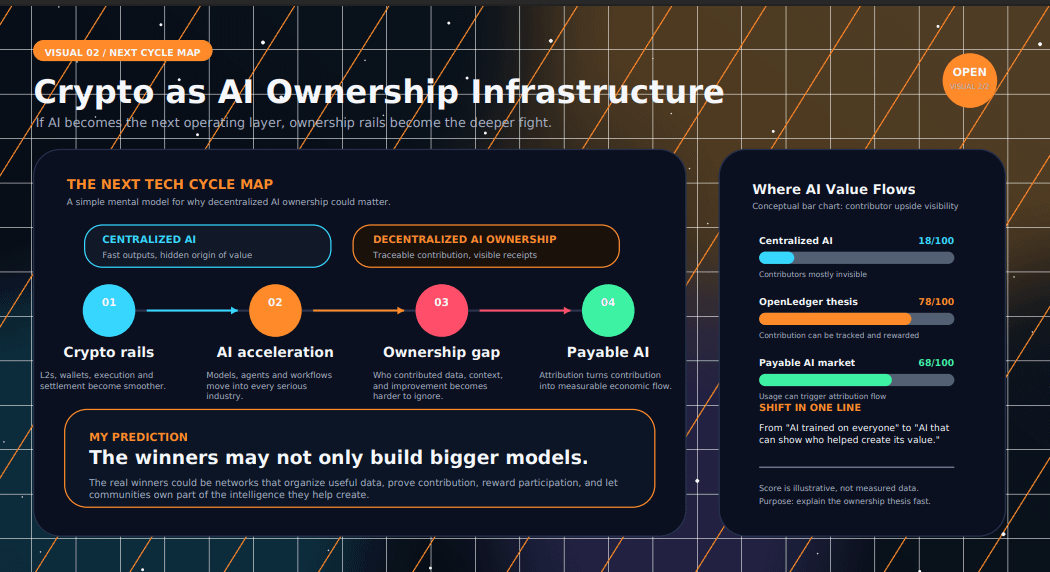
Right now, crypto feels like it is still in an infrastructure-building phase. The rails are being built. Liquidity systems are improving. L2s are scaling. Wallets, bridges, execution layers, and settlement systems are slowly becoming smoother. But at the same time, the world is clearly moving toward AI faster than almost anyone expected. AI is no longer just a product category. It is becoming the next operating layer of the internet, business, work, creativity, research, and automation.
And that is where OpenLedger started to make sense to me.
Because the next tech cycle will not only be about smarter AI models. In my opinion, the real fight will be around ownership, attribution, and value flow. Who contributed the data? Who trained the model? Who improved the output? Who deserves to get paid when that intelligence creates value? These questions are still mostly ignored today, but they will become impossible to ignore as AI gets bigger.
The whole crypto market was built around one powerful word: decentralization. Bitcoin became valuable not only because it was digital money, but because it proved that ownership and settlement could exist without a central authority controlling everything. That one idea changed finance forever. So when we now look at AI, I think the same question appears again. If AI becomes the biggest wealth creating technology of the next five years, then should all of that value stay trapped inside a few centralized companies?
That is the main understanding for me.
Decentralized AI ownership could become one of the biggest shifts in the next tech cycle because AI is moving too fast to remain a closed black box forever. Today, most AI systems are trained on massive amounts of human knowledge, public content, private datasets, user interactions, prompts, feedback, and community intelligence. But the people who create that value usually get nothing back. They feed the system, the model improves, the company captures the upside, and everyone else just watches.
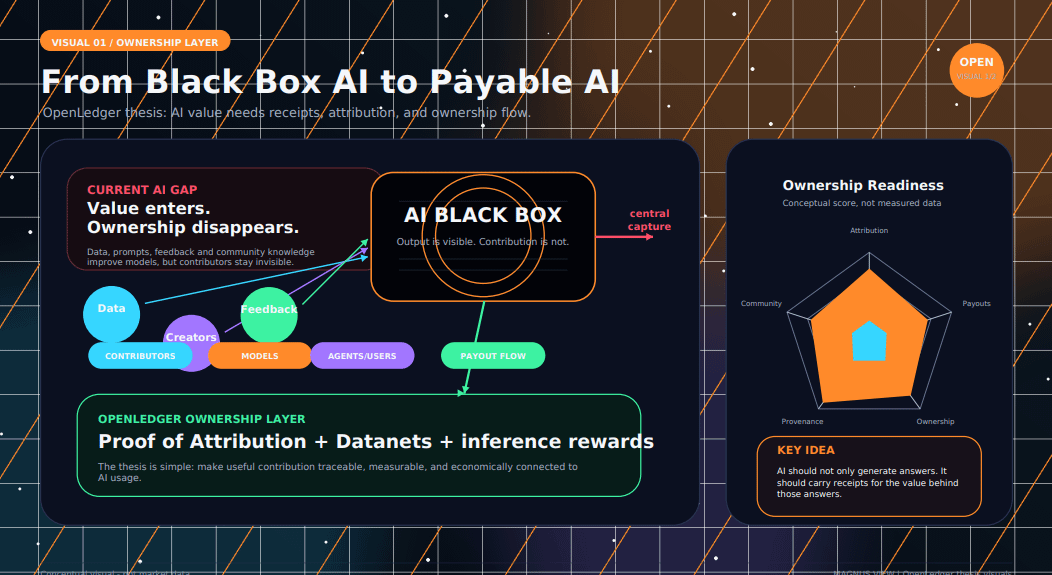
OpenLedger is trying to challenge that structure.
The way I understand OpenLedger, it is not only trying to build AI tools. It is trying to build an ownership and attribution layer around AI. That is a very different angle. Proof of Attribution, Datanets, model contribution, inference rewards, and payable AI all point toward one core idea: intelligence should have receipts. If a dataset improves a model, that contribution should be traceable. If a creator, developer, or community helps build useful AI, they should not disappear from the value chain.
This is why I think OpenLedger’s model feels important for the next phase. In the current AI world, data is treated like fuel, but contributors are treated like background noise. OpenLedger flips that thinking. It says data is not just raw material. It can be owned, measured, used, rewarded, and turned into an economic asset. That sounds simple, but if it works at scale, it could completely change how AI networks are built.
The comparison is very clear to me.
Centralized AI is fast, powerful, and polished, but it often hides the origin of value. You see the output, but you do not see the contributors behind it. You do not know which data shaped the model, who helped improve it, or who deserves the economic upside. Decentralized AI ownership is different. It tries to make the invisible layer visible. It brings ownership, attribution, and fair value distribution into the system instead of leaving everything controlled by one platform.
And honestly, this is where crypto can play a real role in AI.
A lot of people still think crypto and AI are only connected because both are trending narratives. I disagree. I think blockchain matters for AI because AI needs verification, ownership, payments, provenance, and coordination. These are exactly the things crypto infrastructure was built to handle. If AI becomes the engine of the next digital economy, then crypto could become the settlement and ownership layer underneath it.
That is why OpenLedger’s timing feels interesting. We are still early in the AI era. What we are seeing now is only the tip of the iceberg. Chatbots, agents, automated workflows, AI content, AI research tools, and model marketplaces are just the opening phase. Over the next five years, AI could move into every serious industry: finance, healthcare, education, gaming, marketing, logistics, law, research, and on-chain execution. When that happens, ownership will matter much more than it does today.
My prediction is simple: the next big AI winners will not only be the companies with the biggest models. The real winners may be the networks that can organize useful data, prove contribution, reward participation, and let communities own part of the intelligence they help create. That is why I think OpenLedger has a strong concept. It is not just talking about AI hype. It is trying to build around the economic layer behind AI.
Of course, this is still early. OpenLedger still has to prove adoption, real usage, contributor retention, and whether the attribution system can work beyond theory. But the direction makes sense to me. The market may still be looking at OPEN like just another token, but I think the bigger story is about infrastructure. Ownership infrastructure. Attribution infrastructure. AI value infrastructure.
Five years from now, AI will probably be far bigger than what most people can imagine today. And if that happens, the biggest question will not only be who built the smartest model. The bigger question will be who owns the intelligence behind it.
That is exactly why OpenLedger matters to me.
Because decentralized AI ownership is not a small feature.
It could become one of the defining shifts of the next tech cycle...