
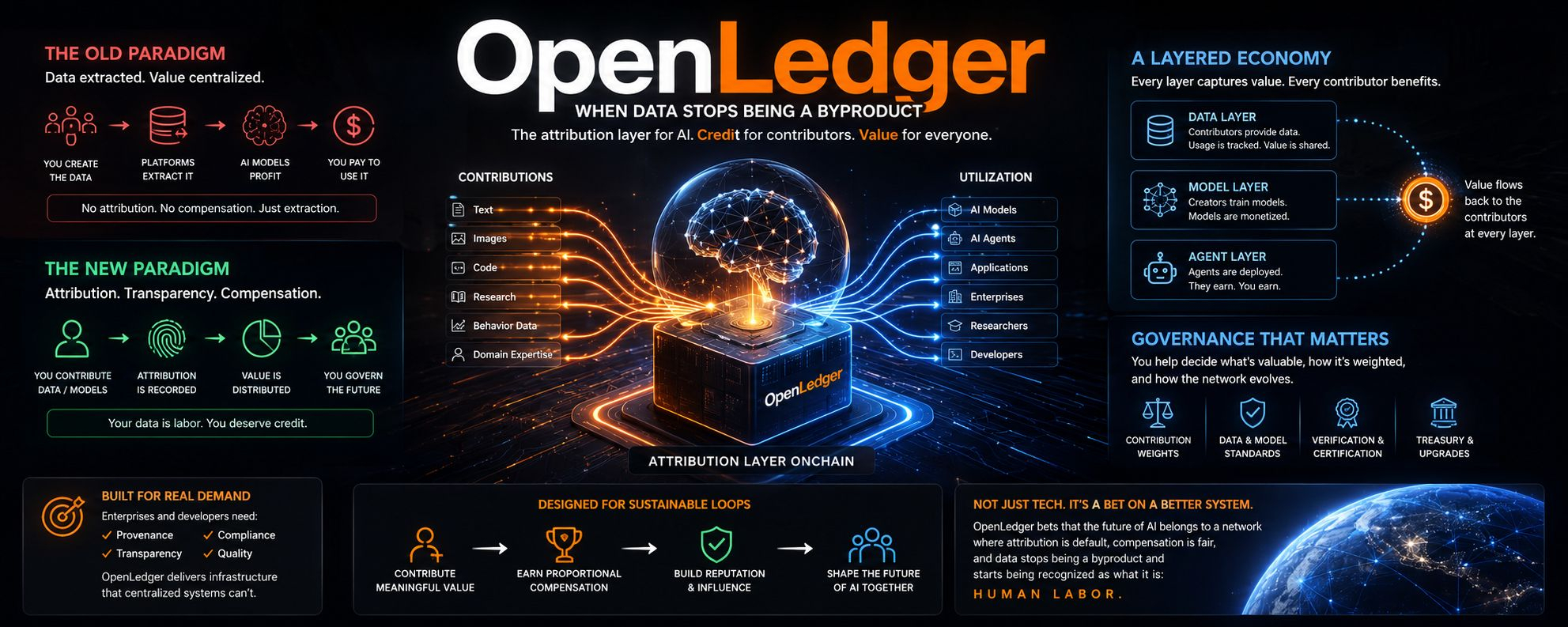
@OpenLedger Most people look at OpenLedger and see a blockchain project trying to tokenize AI. That framing is technically accurate and almost entirely misleading. What's actually being attempted here is something stranger and more interesting a system trying to reverse the fundamental power relationship between the people who generate data and the institutions that profit from it. Whether it succeeds at that or quietly becomes another infrastructure layer nobody talks about is the more honest question to sit with.
The problem OpenLedger is working inside is old, even if the language around it is new. Every major AI model in existence was trained on data that wasn't compensated. Not in any meaningful sense. The people who wrote the posts, created the images, had their browsing patterns scraped they didn't receive equity in the models that learned from them. They received a product they now pay a subscription for. That arrangement has been so normalized that most people don't even register it as an arrangement. It's just how the internet works.
Web3 has tried to fix this before, in different forms. Usually the fix involves a token that goes up during the pitch and sideways afterward. The extraction doesn't stop it just gets rebranded as participation. What's worth watching with OpenLedger is whether it's actually redesigning the plumbing or just painting the pipes a different color.
Underneath the surface, what OpenLedger is actually doing is building an attribution layer. The core behavior it's trying to normalize is traceability the idea that when your data contributes to a model's capability, that contribution is recorded, weighted, and compensated. It's making legible something that has always been invisible. That's not a feature. That's a philosophical stance about what data is. Data isn't exhaust. It's labor.
The system also extends this to AI models and agents themselves. Models trained on the network can be monetized by their creators. Agents can be deployed and earn. This creates a layered economy where the inputs, the trained outputs, and the operational agents all participate in value capture. On paper, that's elegant. In practice, the elegance depends entirely on whether the attribution is honest whether the weights assigned to contributions actually reflect something real, or whether they become a mechanism that concentrates rewards toward whoever controls the weighting logic.
That question deserves more attention than it usually gets.
The behavioral loops inside this system are designed around contribution rather than speculation, which is the right instinct coming out of the play-to-earn collapse. When the dominant loop is "do a thing, earn a token, sell the token," the system cannibalizes itself. OpenLedger is trying to build something closer to a professional incentive — contribute data or models that are actually useful, receive compensation proportional to usage, participate in governance over time.
The habit formation this encourages is slower. It doesn't produce the dopamine spikes of a floor price going up or a daily quest completing. What it might produce, if the flywheel actually turns, is something more like the satisfaction of being a recognized contributor to something larger. That's a harder psychological hook to engineer, but it's also more durable if it works. The risk is that "slower and more durable" can just mean "nobody shows up."
Friction is a real design challenge here. The people most likely to have valuable data researchers, developers, domain experts are also the people with the highest opportunity cost for their time. The onboarding and contribution experience has to be smooth enough that participation feels worth it without compensation, because in the early stages, the compensation will be uncertain. That's a delicate balance that most Web3 projects have historically gotten wrong by either making the process too complex or the rewards too speculative.
On the economic layer, the honest pressure point is demand-side sustainability. Token value in a data marketplace is ultimately a function of how much enterprises and developers are willing to pay to access the data and models on the network. That demand doesn't follow narrative cycles the way speculative assets do. It follows utility. Either the data is better, cheaper, or more accessible than alternatives, or it isn't.
This is actually a more stable foundation than most crypto projects build on but it's also a higher bar to clear. When hype fades and the market stops rewarding attention, what remains has to be genuinely competitive with centralized alternatives. OpenLedger would be competing against organizations with enormous compute, proprietary datasets, and years of model development. The decentralized version of this market has to offer something the centralized version structurally cannot: provenance, contributor compensation, censorship resistance, or composability at a level that closed systems can't match.
The sell pressure risk is real but secondary to this. If real demand exists, token economics can be managed. If demand is primarily internal contributors earning tokens and selling them to other contributors the system is just redistributing attention, not creating value.
What OpenLedger understands that many projects miss is that the AI infrastructure race isn't just about compute. Data quality, data provenance, and model transparency are becoming competitive differentiators as regulatory pressure increases and enterprise buyers get more sophisticated about what they're purchasing. A blockchain layer that credibly solves attribution and licensing for AI training data is actually useful to companies that need to demonstrate compliance. That's a real market, not a speculative one.
The subtle edge, if it exists, is in being boring in the right way. Not a consumer app chasing engagement metrics, but infrastructure that quietly becomes load-bearing for other systems.
Where it could break is also where it's most interesting. The governance of contribution weights, the decisions about what data is valuable and to whom, the process by which models get verified and agents get certified these are all social and political processes dressed in technical language. Decentralization doesn't dissolve those politics; it relocates them. Early contributors will have disproportionate influence over norms that get baked in. That's not a criticism unique to OpenLedger, but it's a pattern worth watching specifically here because the stakes of those decisions are unusually high. Who decides what data is worth is not a neutral technical question.
There's something fitting about this project existing right now, in the specific moment after large language models became household names and before the legal and economic frameworks around AI training data have been settled. OpenLedger is essentially a bet that the settlement, when it comes, will favor attribution and compensation that the current arrangement is unstable and something will replace it. That bet might be right. The window for building the replacement infrastructure while the question is still open is real.
What needs to be proven isn't whether the technology works. It's whether the humans inside the system contributors, buyers, governance participants behave in ways that make the attribution layer meaningful rather than nominal. Systems designed around fairness don't automatically produce fair outcomes. They produce the outcomes that the incentives actually reward.
That part is still being written.
