

I keep noticing how many internet businesses are starting to depend on AI, even when they don't openly describe themselves that way.
Search is changing because of AI. Content production is changing because of AI.
Customer support, research, education, software development and even decision making workflows are increasingly moving through AI systems.
The shift feels gradual on the surface.
But underneath more of the internet economy seems to be collapsing into AI as the primary interface between people and information. That made me think about OpenLedger.
Not because it is another AI project trying to ride the trend, but because its entire structure seems built around a world where AI participation becomes an economic activity of its own.
The more internet activity passes through AI systems, the more valuable the underlying intelligence infrastructure potentially becomes. And OpenLedger appears positioned around that assumption.
Most people still think about AI in terms of applications. Chatbots. Assistants. Content generators. Productivity tools.
Those products attract attention because they sit closest to users. But @OpenLedger is operating further down the stack.
The network focuses on how intelligence is created, owned, attributed, deployed and monetized. Data contributors participate in building models. Models generate inference. Agents interact with those models. Economic value flows between participants through the network itself.
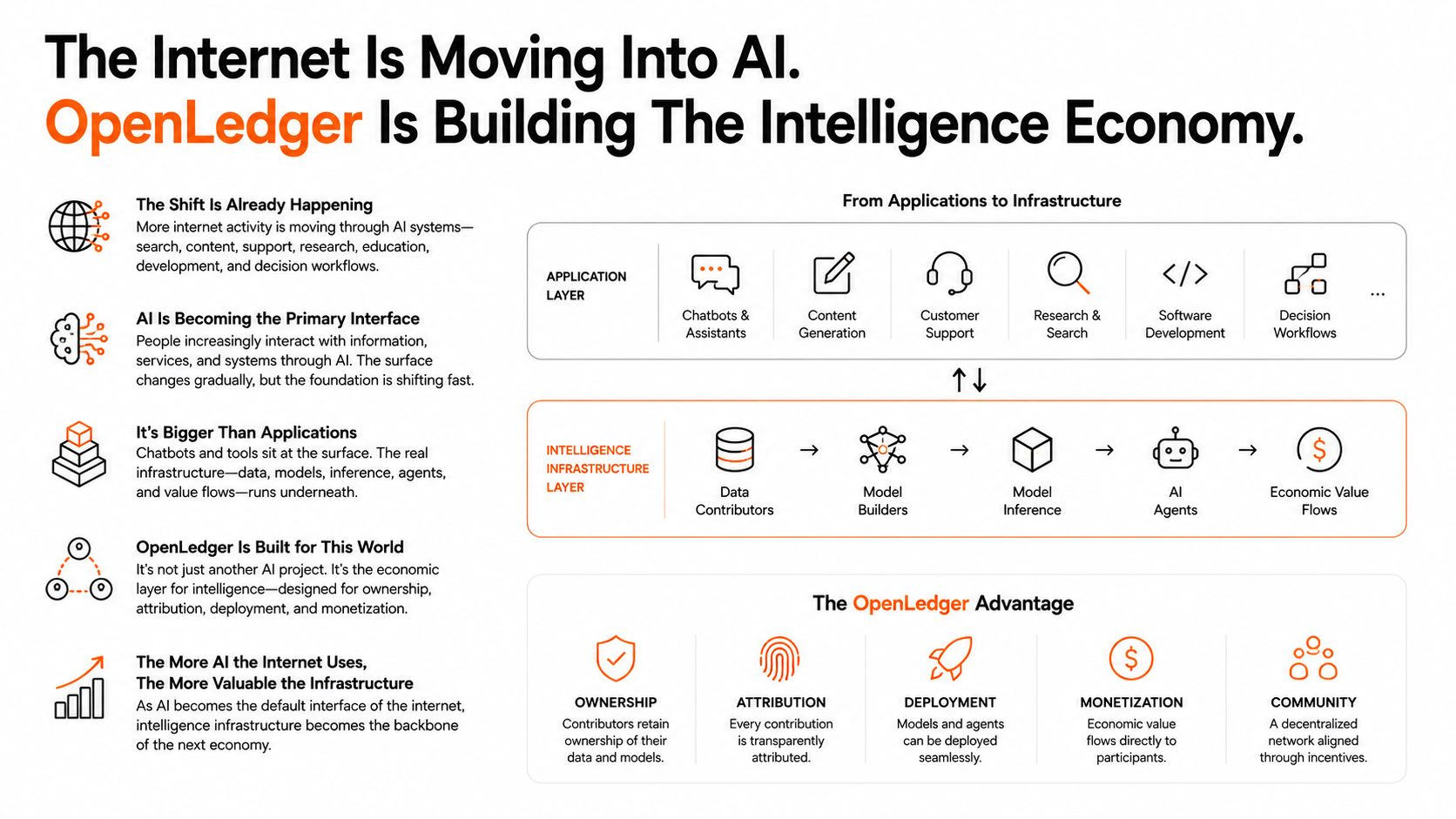
That feels increasingly relevant if AI becomes the default layer through which internet activity happens.
Because every AI interaction depends on infrastructure somewhere. I think this is where @OpenLedger becomes interesting.
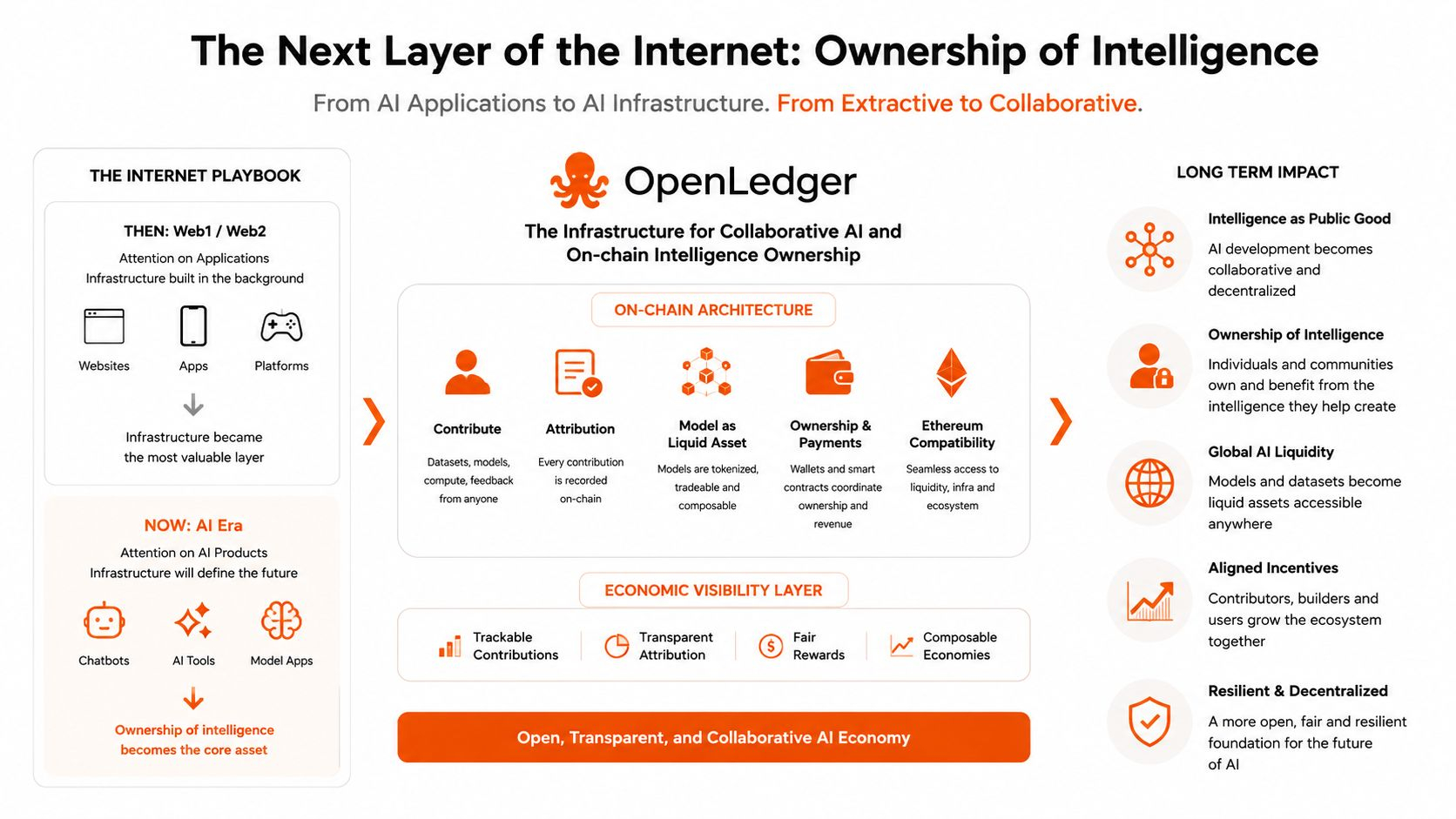
The project's on chain architecture is designed to make AI participation economically visible. Contributions can be tracked. Models can become liquid assets. Wallets and smart contracts can coordinate ownership and payments. Ethereum compatibility allows these activities to connect with broader crypto liquidity and infrastructure.
None of that sounds particularly exciting during periods when people are focused on flashy AI products.
But infrastructure rarely looks important until dependency forms around it. The internet already showed this pattern.
For years most attention flowed toward websites and applications while the deeper infrastructure layers quietly accumulated influence. Over time those underlying systems became some of the most valuable parts of the entire ecosystem.
I sometimes wonder whether AI is heading in a similar direction. If more economic activity keeps moving through AI systems, ownership of intelligence production may become more important than ownership of individual applications.
That possibility aligns closely with what OpenLedger appears to be building.
Instead of treating models as isolated products the network treats intelligence as something that can be created collaboratively, attributed economically and deployed throughout the ecosystem.
At least that seems to be the long term vision. Of course I do not think the outcome is guaranteed.
One risk is that AI value capture becomes concentrated elsewhere. Large companies could still dominate demand. Contributors may not receive meaningful long term rewards. Open intelligence markets may struggle to compete with closed systems that move faster.
Those concerns feel legitimate. I also question whether users actually care about ownership structures as much as crypto communities often assume.
Most users choose convenience. If intelligence becomes widely available, many people may prioritize performance over provenance. They may care more about getting answers than understanding who contributed data or owns pieces of a model.
@OpenLedger eventually has to navigate that reality. Another challenge is speculation.
A significant portion of AI related activity today is still narrative driven. Markets frequently price future possibilities long before actual usage arrives. That can create attention, but attention alone does not build sustainable intelligence economies.
The underlying participation has to remain valuable after excitement fades. That is why I think OpenLedger's relevance depends less on AI hype and more on whether the internet genuinely continues consolidating around AI driven interactions.
If that happens intelligence stops being a feature. It becomes infrastructure.
And if intelligence becomes infrastructure, then systems designed around attribution, ownership, inference monetization, agent deployment and coordinated participation start looking much more important than they do today.
That is the part I keep coming back to. OpenLedger does not necessarily need every AI narrative to succeed.
It only needs the internet economy to keep moving deeper into AI mediated activity.
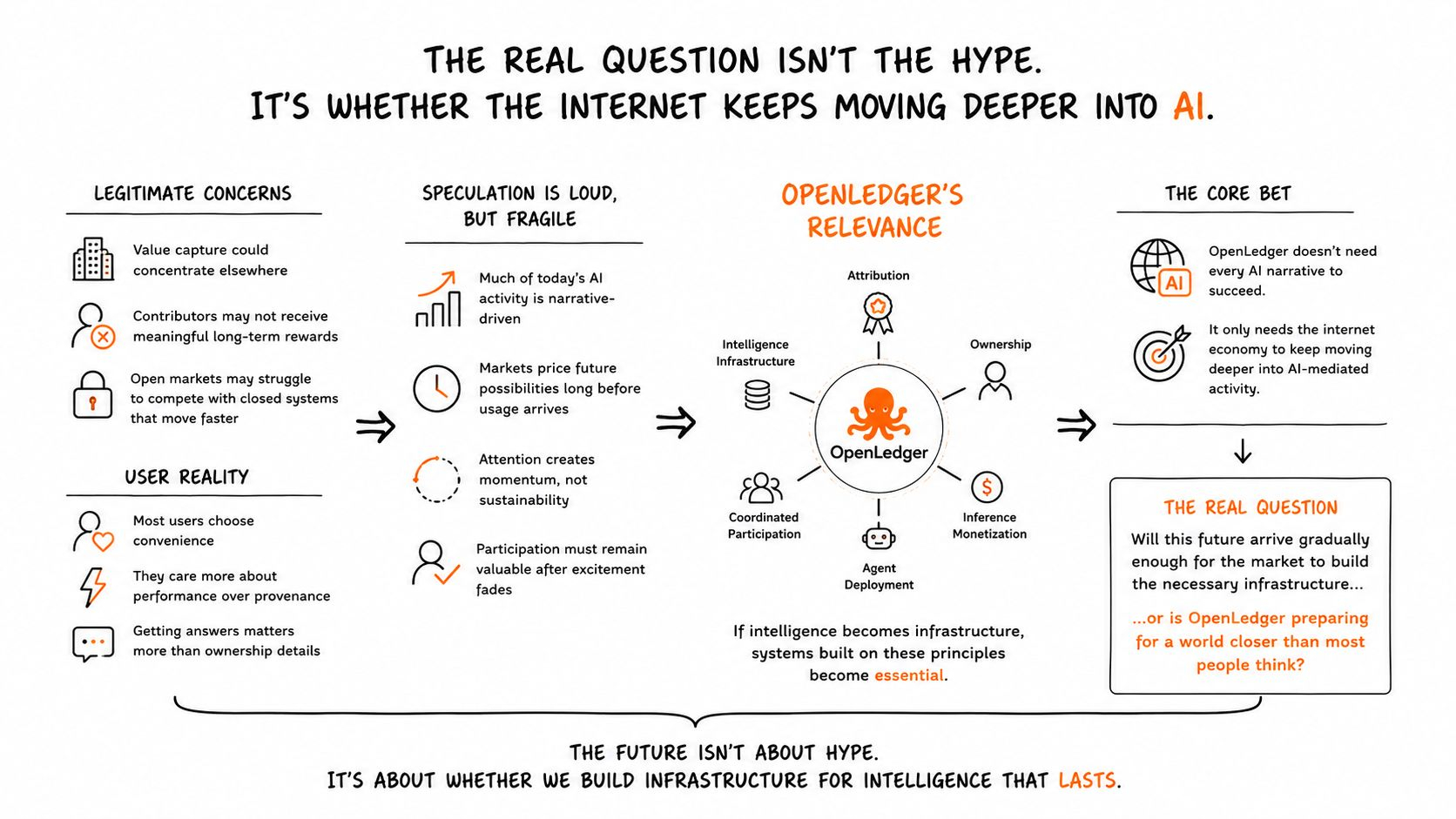
The question is whether that future arrives gradually enough for the market to build the necessary infrastructure around it, or whether @OpenLedger is preparing for a world that most people still think is further away than it actually is.
