Some nights I find myself staring at the screen long after I planned to log off.
The charts stop moving.
The noise fades.
The timelines get quieter.
But the questions never seem to leave.
Crypto has a strange way of making everything feel important in the moment. Every cycle arrives with a new promise. Every narrative claims to be the one that changes everything. For a while people believe it. Money flows in. Communities grow. Conviction spreads faster than facts.
Then time does what it always does.
It reveals what was real and what was simply a story people wanted to believe.
After watching enough cycles, you stop chasing excitement. You start chasing understanding.
That is where I was when I began looking at OpenLedger.
Not searching for the next big thing.
Not searching for a quick trade.
Just trying to understand whether there was something deeper underneath the surface.
Because beneath all the AI conversations, token discussions, and market speculation, there is a question that feels impossible to ignore.
Who should own the value created by intelligence?
The more I think about that question, the more uncomfortable it becomes.
Every day billions of people create value without even realizing it.
We write.
We search.
We share ideas.
We post photos.
We leave digital footprints everywhere we go.
Tiny pieces of ourselves are scattered across the internet.
Individually they may seem meaningless.
Together they have become the fuel powering one of the most powerful technological shifts in history.
Artificial intelligence learns from human experience.
Human creativity.
Human curiosity.
Human mistakes.
Human knowledge.
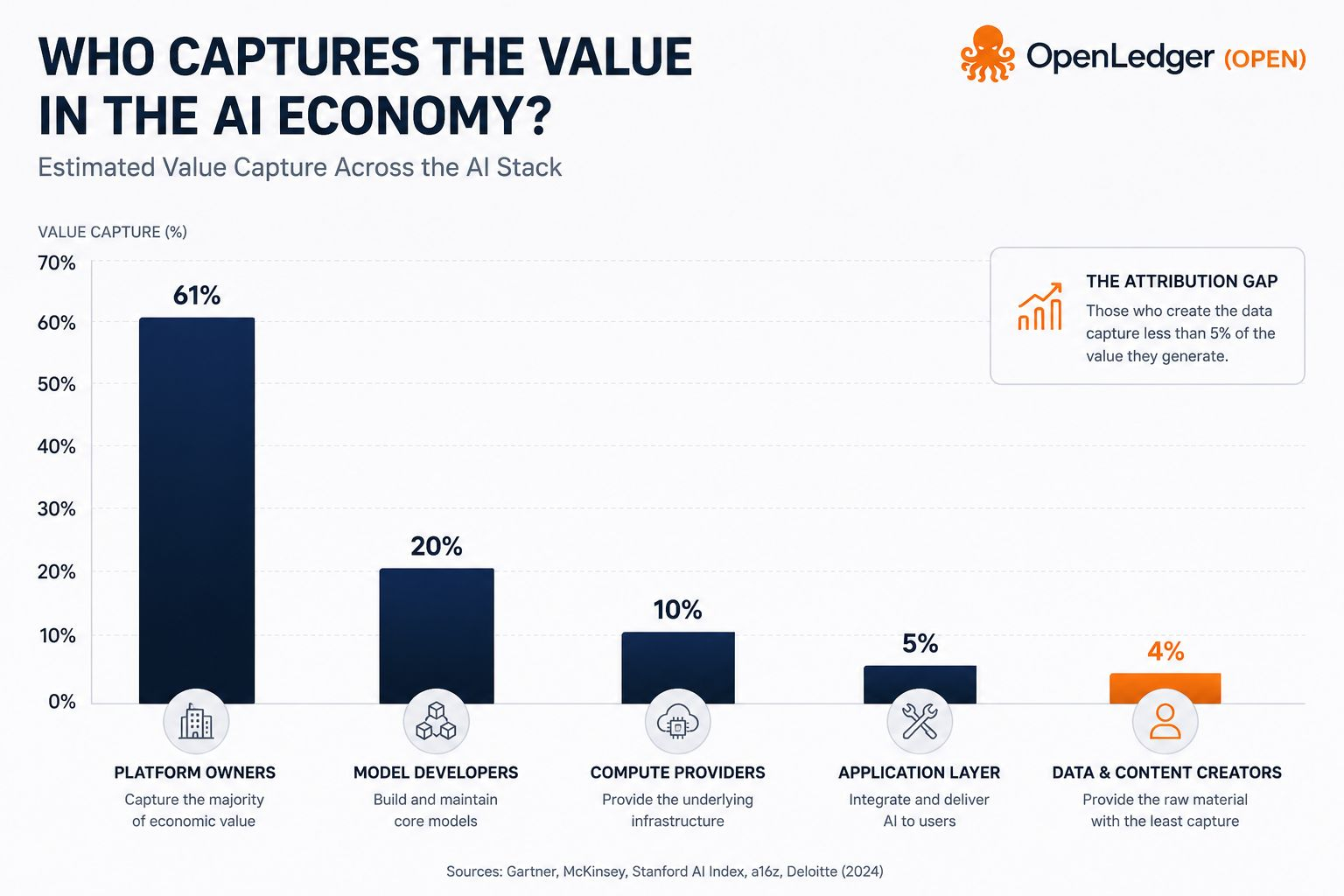
The strange part is that most of the people contributing to this machine never see the rewards it creates.
The value moves upward.
The ownership rarely does.
Maybe that has always been the internet's hidden trade.
We gave away pieces of ourselves in exchange for convenience.
Most of us accepted it because the services were useful enough.
But AI feels different.
The scale feels larger.
The distance between contribution and reward feels wider.
And that is why OpenLedger caught my attention.
Not because it promises a perfect solution.
I have heard too many perfect promises in crypto already.
What caught my attention was the problem itself.
A real problem has weight to it.
You can feel it.
You can see it growing even when nobody is talking about it.
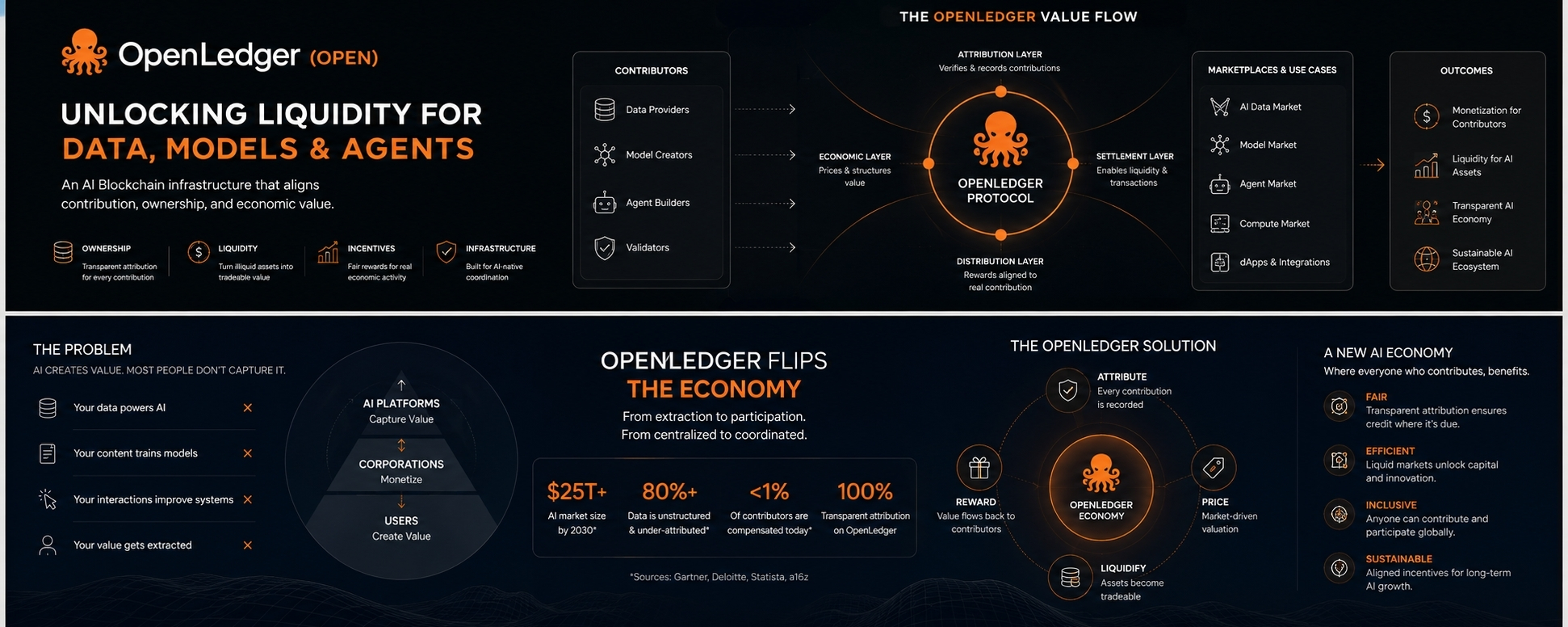
OpenLedger seems to be built around the idea that data, models, and intelligent systems should have a clearer economic relationship with the people who help create them.
On paper that sounds logical.
Maybe even necessary.
But markets do not reward ideas simply because they make sense.
Markets reward execution.
That distinction matters.
A lot.
Because crypto is full of projects that identified the right problem and still failed to build something people genuinely wanted to use.
The graveyard is crowded with good ideas.
That reality keeps me cautious.
Whenever I research a project, I try to ignore the marketing.
Marketing tells you what people want you to see.
Behavior tells you what is actually happening.
I find myself paying attention to different things.
Are users showing up because something is useful?
Or because rewards are available?
Would participation survive if incentives disappeared tomorrow?
Would activity remain if the token price stopped attracting attention?
Those questions usually reveal more than any roadmap ever could.
The uncomfortable truth is that crypto has become incredibly good at creating activity that looks real from a distance.
Wallets appear.
Transactions increase.
Communities become louder.
Metrics improve.
Yet sometimes the entire machine is running on temporary incentives rather than genuine demand.
The difference is hard to spot early.
But eventually it becomes obvious.
Reality always arrives.
It always does.
That is one of the reasons OpenLedger feels difficult to evaluate.
The vision itself touches something meaningful.
The challenge is proving that meaningful vision can become sustainable behavior.
Because human beings are experts at following incentives.
We optimize.
We adapt.
We find shortcuts.
Every economic system eventually gets tested by the people participating inside it.
Sometimes those tests strengthen the system.
Sometimes they expose weaknesses nobody expected.
The outcome is rarely obvious from the beginning.
What keeps pulling me back is the idea that attribution may become one of the most important infrastructure layers in the future AI economy.
Not because it sounds exciting.
Because it sounds necessary.
As artificial intelligence becomes more capable, questions around ownership become harder to avoid.
Who owns the output generated by an AI agent?
Who deserves compensation when a model creates value using information gathered from thousands of contributors?
Who benefits when digital labor becomes increasingly automated?
These questions feel distant today.
But so did social media once.
So did cloud computing.
So did smartphones.
Sometimes the biggest shifts begin quietly before they become impossible to ignore.
That possibility is what makes OpenLedger interesting.
Not because success is guaranteed.
Because the problem feels real.
And real problems have a way of surviving long after narratives disappear.
Still, there are risks everywhere you look.
Execution risk.
Adoption risk.
Competition risk.
Regulatory risk.
The possibility that users simply do not care enough about ownership to change their behavior.
That last one might be the biggest challenge of all.
People say they care about control.
Most people care about convenience.
History has shown that repeatedly.
A better system does not automatically win.
Sometimes the easiest system wins instead.
That reality cannot be ignored no matter how elegant the technology appears.
And yet I cannot completely dismiss what OpenLedger is attempting.
Something about the idea lingers in my mind after the research ends.
Maybe it is because the project sits at the intersection of two powerful forces.
Artificial intelligence is reshaping how value is created.
Crypto is still searching for better ways to distribute that value.
Where those worlds collide, new economic models become possible.
Not inevitable.
Possible.
There is a difference.
The longer I spend studying this space, the less interested I become in certainty.
Certainty usually belongs to people selling something.
Reality is rarely that clean.
Reality is full of unfinished stories.
Half built systems.
Experiments that may succeed.
Experiments that may fail.
OpenLedger feels like one of those stories.
A project standing in front of a question that the industry has not fully answered yet.
Maybe it becomes an important piece of future AI infrastructure.
Maybe it becomes another chapter in crypto's long history of ambitious ideas.
Right now I honestly do not know.
And maybe that is the most honest conclusion available.
Late at night, when the market noise fades and all that remains are first principles, I keep returning to the same thought.
The next phase of AI may not be defined by who builds the smartest intelligence.
It may be defined by who figures out how value flows around that intelligence.
Who owns it.
Who benefits from it.
Who gets left behind.
OpenLedger appears to be exploring that question.
Whether it eventually becomes part of the answer is something only time can reveal.
For now, all I see is a possibility.
Not a promise.
Not a guarantee.
Just a possibility quietly taking shape while most people are still focused on the noise.