
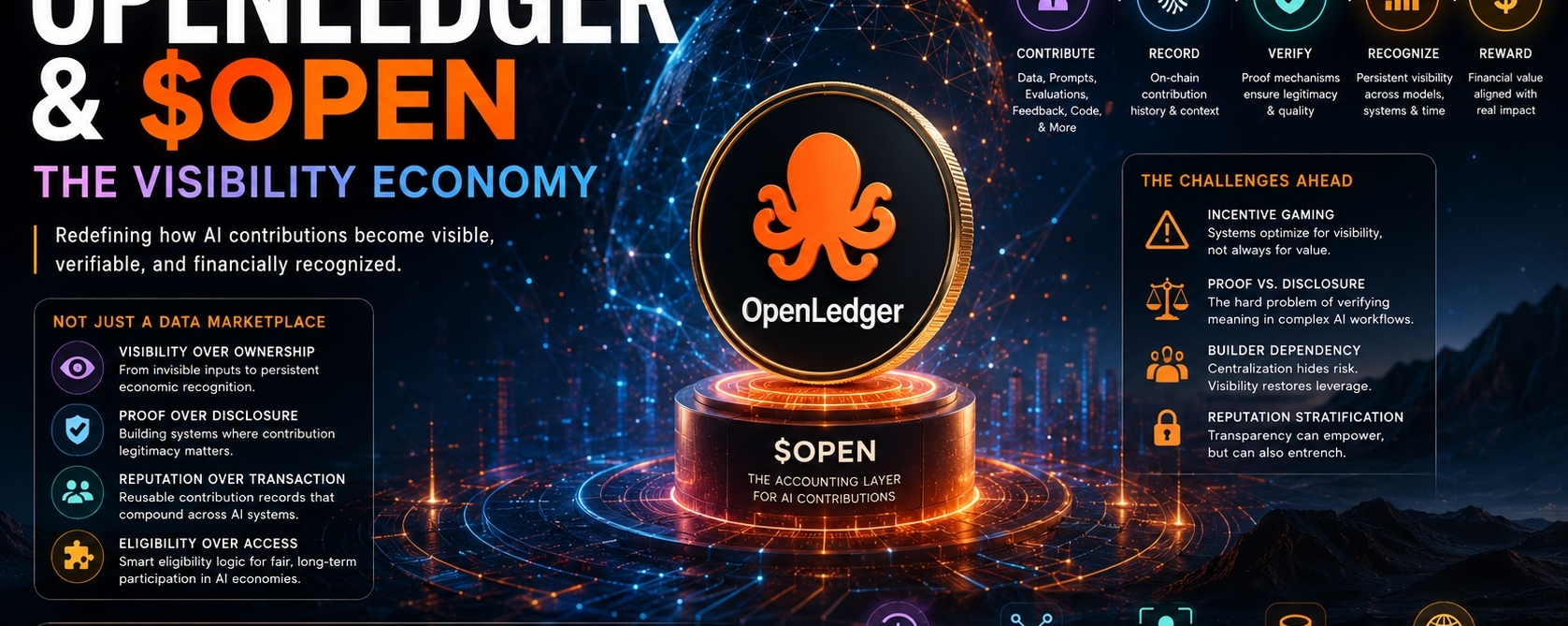
OpenLedger and thetoken appear, at first glance, to fit neatly into that familiar narrative. A decentralized layer where contributors provide data, models, or intelligence and receive rewards in return. Another attempt to structure participation around AI production. Another marketplace trying to connect contributors with demand.
But the more interesting possibility is that OpenLedger may not actually be building a data economy at all.
It may be building a visibility economy.
That distinction matters more than it initially sounds.
Data economies revolve around possession. Visibility economies revolve around recognition. In one system, value comes from owning information. In the other, value comes from proving participation in a way that remains legible, reusable, and economically meaningful across time. The difference is subtle, but it changes the architecture of incentives completely.
Most traditional AI marketplaces treat contribution as an isolated event. A user uploads data, completes labeling tasks, trains a model, or participates in a computation layer. Compensation happens once. The relationship ends there. Contribution becomes transactional and disposable.
OpenLedger seems to be experimenting with something more persistent: contribution as a recorded financial identity.
That shifts the conversation away from “Who owns the data?” toward “Who becomes visible through contribution?”
The implications become larger once AI systems begin relying not only on raw inputs, but on reputation-weighted participation. In practice, most AI ecosystems already operate this way informally. Certain researchers, model builders, dataset curators, and infrastructure providers gain recurring influence because the system learns to trust their historical output. Visibility compounds. Proven participation becomes leverage.
The problem is that most of this process remains opaque.
Contributors rarely possess portable proof of their impact. Platforms capture the value of coordination while contributors become temporary labor plugged into black-box systems. AI workers, annotators, independent researchers, and open-source builders produce immense amounts of invisible infrastructure without persistent economic recognition attached to their history.
This is where OpenLedger becomes more interesting than its surface branding suggests.
If the protocol succeeds, may function less like payment for labor and more like an accounting layer for verified usefulness. The token becomes tied not merely to contribution itself, but to the visibility of contribution inside machine economies.
That introduces a different type of scarcity.
Not scarce data.
Scarce legitimacy.
In centralized AI systems, legitimacy is privately assigned. Companies decide which contributors matter, which models are trusted, which datasets remain authoritative, and which actors receive recurring access. Open systems complicate that process because they cannot rely entirely on institutional authority. They need mechanisms that publicly expose participation quality without collapsing into manipulation.
OpenLedger appears to be moving into that tension directly.
The critical question is not whether contributors can upload information. That problem is already saturated. The internet has no shortage of content generation. The real problem is eligibility. Which contributions become economically visible enough to matter repeatedly?
That is a harder problem because eligibility systems inevitably create power structures.
Every contribution layer eventually develops ranking logic, whether explicit or hidden. Some participants become more discoverable. Some receive more requests. Some gain recurring rewards. Others disappear into low-value labor pools. Even decentralized systems quietly reproduce these hierarchies through wallet histories, staking dynamics, access privileges, or reputation scoring.
What makes OpenLedger worth watching is that it does not seem entirely naive about this reality.
Many AI projects still market decentralization as if openness automatically eliminates asymmetry. In reality, decentralization often redistributes opacity rather than removing it. Incentive systems become gameable. Sybil behavior emerges. Low-quality participation floods reward mechanisms. Metrics become targets. Once rewards exist, optimization follows immediately.
This is where proof and disclosure begin separating from each other.
Proof is verifiable participation.
Disclosure is selective visibility.
Most systems confuse the two. They assume that exposing activity publicly creates trustworthy contribution histories. But visibility itself becomes manipulable once financial incentives are attached. Contributors begin optimizing for what can be seen rather than what is genuinely useful. The system slowly shifts from productive coordination toward performative signaling.
Crypto has already experienced this cycle repeatedly.
Liquidity mining produced mercenary capital.
Engagement farming produced synthetic communities.
Airdrop mechanics produced industrialized wallet behavior.
AI ecosystems are unlikely to escape the same gravitational forces.
If OpenLedger evolves into a contribution economy without carefully designing visibility filters, it risks turning AI participation into another optimization game where contributors produce for metrics rather than utility. In that scenario, becomes merely another incentive token floating above extractive behavior.
But if contribution records become durable, contextual, and reusable across applications, the system changes meaningfully.
Then participation history starts functioning more like financial infrastructure than temporary rewards.
A reusable contribution record has compounding properties. It transforms isolated work into cumulative reputation. A contributor no longer begins from zero inside every ecosystem. Their historical participation becomes portable context. AI systems, builders, and applications can evaluate not only outputs, but continuity.
This matters because AI itself increasingly depends on trust compression.
As model generation accelerates, synthetic content floods every layer of the internet. Verification becomes more valuable than production. The internet already contains infinite content. What it lacks is reliable attribution and persistent credibility.
OpenLedger may be positioning itself around that transition implicitly.
Not “Who can create data?”
But “Whose contribution history remains economically legible across systems?”
That is a fundamentally different thesis.
Under this framework, stops behaving like a simple utility token and starts resembling a coordination primitive for machine-era reputation. The token becomes intertwined with visibility rights, participation weighting, and economic discoverability.
The long-term consequence is subtle but profound.
Platforms that control visibility eventually control opportunity.
Social networks discovered this years ago. Search engines did too. Recommendation algorithms became more powerful than ownership itself because visibility determines access. OpenLedger appears to be exploring a similar principle inside AI infrastructure: the idea that future AI economies may revolve less around possession of intelligence and more around recognized contribution to intelligence systems.
That possibility also introduces uncomfortable dependencies.
Builders entering these ecosystems may gradually rely on OpenLedger not simply for rewards, but for economic legibility. If applications, agents, or models begin evaluating contributors through reusable participation histories tied to $OPEN, then visibility itself becomes infrastructural.
And infrastructure quietly accumulates power.
This is the paradox beneath many decentralization narratives. Systems designed to distribute coordination often become new coordination centers precisely because they standardize trust. Once a protocol becomes the dominant reference layer for legitimacy, opting out becomes expensive.
The concern is not overt centralization.
It is invisible dependency.
Builders optimize toward the visibility system because discoverability affects survival. Contributors shape behavior around eligibility logic because economic access depends on remaining legible to the network. Over time, the protocol does not merely reward participation. It defines what counts as valuable participation in the first place.
That is where OpenLedger becomes philosophically more important than most AI token projects.
The project is not interesting because it promises monetized data. Countless systems already promise that. It becomes interesting if it succeeds in financializing visibility without collapsing into pure performative extraction.
That balance will be extremely difficult to maintain.
Every visibility economy faces the same danger: once recognition becomes monetizable, behavior bends toward visibility optimization. Authenticity competes against incentive engineering. Metrics distort production. Contributors learn to manufacture legitimacy signals rather than meaningful outputs.
The internet already lives inside this dynamic socially.
AI may reproduce it economically.
Whether OpenLedger avoids that trap will depend less on marketing narratives and more on how intelligently it designs contribution persistence, reputation weighting, sybil resistance, and contextual verification layers. The architecture of visibility matters more than the existence of rewards themselves.
Because in the end, the deeper question surrounding AI infrastructure is not who owns the models.
It is who becomes visible enough to matter within them.
And if OpenLedger understands that distinction earlier than the rest of the market, thenmay represent something larger than a decentralized AI token.
It may represent an attempt to build the accounting system for machine-era legitimacy itself. than a decentralized AI token.
It may represent an attempt to build the accounting system for machine-era legitimacy itself.#OpenLedger @OpenLedger $OPEN
