
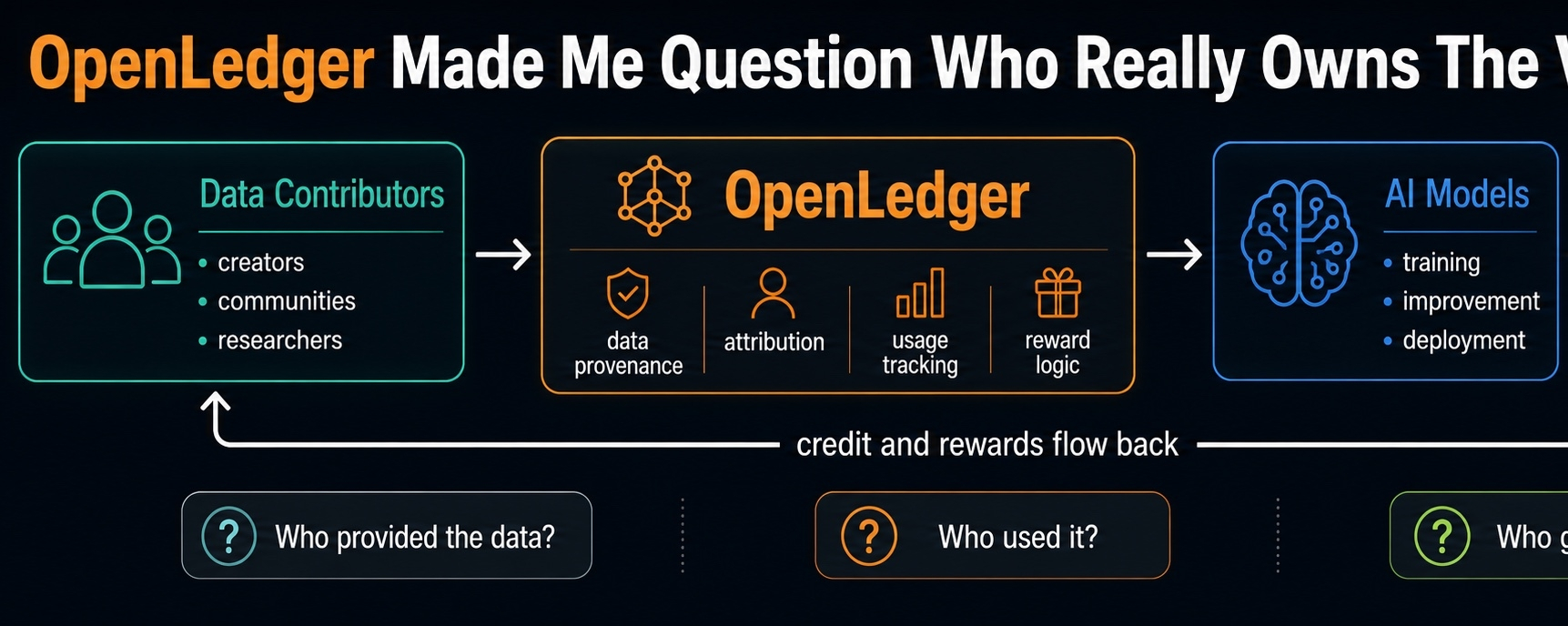
OpenLedger makes me pause for a reason that has nothing to do with the usual AI noise.
I’ve seen this cycle too many times.A project shows up with clean wording, a sharp idea, a serious problem to solve, and suddenly everyone starts acting like the market has never heard a pitch before. Data ownership. AI rewards. Contributor value. Better attribution. It all sounds reasonable. Sometimes it even sounds necessary.
But I’ve watched reasonable ideas die slowly in crypto.
Not because the idea was bad.
Because nobody used it when the incentives got weaker.
That is always where the truth starts leaking out.
OpenLedger is trying to deal with something real. I’ll give it that. Behind every AI model, there is data, and behind that data there are people who usually get erased from the story. Creators, communities, researchers, builders, users, random contributors who added something useful without ever knowing it might become part of a bigger machine later.
AI eats all of it.
Then the final product gets polished, packaged, and sold while the source layer becomes fog.
OpenLedger is trying to pull that fog apart.
The project wants data contribution, model usage, ownership, and rewards to become easier to track. Not just in some vague emotional way where everyone says contributors matter. More like a system where value has a trail. Someone adds useful data. A model benefits from it. A builder uses the model. The network can point backward and say, this is where part of the value came from.
That part matters.
I’m not going to pretend it doesn’t.
The AI market has a credit problem. A serious one. People are producing the raw material, but the value often moves away from them. That tension is only getting heavier. The bigger AI gets, the more uncomfortable this question becomes: who owns the intelligence created from everyone else’s input?
OpenLedger is standing near that question.
That is the interesting part.
But here’s the thing. Crypto has a habit of taking serious questions and turning them into campaign material. That is where my fatigue kicks in. I don’t trust the first clean version of any project anymore. I don’t trust the first wave of posts. I don’t trust the early excitement, because I’ve seen too many networks look alive while everyone was just farming something.
Movement is cheap.
Actual use is harder.
And OpenLedger will not escape that test.
The project can talk about attribution, but attribution only matters if the data is worth tracking. It can talk about contributors, but contributors only matter if they are adding something useful. It can talk about rewards, but rewards become dangerous when they attract people who only care about extracting from the system.
That is the friction.
You can’t just reward activity and call it contribution.
Crypto already tried that a thousand times. Points. Quests. Campaigns. Tasks. Engagement loops. People show up, make noise, collect whatever they can, and leave behind a mess that looks like community from far away but feels hollow up close.
OpenLedger needs to be careful here.
Very careful.
Because a project built around meaningful contribution cannot afford to become another recycling machine for low-quality activity. If the network fills with people adding junk data, forced engagement, repeated content, and reward-chasing behavior, then the whole idea starts eating itself.
I’m looking for the moment this actually breaks.
Not in a bearish way. Just in a realistic way.
Every project has a breaking point where the narrative stops carrying it and the product has to stand up. For OpenLedger, that point is simple. Does the system attract real data? Do builders actually use it? Do models improve because of what flows through the network? Do contributors get rewarded for value, not noise?
That is where I’m watching.
Not the polished lines.
Not the clean explanations.
Not the surface-level AI branding.
I want to see whether useful work starts moving through OpenLedger without needing constant pushing from the project itself.
That is the difference between a network and a campaign.
A campaign can look active for a while. A network has habits. People return because there is a reason to return. Builders come back because the tools save time or create value. Contributors stay because the system treats their input like something with weight, not just another wallet address doing another task.
That is harder to fake.
The idea behind OpenLedger has weight because AI does need better records. It needs a way to show where data came from, how it was used, and who deserves credit when value is created from it. I don’t think that problem is going away. If anything, it gets uglier from here.
More models.
More training.
More scraped material.
More people realizing their work helped build something they never benefited from.
So yes, OpenLedger is touching a real nerve.
But touching a real nerve is not the same as solving the problem.
That is where crypto keeps exhausting people. Every few months, another project identifies a real issue, wraps it in clean wording, adds token economics, pulls in attention, and then the grind begins. The part where users need to care. The part where builders need to build. The part where incentives need to stay healthy. The part where the system has to deal with spam, low-quality input, weak demand, and people trying to game every reward path they can find.
That grind is where most projects lose their shape.
OpenLedger has to survive that.
And honestly, the project’s strongest angle is not “AI.” That word has been drained by overuse. Everyone is AI now. Every second pitch is AI. The word itself has become noisy.
The better angle is accountability.
That is the part I can take seriously.
Who contributed?
What was used?
Where did the value move?
Can the system prove it later?
If OpenLedger can make those questions easier to answer, then it has something more durable than a trend. Not guaranteed. Not safe. But at least more grounded.
The project also has to deal with an uncomfortable truth: most users do not care about attribution until they are the ones being ignored. Builders care about speed. Traders care about price. Communities care about rewards. Data owners care when value leaves them behind.
So OpenLedger is not just building tech.
It is trying to change behavior.
That is harder.
A lot harder.
People love fair systems in theory. In practice, they choose whatever is faster, cheaper, easier, or more profitable. That is the wall OpenLedger has to climb. If using the network feels like extra work without enough payoff, people will move around it. If the reward layer is too loose, it becomes noise. If it is too strict, it may scare away normal contributors.
There is no clean version of this.
That is why I’m not interested in pretending the project is already proven.
It is not.
It has a serious idea. It has a real market problem in front of it. It has a reason to exist if the contribution layer actually works. But the proof still has to come from usage, not from the way people describe it.
I want to see data that matters.
I want to see builders who are not just passing through.
I want to see models that people use for reasons beyond rewards.
I want to see contributors who feel like the system gives them a fairer deal than the usual black box.
That is the signal.
Everything else is noise until it repeats long enough to become habit.
The best version of OpenLedger would probably look boring from the outside. Not loud. Not full of forced excitement. Just a working loop. Someone adds valuable data. A builder uses it. A model improves. Value moves. The record stays visible. The contributor gets recognized. Then it happens again.
And again.
That kind of boring is rare in crypto.
Most projects want attention before they have rhythm. OpenLedger needs rhythm. It needs daily use, not just daily posts. It needs people doing something inside the system because the system helps them, not because the market told them to care for a week.
Maybe it gets there.
Maybe it becomes one of those projects that actually finds a useful lane inside the AI mess.