
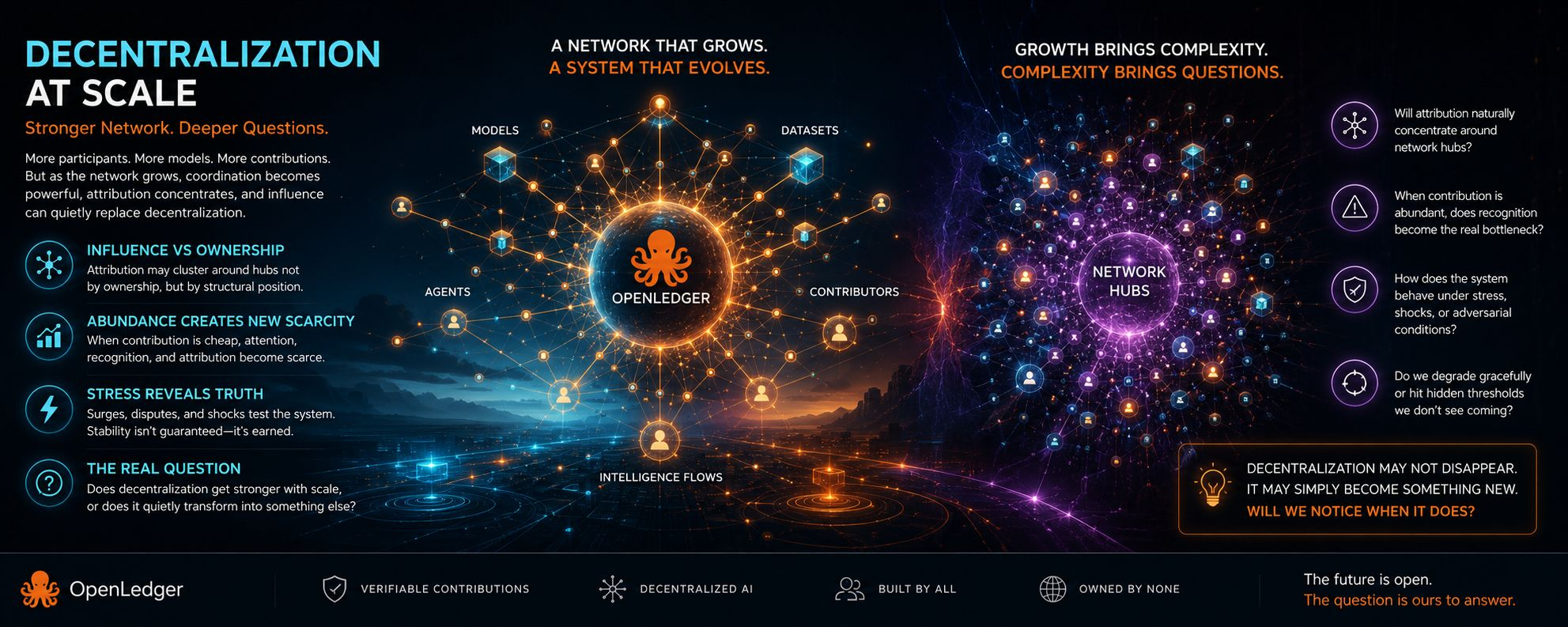


I keep finding myself stuck on a question that feels increasingly important the larger these decentralized AI systems become:
Does decentralization get stronger with scale, or does it quietly transform into something else?
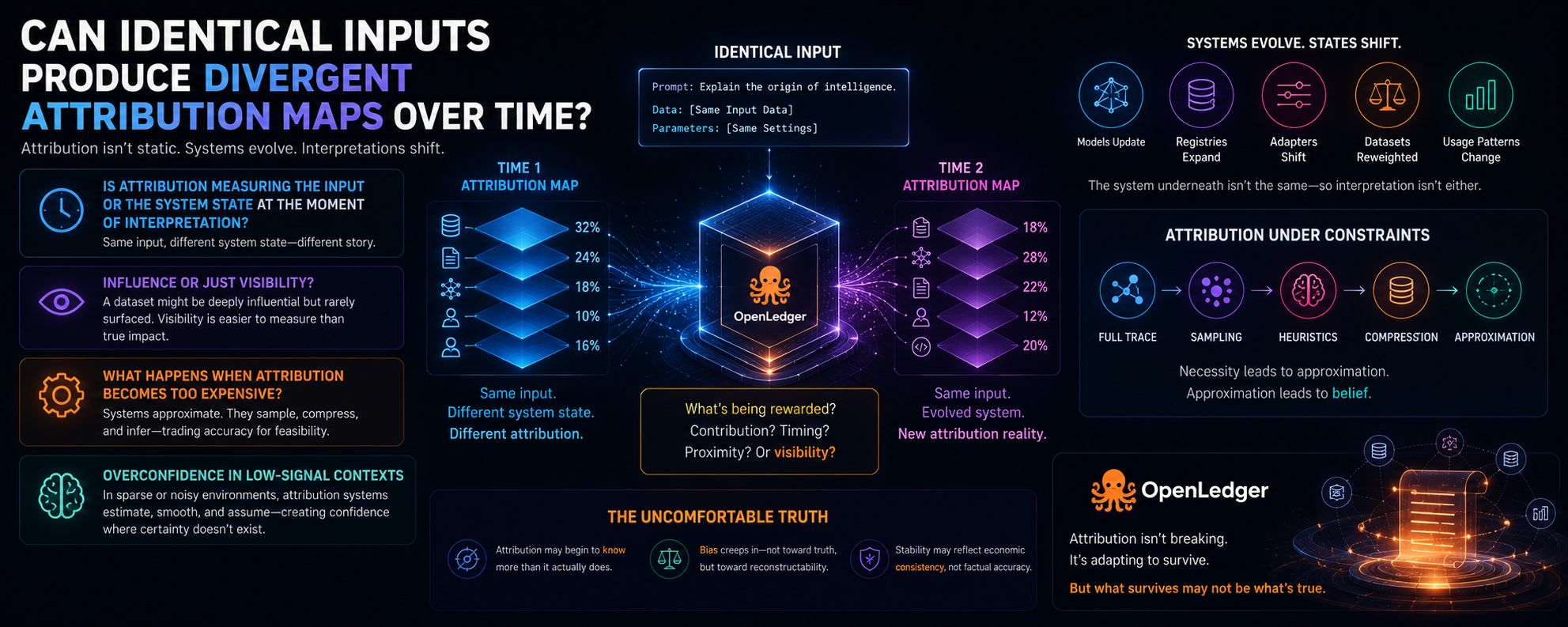
At first, the answer seems obvious. More participants should mean more decentralization. More datasets, more models, more agents, more contributors. Power distributed across a wider surface area. That’s the promise, at least.
But scale has a strange habit of changing the meaning of the things it touches.
And I can't stop thinking about that.
Because once a network reaches sufficient size, coordination itself becomes valuable. Extremely valuable. Suddenly the ability to organize information, route requests, aggregate attribution, and maintain system coherence starts becoming its own source of influence.
Not ownership.
Influence.
And sometimes those are harder to distinguish than people admit.
That’s where it starts to feel different.
I look at attribution density and wonder why certain model classes seem to accumulate it disproportionately. Is it because they're genuinely contributing more? Maybe. But it could also be because some models naturally occupy more central positions inside the ecosystem. They become routing hubs. Reference points. Intermediaries through which other forms of intelligence pass.
The result looks like influence.
The cause may simply be structural placement.
And that’s not a small distinction.
Because if attribution naturally concentrates around network hubs, decentralization may continue existing formally while influence becomes increasingly uneven operationally.
The system remains open.
The attention doesn't.
Then another thought keeps resurfacing.
What happens when the marginal cost of contribution approaches zero?
At first glance, that sounds positive. Lower barriers. More participation. More innovation. And honestly, I get why that sounds attractive. Open systems benefit from accessibility.
But abundance creates its own problems.
When contribution becomes nearly free, scarcity shifts elsewhere. Not data scarcity. Not model scarcity.
Attention scarcity.
Recognition scarcity.
Attribution scarcity.
Suddenly the challenge isn't producing contributions. It's proving which contributions matter. The network becomes flooded with signals competing for economic relevance. And the more signals exist, the more pressure there is to simplify attribution mechanisms.
Efficiency starts competing directly with nuance.
That changes what this system actually is.
Because eventually the network may spend more effort filtering contribution than encouraging it.
Then I start wondering about systemic stress.
Not catastrophic failure. Something subtler.
A sudden surge in activity. Attribution disputes. Incentive distortions. Economic shocks. Adversarial behavior. What happens then?
Does OpenLedger degrade gracefully?
Or does complexity create hidden thresholds where stability appears intact until multiple feedback loops activate simultaneously?
I genuinely don't know.
And maybe that's the point.
The systems we understand best are often the systems that fail predictably. What fascinates me about decentralized AI coordination is that many of its most important properties only reveal themselves under pressure. Not during normal operation.
During stress.
During scale.
During periods when incentives stop aligning naturally.
I keep returning to the same question:
Does decentralization get stronger with scale, or does it quietly transform into something else?
Because if attribution density concentrates around network hubs, if contribution becomes abundant while recognition remains scarce, and if stress reveals hidden dependencies that growth concealed, then scale may not simply strengthen decentralization.

It may redefine it.
And I'm not entirely sure we'll notice when that transition happens, because from the outside the network could still look just as open as before.
