

OpenLedger is one of those projects I don’t want to judge from the surface layer, because the surface layer is where this market keeps fooling people.
Everyone looks at the final output first. The answer. The insight. The clean result sitting at the end of the pipe. I get why. It is the easiest thing to judge, and crypto loves easy judgment. A shiny product screen, a fast response, a few strong claims, some token momentum, and suddenly people act like they have seen the future.
I have seen that movie too many times.
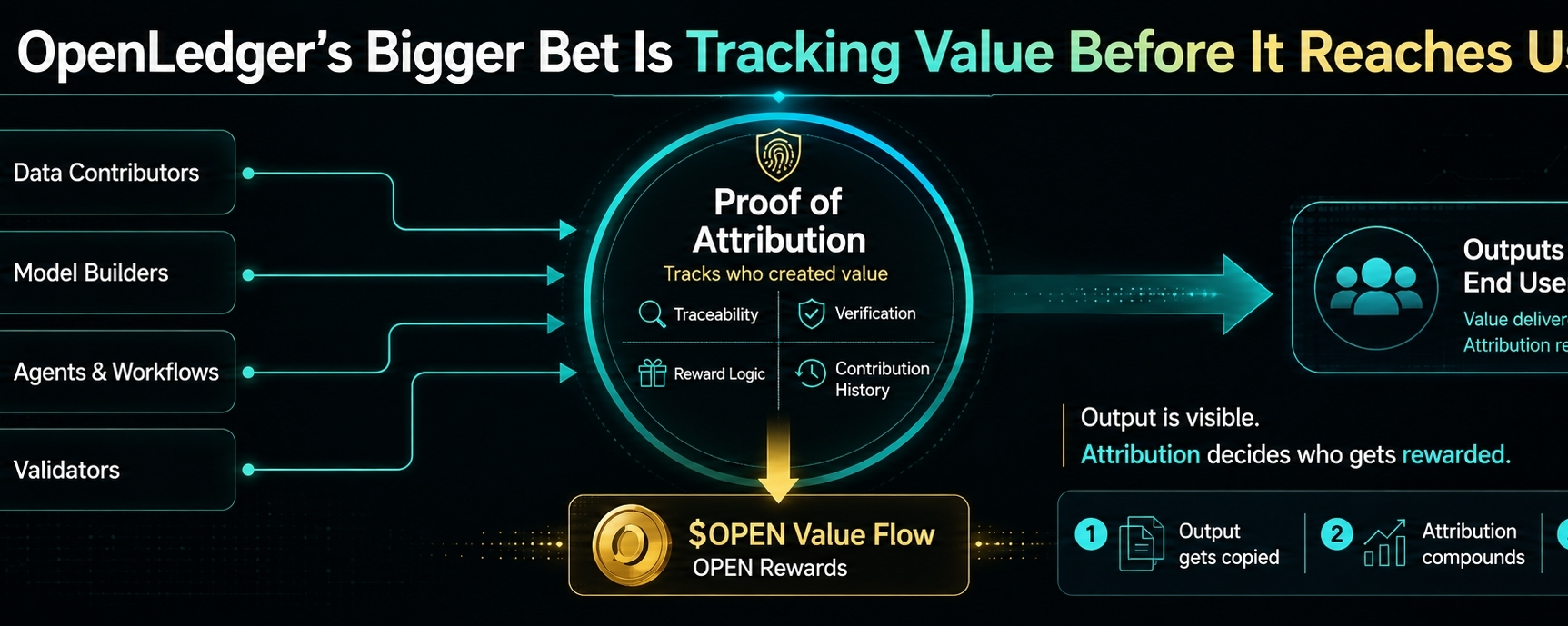
The part that actually matters with OpenLedger is not the output. It is the attribution behind it. That sounds less exciting, almost boring, but boring is usually where the real infrastructure hides. If a piece of data helped shape a result, if a model improved the answer, if an agent handled part of the grind, if some contributor added value before anyone ever saw the final output, OpenLedger is trying to make sure that contribution does not just disappear into the noise.
That is the thing I keep coming back to.
The market is drowning in output now. Answers, summaries, agents, dashboards, generated research, task automation, prediction layers. Every cycle produces more of it. Some of it is useful. A lot of it is recycled sludge with better formatting. The problem is not that systems cannot produce more. They can. They will. The problem is that most of them still do a terrible job of showing where the value actually came from.
OpenLedger’s Proof of Attribution is interesting because it attacks that problem directly. Not perfectly, not magically, and I’m not going to pretend this is already solved. Attribution is messy. It is hard to measure influence. It is hard to know whether one dataset mattered more than another, whether a model really improved the outcome, or whether a contributor is just gaming the reward loop with low-quality input. This is where many projects start sounding clever and then break once real incentives hit them.
I’m looking for the moment this actually breaks.
That is usually where the truth is.
Still, the idea itself has weight. OpenLedger is trying to give the network memory. Not memory in the soft marketing sense, but an economic memory — a way to remember who contributed, what mattered, and how value should move back through the system. Without that, the same old platform pattern repeats again. Contributors feed the machine, the machine produces something clean, and the value gets captured somewhere far away from the people who helped create it.
We have seen this structure before. Too many times.
Data gets treated like free fuel. Builders get reduced to replaceable parts. Agents do the work but lose their fingerprints. Model improvements get absorbed into a larger system until nobody can tell who added what. The end user sees a nice result, and the upstream contributors get a pat on the head, if that.
OpenLedger is at least trying to make that uncomfortable.
For data contributors, this matters more than the usual reward talk. Most data is not special. Let’s be honest. A lot of it is stale, duplicated, noisy, scraped to death, or barely useful. But some data does matter. Some data changes the quality of a result. Some niche input, some domain-specific material, some well-structured contribution can do more for a system than a mountain of generic junk. If OpenLedger can separate signal from noise and tie rewards to actual usefulness, then it has something worth watching.
That is a big “if.”
The reward math has to feel fair. The attribution logic has to be strong enough that serious contributors do not feel like they are donating value into another black hole. The system has to resist spam, farming, lazy uploads, and all the other incentive rot crypto attracts the second rewards appear. This market does not politely use reward systems. It attacks them. It grinds them down. It finds the weak point.
So OpenLedger’s real test is not whether the idea sounds good.
It is whether the attribution layer can survive contact with users who are financially motivated to bend it.
For builders, the value is also pretty clear. If you are building on top of intelligent infrastructure, you need more than a final answer. You need to know what shaped that answer. Which inputs were useful. Which agents have history. Which models actually added value. Which parts of the system are dependable and which parts are just dressed-up noise.
That kind of visibility matters.
Closed systems ask you to trust the black box. OpenLedger is trying to make the box a little less smug.
I like that direction, but I do not want to oversell it. The project still has to prove real usage. It needs builders who are not just chasing incentives. It needs data that is actually worth something. It needs attribution that does not collapse into vague scoring. It needs OPEN to do more than float around as another ticker people rotate into when the narrative heats up.
Because that is another trap.
A token can get attention without having a real role. We have watched that happen across cycle after cycle. Price moves, volume spikes, people start writing threads, and for a while the market confuses motion with traction. Then the noise fades and everyone starts asking what the token actually coordinates.
For OpenLedger, the cleanest answer is contribution. If OPEN is tied to staking, verification, rewards, participation, and the movement of value between contributors and the network, then there is at least a real utility path. Not guaranteed. But real enough to examine.
The project becomes more interesting if the token is not just sitting beside the product, waving for attention. It has to be inside the machine. It has to help coordinate the people adding value and the system benefiting from that value. Otherwise, it is just another asset leaning on narrative until the market gets bored.
And the market always gets bored.
What I find useful about OpenLedger is that it is not only chasing the obvious layer. The obvious layer is output. Everyone is chasing that. More answers, faster answers, cleaner answers, cheaper answers. Fine. But the deeper fight is over provenance, ownership, accountability, and reward. Who made the result possible? Who gets paid when the result has value? Who can prove their contribution was not just swallowed by the system?
That is the heavier question.
OpenLedger’s edge, if it gets one, will come from attribution becoming a habit inside the network. Every useful dataset, every trusted contributor, every agent with a real track record, every verified reward path — all of that starts to build history. And history is harder to copy than a front-end.
Output can be copied.
Attribution has to be earned over time.
That is why I’m still paying attention. Not because OpenLedger has solved everything, and not because the market needs another polished pitch. I’m watching because if attribution becomes real, it changes where value sits. It moves some of the power back toward the people and systems that actually create the intelligence, instead of leaving everything at the final display layer.
Maybe that becomes a serious moat.
Maybe it gets buried under the usual incentive games.
But if OpenLedger can prove contribution without drowning in noise, then the question stops being “what can it produce?” and becomes something more uncomfortable for the rest of the market: