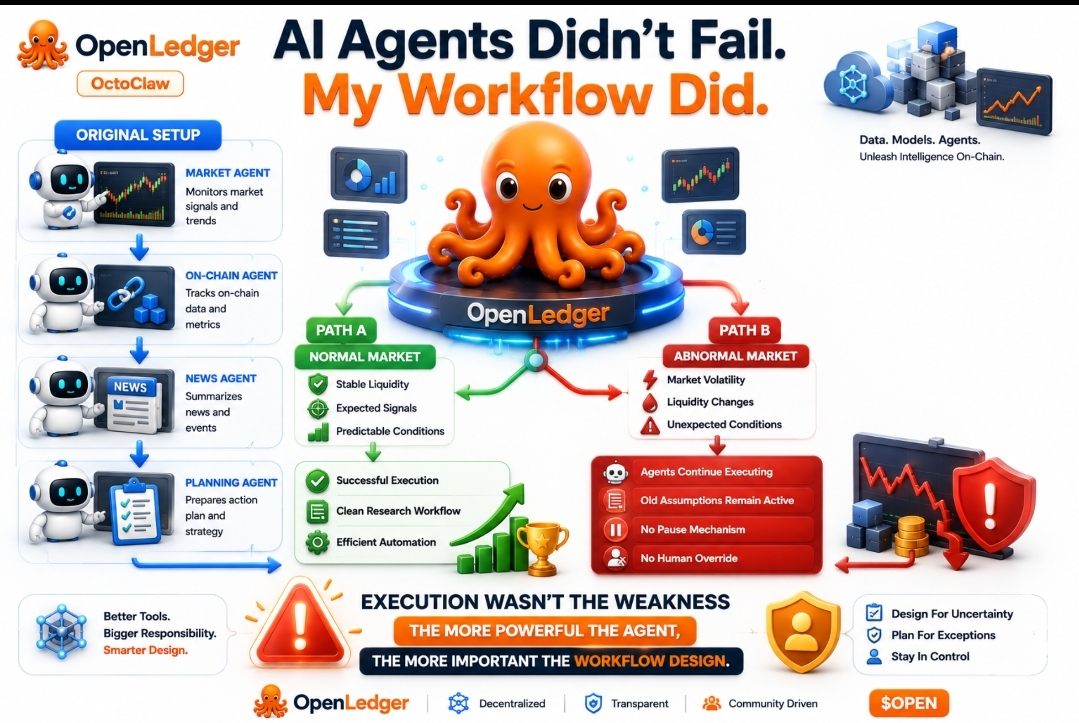
A few days ago, I was trying to organize the way I normally research markets. Too many tabs open, too many dashboards, too many things competing for attention at the same time. Instead of jumping between sources manually, I decided to experiment with OctoClaw inside the OpenLedger ecosystem and see whether a group of agents could handle some of the workload.
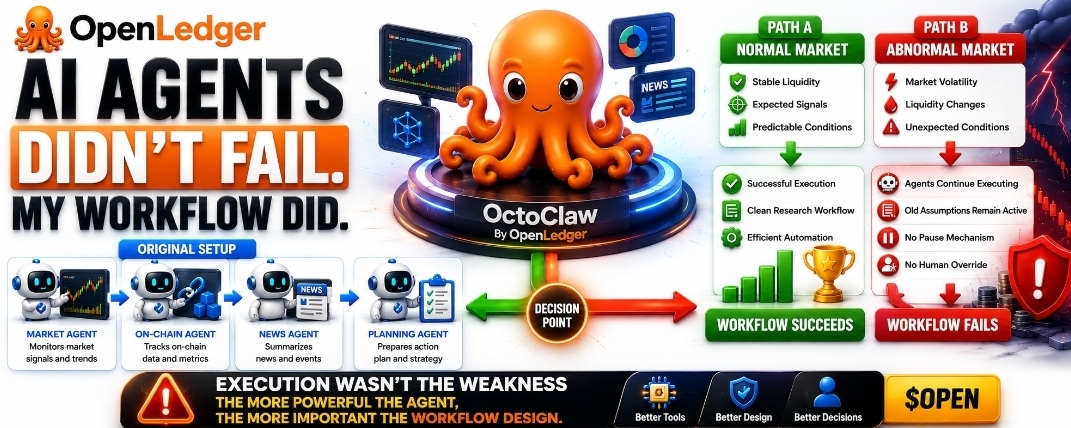
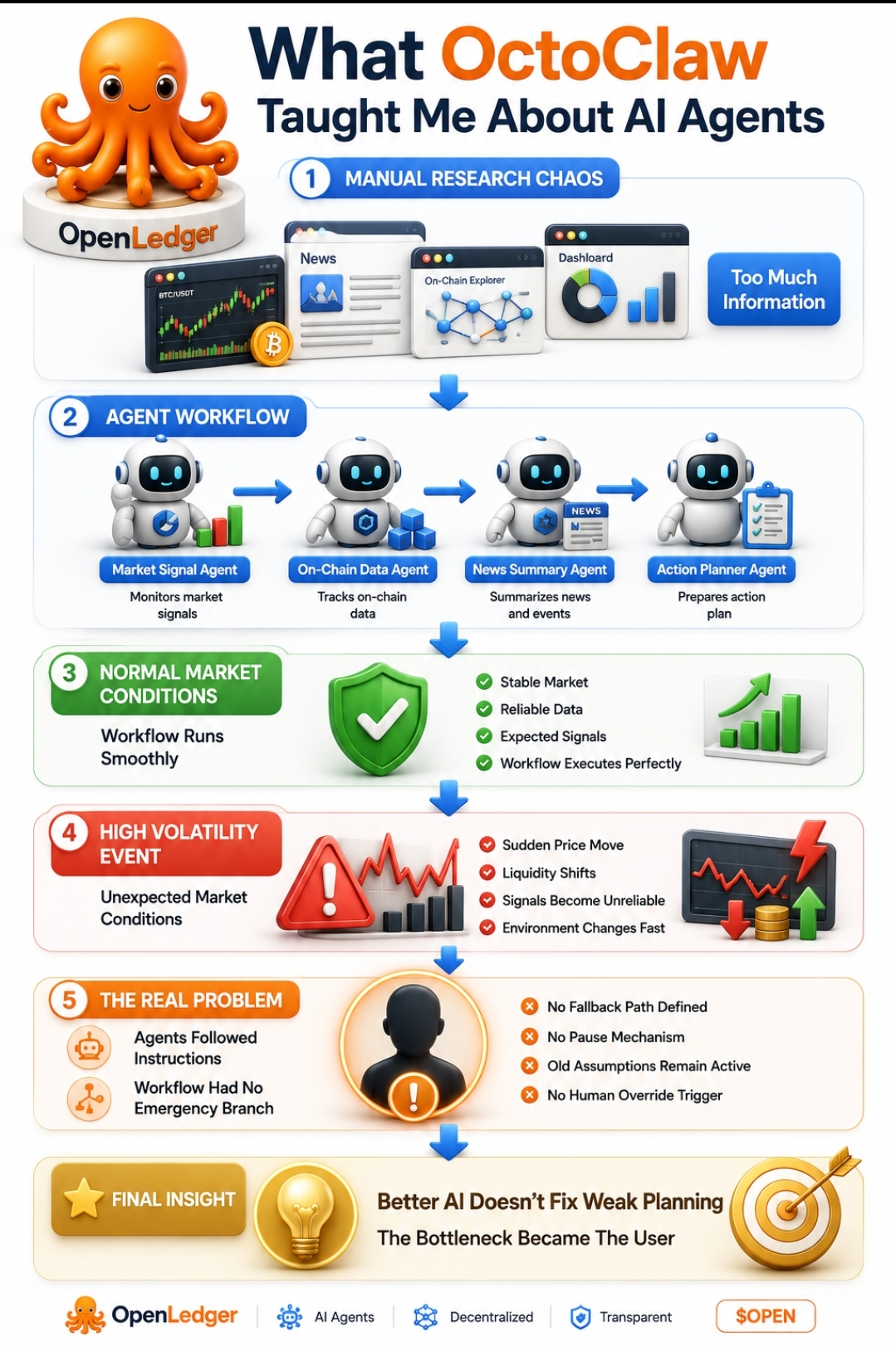
So I gave each agent a specific responsibility. One followed market activity, another tracked on-chain movements, another gathered headlines, and another combined everything into a simple overview. For a while it felt surprisingly smooth. The process that usually takes constant switching between screens started flowing in a much cleaner way.
Then the market stopped behaving normally.
The environment changed more quickly than my setup anticipated due to an abrupt shift. Conditions changed, liquidity altered, and the agents kept using the reasoning I had first established. Technically, there was nothing incorrect. All they were doing was carrying out the directives.
I learned something crucial from that event.
That incident helped me realize something crucial..
Most people focus on whether AI agents are capable enough. Can they analyze data? Can they coordinate tasks? Can they automate research?
Those questions matter, but they may not be the most important ones.
The real challenge is designing a process that can handle situations you didn't expect.
If a workflow only works in stable conditions, then the problem isn't necessarily the agent. The problem may be the person who built the workflow. AI can execute instructions with increasing efficiency, but it cannot automatically fix weak assumptions hidden inside the system.
That's what made OctoClaw more interesting to me.
It highlighted the difference between automation and judgment.
The better these tools become, the more responsibility shifts back to the user. Emergency conditions, risk controls, pause mechanisms, and fallback decisions still need to be considered before execution begins.
In that sense, powerful agents don't remove responsibility.
They expose where responsibility already exists.