

Look, I've been covering technology long enough to remember when cloud computing was supposed to change everything, when the metaverse was supposedly inevitable, when NFTs were going to reinvent ownership, and when every blockchain startup claimed it was building the future of finance.
Most of those stories didn't end the way the pitch decks promised.
That's why projects like OpenLedger immediately trigger a familiar reaction. Not because the idea is necessarily wrong. Sometimes the idea isn't the problem at all. The problem is what happens when an interesting idea gets buried beneath layers of incentives, tokens, marketing narratives, and investor expectations.
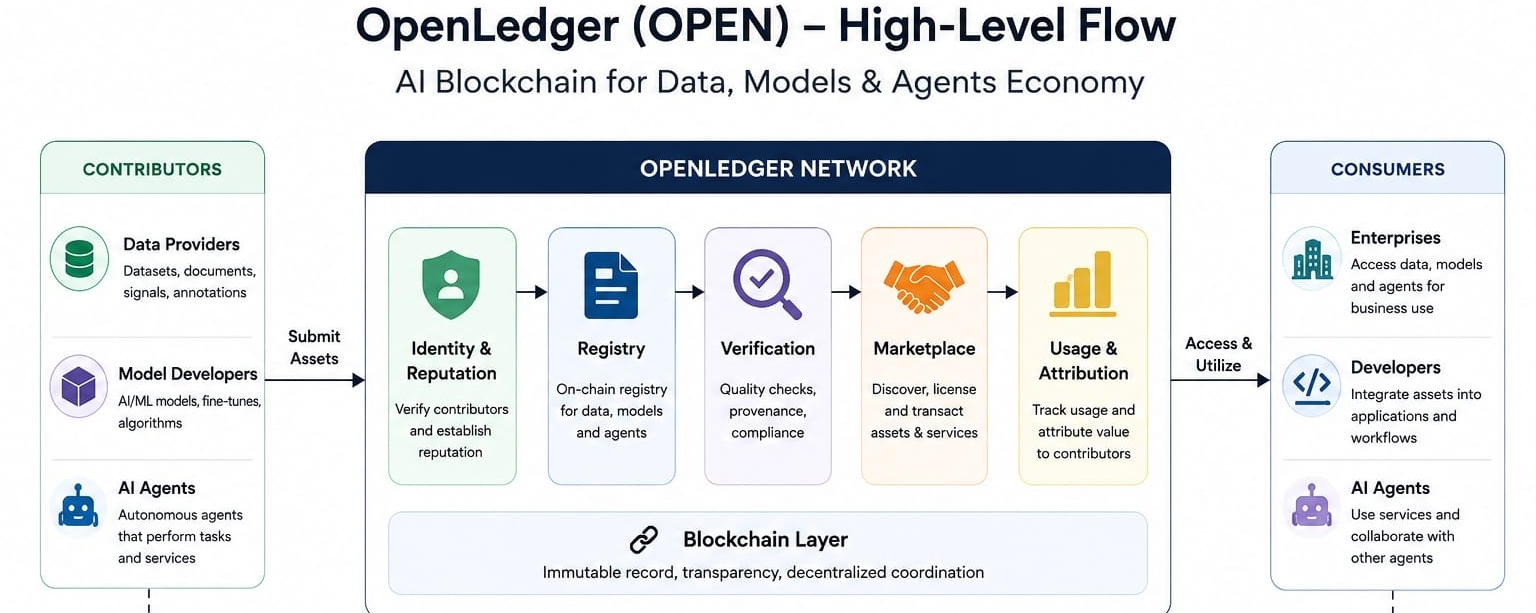
OpenLedger presents itself as infrastructure for the AI economy. The pitch sounds sophisticated. Data owners contribute datasets. Developers contribute models. AI agents perform tasks. Blockchain keeps track of everything. Everyone gets rewarded according to their contribution.
It sounds tidy.
On paper, at least.
But whenever a project promises to create a marketplace for assets that don't currently have an active marketplace, I start asking uncomfortable questions.
Because I've seen this movie before.
The core problem OpenLedger claims to solve is actually a real one. AI systems consume enormous amounts of data. Companies train models on information gathered from countless sources. Researchers contribute knowledge. Organizations provide specialized datasets. Yet when economic value gets created, the rewards tend to flow toward the platform operators and model owners rather than everyone who helped build the system.
That's not an invented problem.
It's happening right now.
A healthcare organization may own valuable medical data. A logistics company may possess years of operational information. Independent developers may create highly specialized models. Yet most of these assets remain trapped inside separate silos because there is no simple mechanism for tracking contributions and compensating participants.
OpenLedger looks at this situation and says blockchain can solve it.
This is where my skepticism begins.
Because blockchain projects have spent fifteen years claiming they can solve coordination problems that are fundamentally social, legal, economic, or organizational in nature.
Technology is often the easy part.
Humans are the hard part.
The project's underlying assumption is that data, models, and AI agents can be transformed into tradable economic assets. In theory, contributors receive rewards whenever their resources generate value within the ecosystem.
Sounds reasonable.
Until you start asking how any of this actually works in practice.
Let's say a dataset contributes to the training of an AI model. That model later generates revenue. How much of that revenue should flow back to the original data provider? Five percent? One percent? A fraction of a fraction of a percent?
Who decides?
Who verifies it?
Who audits it?
More importantly, who gets sued when somebody gets it wrong?
The marketing materials usually skip over that part.
They talk extensively about attribution. They talk less about disputes.
Real markets are filled with disputes.
Ownership disputes.
Compensation disputes.
Quality disputes.
Fraud disputes.
Legal disputes.
Blockchain doesn't eliminate these problems. It simply records them more efficiently.
That's a very different thing.
Then there's the issue nobody likes discussing during conferences.
Data quality.
OpenLedger assumes that valuable datasets will enter the network because contributors want to monetize them. But why would owners of genuinely valuable data rush to place it inside a shared ecosystem?
Think about the most valuable datasets in the world today. They belong to major technology companies, financial institutions, pharmaceutical firms, healthcare providers, and governments.
Their competitive advantage comes from exclusivity.
Not openness.
Not sharing.
Not participation.
If a company possesses data that provides a meaningful business advantage, the strongest incentive is usually to keep it private.
The network therefore risks attracting the exact opposite category of data. Information that owners are willing to part with because its value is uncertain, declining, or difficult to monetize elsewhere.
That doesn't mean all contributed data will be low quality.
It does mean the incentive structure deserves scrutiny.
Then we arrive at the AI agent narrative.
This is where things start getting especially ambitious.
OpenLedger envisions a future where autonomous software agents interact economically, purchase resources, access services, coordinate tasks, and operate inside decentralized systems.
Let's be honest.
Most AI agents today struggle to reliably book travel, manage calendars, or complete basic workflows without supervision.
The gap between today's reality and tomorrow's autonomous economic actors remains enormous.
Could agents eventually become sophisticated enough to participate in digital economies?
Possibly.
Could that happen slower than investors expect?
Absolutely.
Technology history is filled with concepts that arrived eventually but generated far less value than early believers imagined.
Timing matters.
Building infrastructure for a future that arrives twenty years later can be just as dangerous as building infrastructure for a future that never arrives at all.
And then there's the token.
There is always a token.
The token supposedly coordinates incentives, rewards participation, enables governance, and powers transactions across the ecosystem.
That's the official explanation.
The unofficial reality is that tokens often become the primary product.
I've watched this happen repeatedly.
The technology becomes secondary.
The speculation becomes central.
Communities stop discussing adoption metrics and start discussing price action.
Developers talk about infrastructure while investors stare at charts.
The economic incentives slowly drift away from actual utility.
OpenLedger is hardly unique in facing this challenge. Nearly every blockchain project faces it. The question is whether genuine network activity can grow faster than speculative activity.
History suggests that's harder than most founders expect.
Another issue sits quietly in the background.
Centralization.
Every decentralized project eventually encounters this question.
Who controls development?
Who controls governance?
Who controls treasury funds?
Who controls the roadmap?
Who controls upgrades?
The marketing language usually emphasizes distributed participation. The operational reality often looks different.
A relatively small group of developers, investors, validators, or insiders frequently hold significant influence.
That's not necessarily malicious.
It's often unavoidable.
Building complex systems requires coordination.
But it does raise an uncomfortable possibility.
Sometimes decentralization becomes less of a technical reality and more of a branding strategy.
And finally, we reach the problem that technology founders rarely enjoy discussing.
Failure.
What happens when something breaks?
Not theoretically.
Actually breaks.
What happens when contributors disagree about ownership?
What happens when rewards are distributed incorrectly?
What happens when fraudulent datasets enter the system?
What happens when regulators decide certain data should never have been traded in the first place?
What happens when participants lose money?
Traditional businesses solve these problems with contracts, compliance departments, customer support teams, lawyers, insurance policies, and regulatory oversight.
Decentralized systems often replace those mechanisms with protocols.
Protocols are useful.
Protocols are not lawyers.
Protocols are not courts.
Protocols do not answer phone calls at three in the morning.
That's the catch hidden beneath much of the marketing.
OpenLedger isn't merely trying to build an AI marketplace. It's trying to build trust infrastructure, dispute resolution infrastructure, ownership infrastructure, economic infrastructure, and governance infrastructure simultaneously.
That's an enormous amount of complexity.
Maybe the system works.
Maybe it attracts enough valuable participants to create genuine network effects.
Maybe it succeeds where dozens of similar projects struggled.
But after twenty years of covering technology, I've learned something simple.
When a startup claims it is removing friction, it is often moving that friction somewhere else.
And in OpenLedger's case, the friction doesn't disappear.
It simply shifts from centralized institutions into a web of incentives, governance mechanisms, attribution systems, token economics, and assumptions about how people will behave.
The technology may function exactly as designed.
The harder question is whether real organizations, real developers, and real businesses will trust it enough to build their future on top of it.
That's usually where the story starts.
And where many grand visions quietly end
