
I've spent enough years around crypto to develop a habit of ignoring most grand claims.
Not because I'm cynical. At least, I don't think I am.
It's just that after watching multiple market cycles, you start noticing patterns. A new narrative appears, everyone rushes to explain why it changes everything, capital pours in, expectations become impossible, and eventually reality shows up. Reality usually arrives much later than people expect, and it's rarely as exciting as the story that came before it.
That's probably why I've been thinking about AI attribution more than I expected.
Not AI itself. Everyone is talking about AI.
The part that keeps pulling my attention back is something much less glamorous.
Who actually deserves credit when AI creates value?
The more I think about it, the stranger the situation starts to feel.
For years, the internet trained us to believe that data is everywhere and therefore somehow free. AI inherited that assumption. Massive models were built on enormous collections of human knowledge, conversations, images, documents, research, and countless small contributions made by people who never imagined their work would become training material for intelligent systems.
Now those systems are generating revenue, building businesses, and becoming products in their own right.
Yet most of the people who contributed to that foundation remain invisible.
I've noticed that whenever this topic comes up, the conversation usually turns into a fight between extremes.
One side believes everything should remain open and unrestricted.
The other side wants perfect ownership and perfect compensation for every contribution.
Neither position feels realistic to me.
The internet has never worked that way.
AI probably won't either.
But that doesn't mean the current situation makes sense.
Because right now, there is a strange disconnect between value creation and value attribution.
The more powerful AI becomes, the harder that disconnect is to ignore.
This is where blockchain keeps finding its way back into the discussion.
Normally, when someone says blockchain can solve a problem, my instinct is to become immediately suspicious.
I've seen too many situations where a blockchain was added simply because nobody had a better story to tell.
But attribution feels different.
Not solved.
Not guaranteed.
Just different.
Because blockchain is fundamentally a record-keeping system.
At its core, it creates histories.
It creates trails.
It creates evidence that something happened.
And when you're talking about AI, evidence suddenly becomes valuable.
Who contributed data?
When was it added?
Which model used it?
How was value generated?
Who should receive a portion of that value?
Those questions are becoming increasingly difficult to answer inside traditional systems.
I don't think most people realize how messy attribution becomes once AI starts operating at scale.
It's easy to imagine a simple scenario where a model learns from a dataset and rewards flow back to contributors.
Reality is rarely that clean.
One dataset influences another.
A model gets retrained.
An agent uses multiple tools.
Additional context gets injected.
Outputs become combinations of thousands of tiny influences interacting with each other.
At some point, tracing contribution starts feeling less like accounting and more like archaeology.
You're trying to reconstruct a chain of influence after the fact.
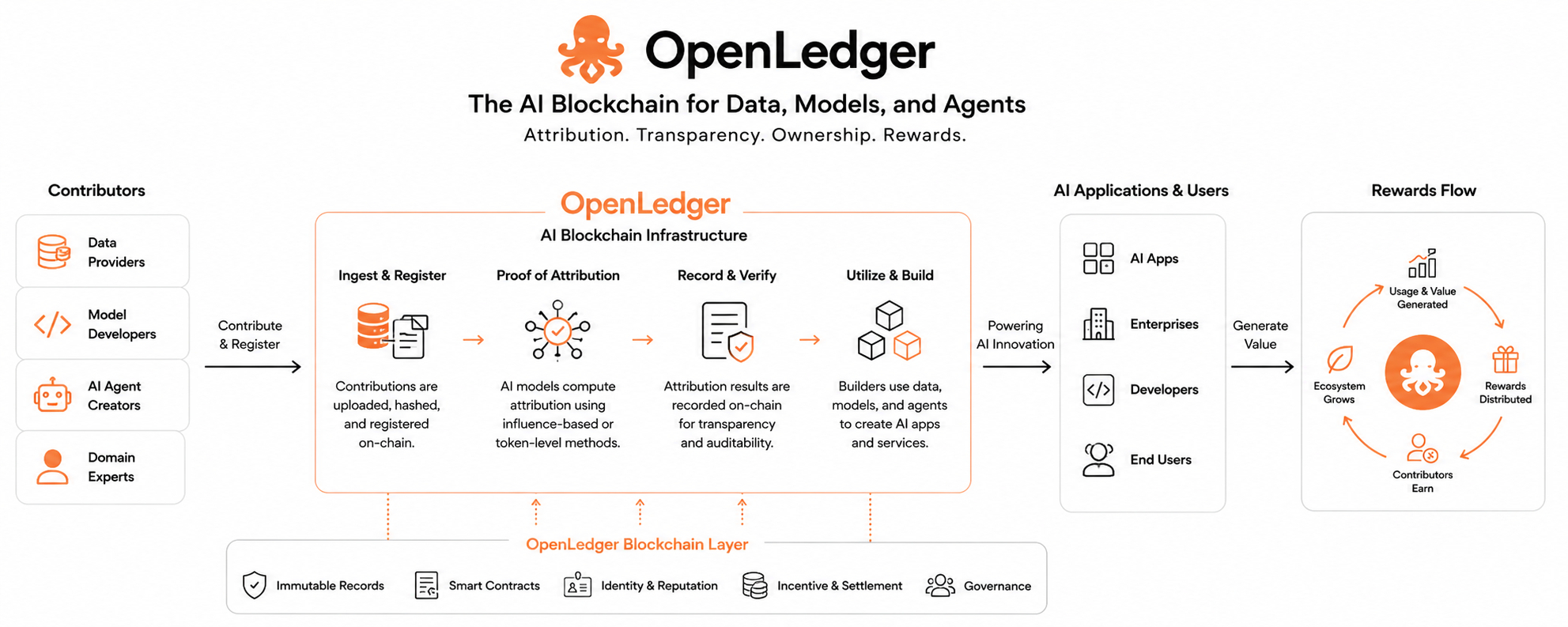
That's why I find projects like OpenLedger interesting, even if I'm still cautious.
The idea of creating systems where data, models, and agents can be tracked and monetized through attribution feels like a logical direction for the industry.
Not because it's guaranteed to work.
Because the alternative feels increasingly unsustainable.
The AI economy is growing.
The number of participants is growing.
The amount of value being created is growing.
Sooner or later, people will want transparency around where that value originates.
That seems inevitable.
What I'm less certain about is whether attribution can ever become as precise as people hope.
I've watched enough technology evolve to know that measurement itself creates problems.
The moment rewards become attached to a metric, people start optimizing for the metric.
Sometimes that improves the system.
Sometimes it quietly breaks it.
Crypto has a long history of discovering that incentives can be manipulated faster than they can be designed.
That's one reason I remain careful whenever attribution is discussed as if it's a solved engineering problem.
It's not.
It's an economic problem.
It's a social problem.
In some ways, it's even a philosophical problem.
How much credit should a single contribution receive?
What counts as influence?
Where does one contribution end and another begin?
There are no easy answers.
And honestly, I would be suspicious of anyone claiming there are.
Still, I keep noticing something.
For the first time in a while, the conversation feels connected to a real need rather than a manufactured narrative.
That alone stands out.
Most crypto trends begin with a token searching for a purpose.
This feels more like a genuine problem searching for a workable solution.
Maybe that's why I'm paying attention.
Not because I think blockchain suddenly fixes attribution.
Not because I think every AI system will become on-chain.
Not because I believe a perfect ledger of human contribution is right around the corner.
I don't.
But I do think we're moving toward a world where people will demand better answers about where AI value comes from.
And when that happens, systems that can provide some level of transparency will have an advantage over systems that provide none.
Maybe blockchain ends up being part of that answer.
Maybe it only solves a small piece of the puzzle.
Maybe it introduces entirely new problems we haven't discovered yet.
All of those outcomes seem possible.
After enough years in crypto, I've learned to be comfortable with uncertainty.
The projects that survive are rarely the ones with the loudest promises.
They're usually the ones addressing a problem that refuses to go away.
The attribution problem feels like one of those problems.
It's been sitting in the background for years, quietly growing larger while everyone focused on model performance, funding rounds, and adoption numbers.
Now it's becoming impossible to ignore.
Whether blockchain can truly solve it remains an open question.
What I know is that the question itself is finally becoming more important than the hype surrounding it.
And honestly, that's usually when the interesting work begins.
