

Let’s cut right to it — building truly decentralized AI infrastructure isn’t about tossing around fluffy computer science buzzwords or relying on wishful software theories. Nope. The whole thing lives or dies on whether you can squeeze every last drop out of your hardware, doing wild math at the lowest possible level, as fast as physically possible, without guzzling ridiculous amounts of energy and memory. Meanwhile, the old tech empires built on centralized clouds? Yeah, they’re wheezing under their own weight, while cloud giants hoard control and jack up prices.
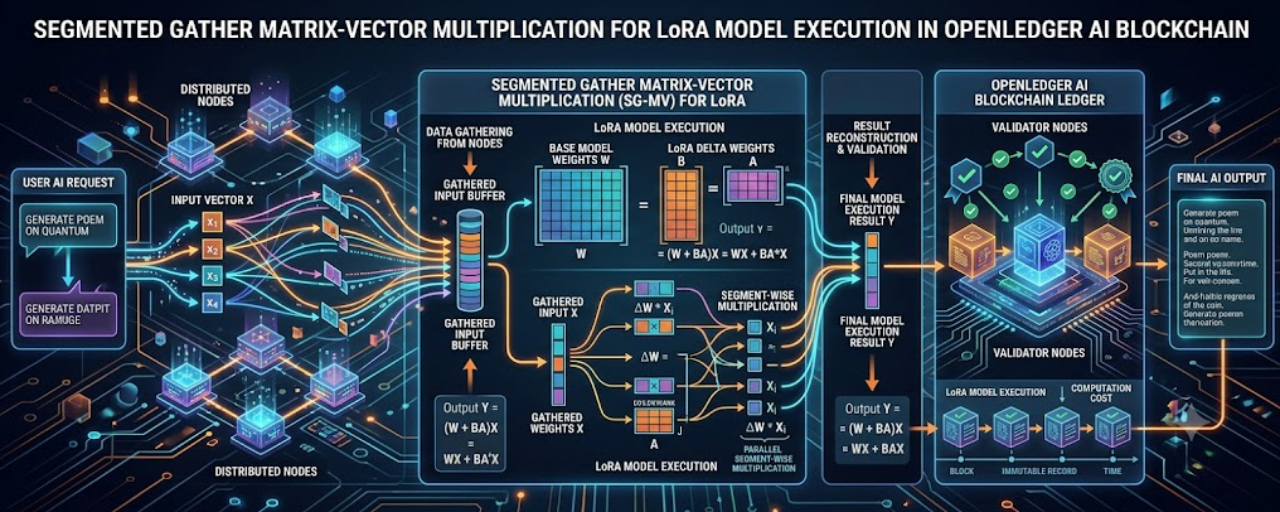
Here’s where OpenLedger AI Blockchain strolls in, not just as another “web3” project but as the backbone for a new kind of digital economy — think: blazing fast, machine-native, and totally not gatekept by the usual suspects. At the gnarly edge of all this sits some heavy-duty math magic: Segmented Gather Matrix-Vector Multiplication for LoRA Model Execution (yeah, it’s a mouthful, but stick with me). This is the not-so-secret sauce letting networks of GPUs absolutely shred through hundreds of specialized AI requests at the same time — like, hundreds of models doing their own thing, in parallel, without the whole system melting down or getting stuck twiddling its thumbs.
Let’s be real for a second: running a ton of AI models at scale used to suck. If you wanted custom AI models for medicine, law, finance, etc., you needed an army of expensive chips running night and day, mostly just twiddling their thumbs until someone actually needed them. Why? Because those massive language models are clunky giants. To serve even just a few users, all the weights and data had to squat in memory, hogging space. And when thousands of people start throwing in requests for totally different specialized models? The hardware grinds to a halt, memory gets chopped up, everything slows down, and your cloud bill explodes.
Low Rank Adaptation (LoRA) showed up to split up the problem: instead of shipping the whole giant model for every new task, you keep a universal base and just plug in little adapters for specialties. Handy, but in a decentralized world, this kicked up its own mess. See, on a network of random GPUs spread everywhere, every user is chucking in wildly different requests — medical here, legal there, finance over there. Each keeps its own weights, off in various memory nooks and crannies. So GPUs waste time hunting and poking around for what they need. It’s like tracking down socks in a laundry basket at midnight — pure chaos. This “irregular memory access” gums up the works, stalls the hardware, and eats up the performance (and the money) LoRA was supposed to save. The whole decentralized movement needed a way to actually align these messy computations on the hardware itself so GPUs weren’t tripping over their shoelaces.
OpenLedger nukes this bottleneck with Segmented Gather Matrix-Vector Multiplication — baked right into its pipeline. Here’s the fun part: instead of treating each user as an awkward individual transaction (slow, clunky, sad), the new protocol acts more like a supercomputer bouncer. It grabs all the incoming requests, sorts them by adapter type (medicine, law, cats with hats, whatever), and tells the GPU exactly where to fetch what it needs, in one nice tidy go.
So when the requests land, the system creates a segmentation map that tells the graphics hardware, “You, grab these chunks of data from here, these from over there, now line them all up.” Boom — the GPU scoops up everything in one fell swoop, no more scatter brained memory hunts. Matrix-vector multiplication happens in a single flashy move across the whole batch. The result? That same GPU box can now handle hundreds of different queries practically at once, no lag, no duplication of the big base model for each user. You can have tax law, rare disease diagnostics, and supply chain analysis all happening on the same hardware, at lightning speed.
Now, where does all this happen? Not on some private server room hiding behind a corporate firewall. The whole dance is tracked and enforced on-chain by OpenLedger’s Layer 2 blockchain. Real talk: anyone, anywhere, can hook up their spare GPU to the network, declare their specs and location, and let the OpenLedger grid put their hardware to work. The blockchain literally maps who's got what, where, and what it can do — like a giant, global “find me the nearest, fastest, best GPU for this job” map. Forget having Amazon or Google calling all the shots.
But the real genius is tying it all together with Proof of Attribution. Old-school platforms took the lion’s share and tossed scraps to hardware owners, data curators, and developers. Here, everything gets tracked at the atomic level — who ran the hardware, who built the model, who supplied the training data — so when a user pays up (say, through the Open Chat frontend), the smart contract splits the rewards instantly. The OPEN token shoots out to wallets around the globe. So if a dude in Italy runs a medical query through an adapter built by a team in Singapore with American training data? All three parties get paid instantly, no middlemen, no handshakes, no waiting for quarterly reports.
Security’s no afterthought either. Enterprises don’t want their secret sauce leaking all over creation. OpenLedger runs isolation playbooks and zero-knowledge stuff to make sure data never crosses fences — nobody’s queries slip into a rival’s results, nothing gets stored somewhere sketchy. Sensitive info stays locked down; your query touches the hardware, crunches the numbers, then poof, no trace left behind.
And it’s wild to think where this all goes. As AI agents start running their own businesses (hiring computation, buying training data, balancing their own accounts — seriously, it’s coming), they’ll need a platform that settles up instantly, at machine speed, with no gatekeepers. OpenLedger’s building that — a playground where hardware and brains (and, yeah, “owners” too) can all share in the upside, completely sidestepping corporate control. The future isn’t some closed club hoarding the gains — it's a messy, glorious internet of minds, with the spoils split wide open. More brains, more coins, more innovation, fewer bosses in boardrooms. That’s what this revolution smells like.