

Look, I've been covering technology long enough to remember when cloud computing was going to change everything. Then it was social media. Then big data. Then NFTs. Then the metaverse. Now it's AI combined with blockchain.
Every cycle arrives with the same confidence. This time is different. This time the technology finally fixes the problems that previous technologies couldn't. This time the incentives align.
I've seen this movie before.
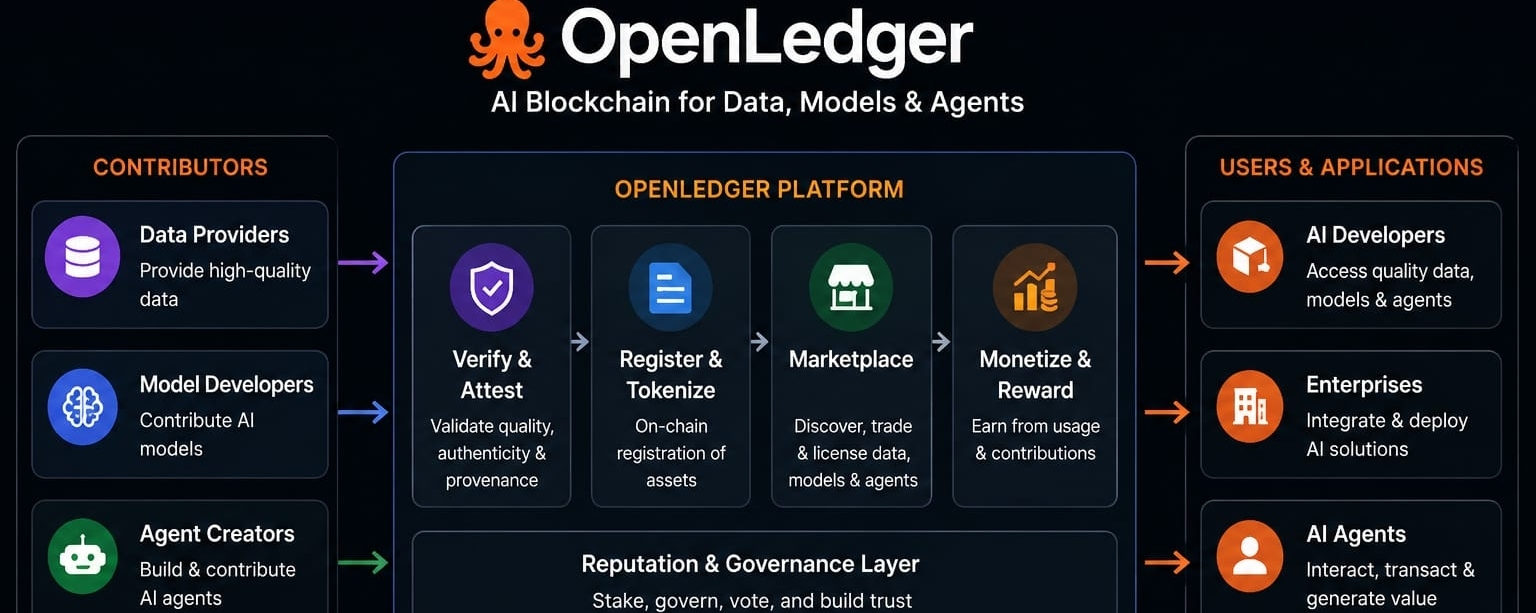
OpenLedger's pitch sounds simple enough. Artificial intelligence runs on data. The people who create or contribute that data often receive little compensation. Large technology companies capture most of the value. Therefore, build a blockchain-based system where data, AI models, and autonomous agents become tradable assets, and suddenly everyone gets a fairer slice of the pie.
It sounds tidy.
On paper, at least.
But when you start pulling at the threads, the story becomes far more complicated.
The core problem OpenLedger claims to solve is real. That's important to acknowledge. AI systems consume enormous amounts of information. Most of that information comes from somewhere. Individuals create it. Businesses generate it. Communities contribute it. Yet the economic rewards tend to flow toward the companies that own the platforms and infrastructure.
Nobody seriously disputes that.
The problem is what comes next.
OpenLedger assumes that because something has value, it can be transformed into a market. That's where things start getting messy.
Take data itself. Everyone talks about data as though it's a commodity. It isn't. Oil is a commodity. Wheat is a commodity. Gold is a commodity. Data is context-dependent. The exact same dataset can be worth millions to one company and absolutely nothing to another.
So the obvious question becomes: who decides what a dataset is worth?
The marketing material usually skips past that part.
That's because pricing data is hard. Really hard.
Imagine two healthcare datasets. One contains information that helps train a diagnostic system. The other contains incomplete records collected from outdated systems. One might be extremely valuable. The other might be nearly useless. Yet both can be packaged, tokenized, traded, and promoted inside a marketplace.
The blockchain doesn't solve that problem.
It simply records transactions.
This is where many crypto projects quietly substitute technology for economics. They build sophisticated systems for moving assets around while avoiding the harder question of whether those assets can be valued consistently in the first place.
And then there is the issue of incentives.
Let's be honest.
Whenever a project introduces a token, I immediately want to know who owns most of it.
Not because tokens are inherently bad. Because incentives matter.
The public story usually focuses on community participation and decentralized ownership. The private reality often involves early investors, venture funds, foundations, insiders, and strategic partners holding significant portions of supply long before ordinary participants arrive.
That doesn't automatically make a project illegitimate.
But it does raise questions.
If the ecosystem becomes successful, who benefits most? The thousands of future contributors supplying data? Or the relatively small group that acquired positions before the broader market appeared?
Those are not the same thing.
Then we arrive at one of blockchain's favorite words.
Decentralization.
I've spent years hearing that word applied to systems that were anything but decentralized.
Look closely enough and many supposedly decentralized networks depend on a small group of developers, validators, governance participants, infrastructure providers, or foundation members. Decision-making becomes concentrated even when ownership appears distributed.
OpenLedger faces the same challenge.
Because AI systems don't magically govern themselves.
Someone determines standards. Someone verifies data quality. Someone decides which contributions deserve rewards. Someone updates the software. Someone resolves disputes.
Human beings sit behind all of those processes.
The more valuable the network becomes, the more important those decisions become.
And power tends to concentrate around important decisions.
That's not a blockchain problem. That's a human problem.
Now let's talk about the part that almost nobody likes discussing.
What happens when things go wrong?
Because they always do.
Imagine a contributor uploads misleading data. Imagine an AI model trained on that data produces harmful outputs. Imagine ownership claims become disputed. Imagine regulators decide certain datasets violate privacy laws. Imagine intellectual property lawsuits begin appearing around AI-generated content.
Who is responsible?
The blockchain?
The token holders?
The developers?
The contributors?
The answer is usually less clear than the marketing presentation suggests.
Technology projects often assume transparency creates accountability.
It doesn't.
A perfectly transparent system can still make terrible decisions.
A public ledger can show exactly how a disaster happened while offering no practical way to prevent it.
That's particularly relevant for AI, where the consequences of bad information can spread quickly through automated systems.
And then there is the largest question of all.
Do people actually want this?
That may sound unfair, but it matters.
Many blockchain projects begin with an assumption that users desperately need decentralized alternatives. Then they spend years discovering that most users prioritize convenience, speed, reliability, and simplicity over ideological purity.
The average business does not wake up asking for tokenized data infrastructure.
The average developer does not spend sleepless nights wishing their datasets lived on a blockchain.
They want solutions that reduce costs, improve efficiency, and create measurable value.
If OpenLedger can accomplish that, it has a chance.
If it merely adds another layer of tokens, governance systems, wallets, verification mechanisms, staking requirements, and marketplace complexity, adoption becomes a much harder sell.
Because complexity is expensive.
People underestimate that.
Every additional layer introduces friction. Every new system creates another potential failure point. Every economic incentive creates opportunities for gaming the rules.
The catch, then, isn't hidden in the technology.
It's hidden in the assumption.
The assumption that data ownership problems are primarily infrastructure problems.
They may not be.
Many of them are legal problems. Economic problems. Governance problems. Human problems.
Blockchain can record ownership claims. It cannot guarantee courts recognize them.
Blockchain can track contributions. It cannot guarantee those contributions have meaningful value.
Blockchain can distribute rewards. It cannot guarantee those rewards create sustainable behavior.
I've watched enough technology cycles to know that building a market is usually much harder than building a platform. OpenLedger may succeed in creating impressive infrastructure. The bigger challenge is convincing enough people that the infrastructure solves a problem they genuinely have.
Because history is full of technically elegant systems that never found a market.
And markets have a habit of ignoring ideas that looked brilliant in a white paper