
Wasn't really planning to go deep today. Had the charts open, OPEN was doing the usual — hovering around the same range it's been stuck in for weeks, nothing dramatic. Market felt like it was waiting for something. So I closed the price tab and pulled up something I'd bookmarked a while back, just to fill the time.
Started reading through some OpenLedger, $OPEN , #OpenLedger @OpenLedger documentation. Had an angle in my head going in — the whole "next generation internet" pitch. Web3. Decentralization. User ownership. The kind of thing that sounds impressive at a conference and then evaporates when you try to point to something concrete.
But I sat with it longer than I expected to. And something came loose.
Here's the realization. Every generation of the internet has been defined not by what users got to do — but by who controlled the underlying infrastructure layer that everything else ran on.
Web1: whoever owned the servers had the leverage. Those were the ISPs, the hosting companies, the router infrastructure. The application layer on top was almost irrelevant — the infrastructure was the moat.
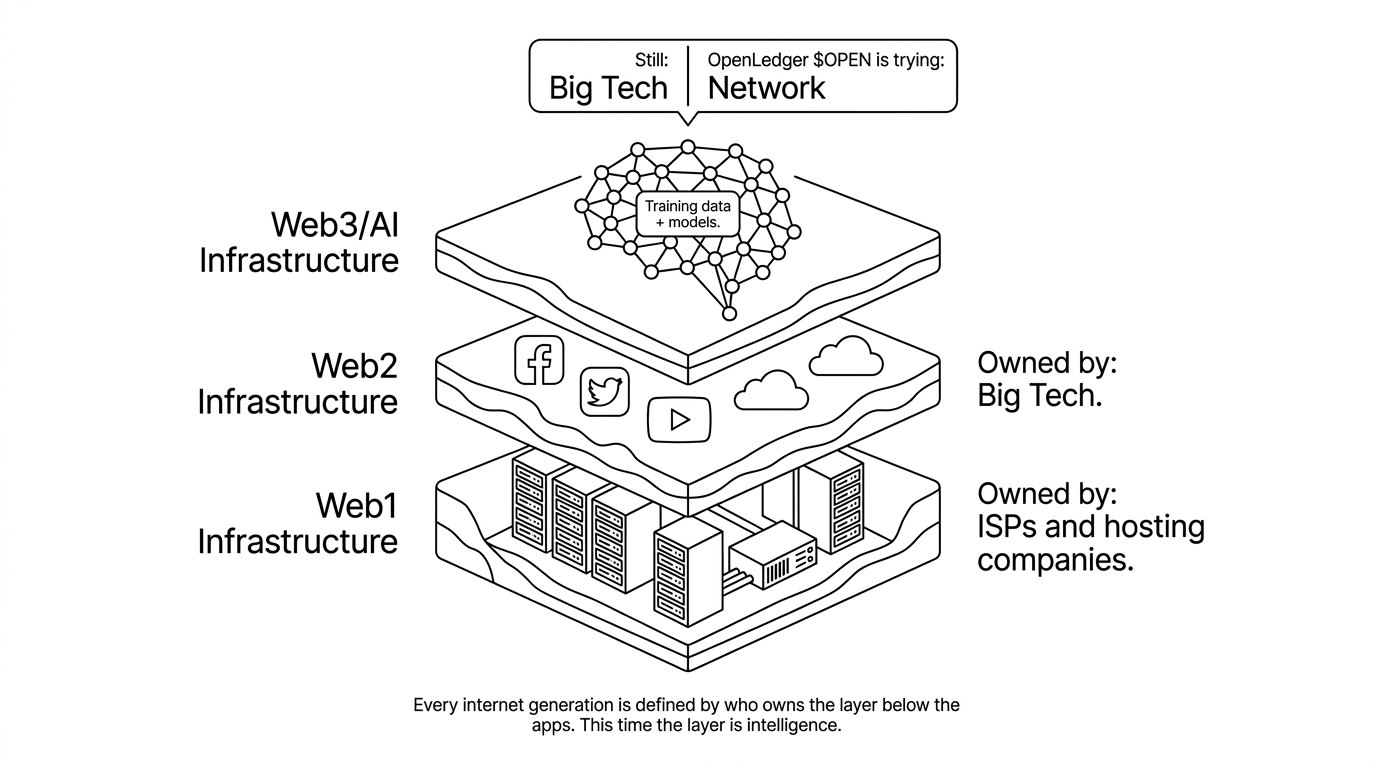
Web2: the infrastructure became the platforms. Facebook, Google, AWS. The data pipelines and distribution rails. Once they owned the pipes your content flowed through, they owned the value. And they were right — user-facing applications on top came and went, but whoever ran the infrastructure printed money.
Now look at what AI is doing to the internet. The application layer is changing constantly — new interfaces, new chatbots, new products. But underneath all of it, there is one thing that the entire AI economy depends on: training data and the models built from it. That's the new infrastructure layer.
And right now, it's entirely owned by a handful of private companies. Same structure. Different layer.
OpenLedger is trying to make that layer ownable and settleable by the network — not by a corporation. Not as a fairness gesture. As an infrastructure play. The Proof of Attribution system, the Datanets, the on-chain lineage — it's all aimed at the same thing: making intelligence infrastructure function more like a protocol than a proprietary product.
That reframe hit differently than the usual "Web3 narrative" pitch. Because Web3 often ends up being about applications — NFTs, DAO voting, token-gated communities. Interesting maybe, but not infrastructure. This is infrastructure-level positioning.
I thought "okay, this is a compelling thesis." But then I checked the actual chain data. DeFiLlama has annual protocol revenue at $693K. Fees dropped another 23% this past week. The circulating supply has expanded to over 290M tokens from 215.5M at launch — meaning a lot of tokens went out the door and relatively little revenue came back in.
And that's the quiet problem with infrastructure bets. The idea can be structurally correct and still fail. Infrastructure requires enormous network scale to generate moat value. TCP/IP is the protocol that runs the internet — but the companies that tried to own variants of TCP/IP mostly disappeared. The ones that survived were the ones that reached critical mass before competitors did.
OpenLedger has the positioning right. Whether it reaches the adoption threshold before the September 2026 investor unlocks arrive, before better-funded competitors converge on the same territory, before the window closes… that I can't tell from the current numbers.
The idea is right. The timing is the gamble.
Still watching. Nothing obvious to do right now.