
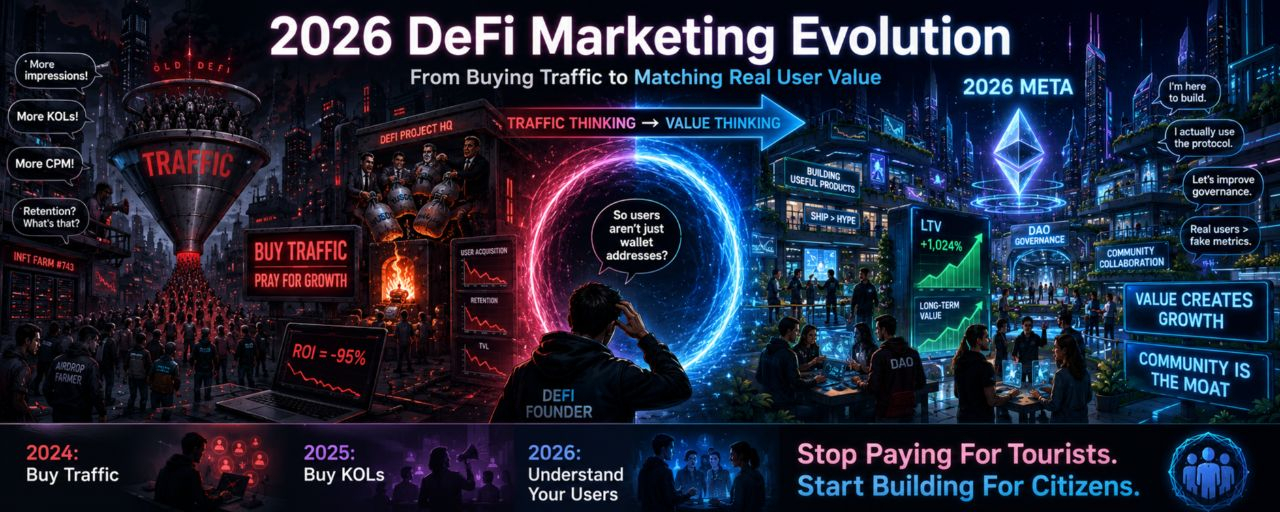
The DeFi ecosystem continues to mature in 2026, bringing systematic upgrades to user cognition, investment logic and market communication paradigms. A new KOL marketing framework has emerged, fully replacing traditional inefficient traffic-oriented promotion models. Conventional tactics including mechanical KOL recruitment, budget flooding and vanity exposure have become obsolete. The new golden rule for effective DeFi marketing centers on a user-first reverse strategy. Instead of one-way project promotion, marketing now focuses on users’ full journey — discovery, trust building, engagement and long-term retention — rebuilding DeFi growth and communication logic based on real user demands.
Traditional crypto marketing suffers from rigid formulas and severe homogenization, relying heavily on exaggerated slogans and superficial traffic, resulting in low conversion rates that fail to fit today’s data-driven, rational DeFi market. Modern marketing breakthroughs lie not in tactical stacking, but in dissecting user behavioral logic. Only by identifying user motives for discovering new projects, making decisions and staying loyal can brands build highly targeted, high-conversion and sustainable marketing system.
1. Core DeFi User Behavior in 2026: Social Discovery, Data-Driven Decisions
DeFi users have become highly professional in 2026, moving beyond blind speculation and forming standardized investment habits defined by social-led discovery and on-chain data-led decision-making.
X remains the primary discovery channel for DeFi projects. Users encounter new protocols through KOL content, yet social exposure only delivers initial awareness rather than immediate investment. After seeing recommendations, users conduct rigorous due diligence: verifying official reputation, checking key on-chain metrics including TVL, trading volume and incentive mechanisms via DefiLlama and DeBank, studying official documentation to understand product logic, and finally making small test transactions for initial engagement.
This behavioral pattern solidifies X’s core marketing status as a hub for narrative incubation, risk exposure and industry debate. Modern DeFi marketing prioritizes targeted, credible niche exposure to reach core professional users over viral superficial traffic.
High-quality marketing balances public exposure and fundamental strength. KOLs serve merely as traffic entry points; sustainable user retention relies on solid on-chain data, complete audit reports and mature product mechanisms. Projects relying solely on KOL endorsements with weak fundamentals only attract short-term speculative traffic and fail to retain long-term core users.
2. 2026 DeFi User Preferences: Verifiable Mechanisms Beat Empty Hype
After prolonged industry consolidation, 2026 DeFi users are highly rational and professional, rejecting empty narratives and conceptual speculation. Capital exclusively favors verifiable, traceable and practical projects and tracks, focusing on five mainstream verticals.
2.1 Mainstream Narratives: Perpetuals, RWA and Crypto-AI Integration
Perpetual contracts, Real World Asset (RWA) tokenization and crypto-AI integration have become the most capital-absorbing DeFi tracks. The implementation of permissionless perpetual listing has spawned over 100 RWA trading markets covering stocks, commodities, forex and pre-IPO assets, with total trading volume exceeding $130 billion. As of Q1 2026, RWA transactions account for over 90% of open interest in perpetual ecosystems, dominating the market.
The emerging “perpification” model streamlines traditional asset onboarding. Without full tokenization infrastructure, perpetual trading systems can be built using only price oracles and liquidity pools, accelerating traditional financial asset integration on-chain. This mechanism enables pre-IPO and commodity price discovery in advance, bridging the gap between traditional finance and DeFi.
Crypto-AI fusion stands as another defining trend. Users ignore empty hype and prioritize practical implementations such as agentic payments and AI computing power incentives. Leading projects build moats through mature technology, stable subnet operations and sustainable protocol revenue, attracting incremental capital with proven business performance and driving standardized industry development.
2.2 Airdrop Upgrade: Rewarding Genuine Ecosystem Contributions Over Sybil Activity
Airdrops remain vital for ecosystem activation, yet the era of effortless token farming has ended. 2026 airdrop mechanisms focus entirely on authentic ecosystem contributions, with Sybil detection and fake interaction filtering becoming industry standards. Rewards no longer support simple lock-up or mechanical trading, but prioritize liquidity provision, content creation and community development, rendering short-term speculative farming ineffective.
2.3 Real Yield Fully Replaces Inflation-Based Returns
Market perception of returns has fundamentally upgraded. Users clearly distinguish between inflation-driven fake yields and organic business-generated profits. Capital is continuously flowing toward Real Yield tracks, where revenue derived from trading fees, lending spreads, funding rates and RWA collateral delivers stable, low-volatility and traceable returns, becoming the mainstream market allocation choice.
The Real Yield ecosystem has matured significantly. Leading protocols generate diversified revenue streams, pushing the industry away from inflation-dependent yield mining toward real-value generation and compliant profit distribution. The recognition of Real Yield protocols by traditional financial institutions marks the formal standardization and institutionalization of DeFi revenue models.
2.4 Value-Capturing Tokenomics: Deep Alignment Between Business and Token Value
Tokenomics has become the core benchmark for user project selection. The market favors value-capturing models where token value is tightly tied to operational performance. Top-tier projects adopt buyback-and-burn, revenue sharing and controlled deflation mechanisms to establish positive correlation between business growth and token value, eliminating reliance on narrative-driven speculation.
Leading protocols have standardized deflation models powered by trading fee buybacks, computing power staking and halving mechanisms to reduce circulating supply and consolidate asset value. These token systems enable platform activity and revenue growth to directly boost token valuation without dilution, forming a self-sustaining value loop that defines 2026’s mainstream token design paradigm.
2.5 Emerging Trading Scenarios: Sustainable Volume From New Speculative Verticals
The 2026 DeFi market continues to expand, with user attention shifting from conventional lending and trading to prediction markets, digital collectibles and on-chain gamified finance. Though speculative in nature, these verticals generate verifiable, sustainable on-chain trading volume and protocol revenue, serving as critical new industry growth drivers.
Digital collectibles have achieved large-scale commercialization, with on-chain trading platforms ranking among the highest-revenue DApps. The GambleFi sector is booming with year-on-year revenue doubling. Its non-KYC, global accessibility and provably fair mechanisms continuously attract global incremental users, emerging as a vital DeFi sub-sector.
3. Sustainable User Retention: Value Fundamentals Outperform Short-Term Gimmicks
Projects capable of surviving market cycles and retaining core users never rely on high temporary APYs, inflated metrics or episodic marketing campaigns. Long-term user retention depends on practical product utility, sustainable profitability, continuous iteration capabilities and win-win token economics that align community interests.
First, normalized real-world financial scenarios reduce speculative dependence. Elite projects integrate on-chain assets with daily fund management and consumption scenarios, embedding DeFi into routine financial behavior and stabilizing ecosystems against market volatility.
Second, closed-loop token value systems create sustainable growth. Mature protocols leverage real protocol revenue to form a virtuous cycle: business expansion, revenue growth, token deflation and holder value appreciation, attracting continuous user and capital inflows via intrinsic value.
Third, incentive systems are becoming de-risked and refined. The industry is phasing out crude transaction-based airdrops, focusing on authentic ecosystem contributions while strictly filtering fake interactions and speculative accounts to cultivate high-quality, long-term user bases.
4. Four Core Pillars for 2026 DeFi Long-Term Operation
Based on 2026 DeFi ecosystem evolution and user behavioral trends, sustainable growth and user retention rely on four synergistic core pillars:
Polished lightweight products: simplified operations and enhanced stability to support frequent daily usage and solidify retention foundations;
Professional and responsive user support: timely resolution of on-chain interaction, asset allocation and mechanism consultation issues to optimize user experience;
Win-win token economics: avoiding short-term inflation and dumping to align long-term benefits between projects and users;
Value-driven community governance: moving beyond superficial group management to build high-consensus, high-loyalty communities based on tangible product deliverables.
5. Tiered KOL Strategy & Common Marketing Pitfalls
5.1 Four Tiered KOL Categories for Targeted Matching
DeFi KOLs are not universal traffic tools. Different creator categories correspond to distinct user lifecycle stages. The industry divides KOLs into educators, content analysts, practical traders and vertical experts, covering user awareness building, in-depth research, practical participation and niche exploration. Marketing strategies require precise tiered matching instead of one-size-fits-all deployment.
5.2 High-Converting vs. Low-Quality Content
High-performing DeFi content shares consistent traits: verifiable data, logical clarity and practical operability, including on-chain data breakdowns, strategy tutorials, neutral protocol reviews, risk analysis and in-depth sector research.
In contrast, low-quality content is homogenized, unsubstantiated and hype-driven, decoupled from real product value and unable to convince sophisticated core users.
5.3 Prevalent Industry Marketing Mistakes
Six critical marketing errors prevail across the industry: partnering with creators misaligned with product logic, releasing generic hollow content, mismatched KOL audiences, over-reliance on top-tier influencers leading to concentration risk, chasing vanity exposure, prioritizing short-term promotion over long-term ecosystem building, and premature marketing before product maturity. These pitfalls cause low conversion and hinder loyal user accumulation.
6. Conclusion: The Ultimate Rule of 2026 DeFi Marketing
From a macro evolutionary perspective, 2026 DeFi marketing essentially replicates standardized user behavioral logic. KOL content builds initial awareness, verifiable product mechanisms drive user engagement, and premium user experience plus closed-loop tokenomics enable long-term retention.
Sustainable DeFi growth has abandoned crude traffic-hunting and formed a complete value loop: KOL-driven awareness, data-backed trust, community-fueled word-of-mouth diffusion, and value-based user retention. As narrative dividends fade in the maturing 2026 DeFi market, only implementable mechanisms, traceable data and sustainable ecosystem value enable projects to survive market cycles and achieve continuous growth.