
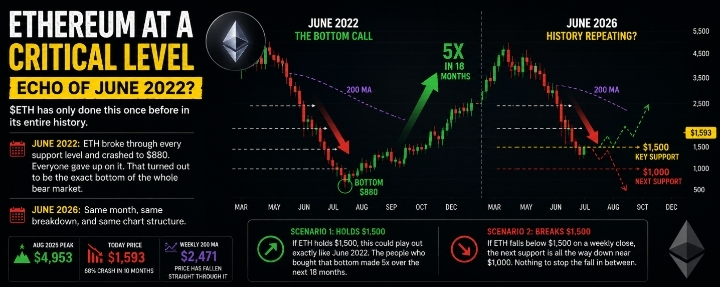
Ethereum is once again sitting at a critical point where traders are split between calling a major macro bottom or preparing for a deeper correction. The current price action has drawn comparisons to past bear market behavior, especially the infamous June 2022 capitulation phase.
Back then, $ETH broke through multiple support zones, lost key moving averages, and eventually bottomed near $880. That level later became one of the strongest long-term accumulation zones in Ethereum’s history.
Now in 2026, a similar emotional and structural debate is forming again as ETH trades near $1,593 after falling from a high of $4,953 in August 2025. This represents a sharp 68% drawdown in under a year, adding pressure on investor sentiment.
The weekly 200 moving average is currently around $2,471, and price has already broken below it, which historically signals strong bearish momentum and macro trend weakness. The next major area of interest is around $1,500, which is now acting as a key psychological and structural support zone.
From a market perspective, two scenarios are being discussed. If ETH holds above $1,500 and stabilizes, this could resemble the June 2022 accumulation phase where fear peaked and long-term buyers stepped in before a major multi-month recovery. In that case, Ethereum could potentially build a long base before a strong upside cycle similar to previous recovery phases.
However, if ETH loses $1,500 on a weekly closing basis, it would signal continuation of bearish momentum. In that case, the next major historical support zone sits near $1,000, where liquidity and previous cycle demand could come into play.
Overall, ETH is at a decisive level where market structure, psychology, and macro sentiment are all intersecting. Whether this becomes a generational accumulation zone or a deeper correction phase will depend entirely on how price behaves around this key support region in the coming weeks.
#StrategyBuys1550BTC #KOSPIDropsOver8PctTradingHalt #BitcoinBreaksAbove$63K #YugaLabsRescues62NFTsFromFlooringProtocol