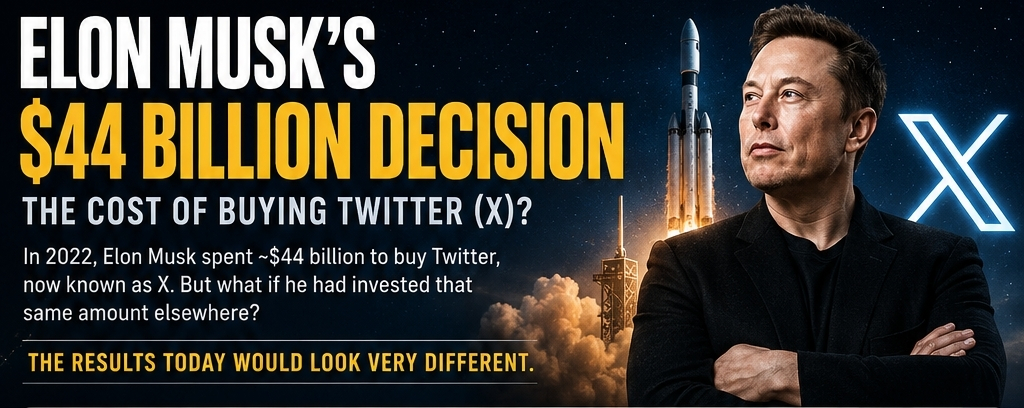
One of the most debated business decisions in modern history was Elon Musk’s acquisition of Twitter, now known as X. In 2022, Musk spent approximately $44 billion to take ownership of the social media platform. However, from an investment perspective, one question continues to dominate discussions:
What if that same $44 billion had been invested elsewhere?
The answer is not only fascinating but also offers valuable lessons for investors about capital allocation, opportunity cost, and long-term wealth creation.
Understanding Opportunity Cost
In investing, opportunity cost refers to the potential gains an investor gives up by choosing one investment over another.
If Elon Musk had invested the same $44 billion into different assets instead of acquiring Twitter, estimates suggest those investments could be worth approximately:
Gold ($XAU ): $114.4 Billion
Silver ($XAG ): $158.2 Billion
Turkish Lira$: $17.7 Billion
$SPCXB Investment: $675–728 Billion
These numbers highlight the dramatic impact that asset selection can have on long-term returns.
Gold: The Power of a Safe-Haven Asset
Gold has been one of the strongest-performing stores of value in recent years, supported by geopolitical uncertainty, central bank accumulation, and persistent inflation concerns.
Had Musk allocated the $44 billion to gold, the investment could now be worth roughly $114.4 billion.
For investors, gold continues to offer several advantages:
✔ Long-term preservation of purchasing power
✔ Protection against inflation
✔ Stability during economic uncertainty
✔ Global recognition as a reserve asset
Gold remains a core component of many institutional and sovereign portfolios, proving that capital preservation can be just as important as aggressive growth.
Silver: The Industrial Metal with Explosive Potential
While silver is often viewed as gold’s smaller counterpart, its role in modern industry makes it a unique investment opportunity.
Demand for silver continues to rise due to its critical applications in:
Solar energy systems
Electric vehicles
Semiconductor manufacturing
AI infrastructure
Advanced electronics
If Musk had invested in silver instead, that same $44 billion could now be worth approximately $158.2 billion.
The performance highlights silver’s growing importance as both a precious metal and a strategic industrial resource in the global economy.
Turkish Lira: A Harsh Reminder of Currency Risk
Not every investment story ends with extraordinary gains.
If the $44 billion had been held in the Turkish Lira, its value would have fallen to approximately $17.7 billion, representing a loss of more than 60%.
This serves as an important lesson for investors:
Currency depreciation can destroy wealth.
Inflation can significantly reduce purchasing power.
Low-priced assets are not necessarily good investments.
Macroeconomic stability matters when allocating capital.
The Turkish Lira example demonstrates how critical it is to evaluate economic fundamentals before making long-term investment decisions.
SpaceX: The $700 Billion “What If”
The most remarkable comparison comes from SpaceX.
Based on current private-market valuations, if Musk had simply invested the same $44 billion into SpaceX instead of acquiring Twitter, that investment could potentially be worth between $675 billion and $728 billion today.
This represents one of the most extraordinary hypothetical returns among major private companies.
SpaceX continues to dominate several high-growth sectors:
✔ Commercial space transportation
✔ Satellite communications
✔ Global broadband through Starlink
✔ Reusable rocket technology
✔ Future space infrastructure
Many analysts believe SpaceX could eventually become one of the world’s first multi-trillion-dollar private enterprises if its growth trajectory continues.
Why Investors Are Watching the Space Economy
The SpaceX story also highlights a broader investment theme: the rapidly expanding space economy.
Investors are increasingly exploring opportunities tied to:
Satellite networks
Aerospace innovation
Defense technology
AI-powered communications
Global connectivity infrastructure
Assets and companies connected to this sector, including those tracked through themes such as $SPCXB, continue attracting attention from growth-focused investors seeking exposure to next-generation technologies.
As governments and private companies invest heavily in space infrastructure, many believe the sector could become one of the defining investment trends of the coming decades.
Could X (Twitter) Still Justify the Decision?
From a purely financial standpoint, the opportunity cost appears enormous.
Gold and silver generated substantial returns.
SpaceX potentially offered hundreds of billions of dollars in additional value creation.
However, investing is not always about maximizing short-term returns.
Musk’s vision for X extends far beyond social media. His goal is to transform the platform into an “Everything App” that integrates:
Digital payments
E-commerce
Financial services
Artificial intelligence
Global communication networks
If that vision succeeds, the long-term value of X could eventually reshape how investors evaluate the acquisition.
For now, however, the comparison remains one of the most fascinating examples of opportunity cost in modern business history.
Final Thoughts
Elon Musk’s $44 billion Twitter acquisition has become a masterclass in capital allocation and opportunity cost.
The numbers suggest that gold, silver, and especially SpaceX would have generated significantly greater financial returns over the same period. Yet history often rewards bold visionaries who are willing to pursue opportunities others cannot see.
Whether X ultimately becomes a transformational platform or remains an expensive detour is still an open question.
What is certain is that this case highlights a timeless investing lesson:
The asset you choose today can determine whether billions become hundreds of billions tomorrow.
For investors, the takeaway is simple: identify long-term trends, focus on high-conviction opportunities, and never underestimate the power of strategic capital allocation.