

As Europe's July 1 licensing deadline nears, BitGo is offering crypto firms a way to rent MiCA compliance, revealing that the real product in crypto infrastructure is regulation itself.
Key Takeaways
BitGo is offering European crypto firms a route to MiCA compliance ahead of the July 1 deadline.
Its Crypto-as-a-Service model lets firms "rent" regulated infrastructure instead of building it.
Clients onboard into segregated, MiCA-compliant storage while keeping their own customer relationships.
With the deadline for European crypto firms to obtain licenses days away, BitGo is positioning its Crypto-as-a-Service platform as a compliance lifeline for companies that have not secured their own authorization. The pitch is straightforward, but the more interesting point is what it reveals about where the crypto industry is heading: the thing being sold here is not really technology at all.
What BitGo Is Actually Offering
The mechanics are simple enough. BitGo Europe, authorized by Germany's financial regulator BaFin under MiCA, lets other crypto firms plug their operations into BitGo's already-regulated stack rather than build a compliant operation from scratch. According to CoinDesk, a firm running wallets without a MiCA license can integrate into BitGo's infrastructure, complete the required know-your-customer work, and continue operating.
CEO Mike Belshe described the structure in plain terms: a client's users are onboarded into segregated sub-accounts inside BitGo's compliant custody, while the client retains the entire customer-facing relationship. "Now, they are your clients: you help them with support, you help them with all of the products," Belshe said, with BitGo handling none of that side. The customer never sees BitGo; their bank or app appears to offer crypto, while the regulated machinery underneath belongs to someone else.
The Real Product Is Regulation, Not Software
Here is the insight that most coverage of these arrangements misses. It is tempting to look at Crypto-as-a-Service and see wallets, APIs, custody, and trading rails, the technology. But the technology was never the hard part. For a bank or fintech entering crypto in Europe, building the software is the easy half of the problem. The expensive, slow, genuinely difficult half is regulatory: obtaining licenses, maintaining compliance programs, monitoring transactions, satisfying custody rules, and doing all of it across multiple jurisdictions.
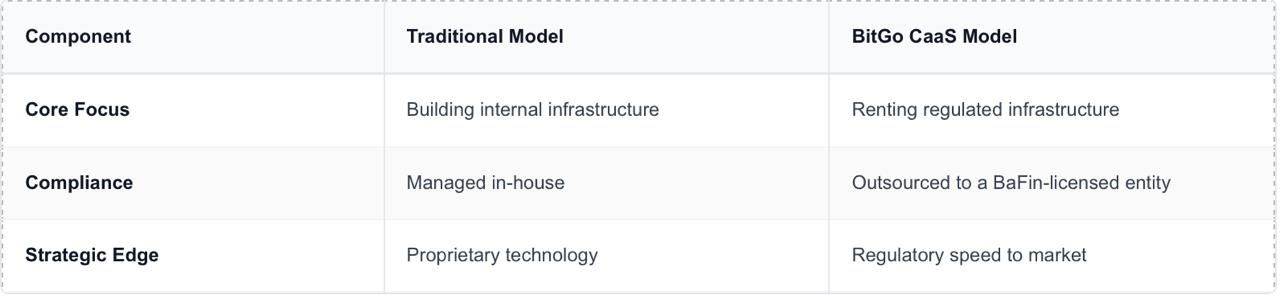
What BitGo is really selling, then, is a way to rent that regulated infrastructure instead of constructing it. The closest analogy is cloud computing. Years ago, companies stopped building their own data centers and started renting capacity from cloud providers, turning infrastructure into a utility. Crypto-as-a-Service applies the same logic to compliance: instead of building custody, licensing structures, and compliance frameworks in-house, a firm plugs into an existing one and redirects its attention to customers and products. The crypto stack becomes a utility rather than a core business function.
Why MiCA Is the Catalyst
This is where timing matters more than technology. The value of a service like this is not constant; it rises and falls with how hard compliance is. When regulatory requirements are light, firms can reasonably build their own solutions, and renting offers little advantage. When compliance becomes difficult and expensive, the calculus flips, and outsourcing becomes compelling.
MiCA is precisely the kind of event that flips it. With the July 1, 2026 deadline closing the transitional window across the EU and EEA, any firm still serving European clients without authorization faces operating in breach of EU law. That hard cutoff converts compliance from a long-term project into an immediate problem, and it hands an enormous structural advantage to whoever has already done the work. A provider that has spent millions obtaining licenses and building compliance systems can now spread those fixed costs across hundreds of clients, the economies of scale that make the rental model powerful. Roughly 200 entities across 22 EU and EEA jurisdictions have already secured licensed positions; the firms that have not are exactly BitGo's addressable market.
BitGo CEO Mike Belshe, speaking in a separate interview, framed why MiCA carries weight beyond a simple compliance deadline. In his view it is the first time a major region has put digital assets into a single operating framework spanning banks, custodians, and the users who ultimately hold the assets, which makes Europe, as he put it, "a live test case for how institutional crypto can actually function at scale." That framing matters for reading the CaaS opportunity: if MiCA is the first real proving ground for institutional crypto, then the infrastructure firms positioned underneath it are not just selling compliance shortcuts but staking out ground in the template other regions, including the US, are likely to study and follow.
https://www.youtube.com/watch?v=aLI23B28ahk
The Advantage Is Time, and the Cost Is Control
The competitive edge here is easy to misidentify as cost savings. It is really speed. A firm might spend years building a compliant framework or a few months integrating with a provider, and in financial services, launching a year earlier often matters more than saving money. With a regulatory deadline bearing down, that time compression is the entire value proposition.
But the trade-off deserves equal billing, because it is the part the sales pitch tends to underplay. A firm that rents its regulated stack gains speed and loses a measure of independence. Part of its infrastructure now sits outside its own walls; a regulatory or operational change at the provider level can ripple across every client on the platform simultaneously; and its operational dependencies deepen.
The firm owns the customer relationship but no longer fully owns the machinery underneath it. For a company whose entire identity is its app and its users, that may be an acceptable bargain. For one that views infrastructure as a strategic asset, it is a real concession.
That said, the dependency runs to a BaFin-licensed, MiCA-authorized entity rather than an unregulated one, which is the entire point: the provider has already cleared the regulatory bar its clients are scrambling to meet, so the concentration risk is paired with a genuine compliance guarantee.
What This Signals About Crypto's Maturation
Step back from BitGo specifically and the development says something larger about the industry. Early crypto firms built everything themselves because no infrastructure existed to rent; vertical integration was not a choice but a necessity. What is happening now is specialization: some firms concentrate on regulation, others on custody, others on trading, others on user acquisition, and they assemble each other's regulated building blocks rather than each constructing the whole stack.
That is exactly how traditional financial services already work, where most institutions do not build every piece of their own infrastructure but instead combine vendors and focus on distribution and revenue. Crypto-as-a-Service is a marker that crypto is converging on that model. The deeper story is less about crypto than about the industrialization of crypto infrastructure, and it points to a particular kind of winner. The firms that come out ahead may not be the ones with the best wallets or the slickest APIs, but the ones that can turn regulation and compliance, the hardest and least glamorous part of the business, into a scalable service that everyone else pays to use.