

Bitcoin trades near $65,000 as the Federal Reserve prepares to announce its June rate decision - the first under new chair Kevin Warsh, whose communication style and dot plot revisions may matter more than the rate itself.
Key Takeaways
The Fed is near-certain to hold rates at 3.50–3.75%, but Warsh's press conference tone matters more than the decision itself
On-chain data from Glassnode shows BTC remains in bear-market territory, with the True Market Mean sitting 15% above spot at $77.2K
FOMC meetings create short-term 7-day volatility for Bitcoin, but 30-day data shows consistent recovery
Geopolitical noise — the Iran-US deal uncertainty and ongoing Israeli strikes — continues to weigh on broader risk sentiment
Kevin Warsh chairs his first Federal Open Market Committee meeting today, and for Bitcoin traders the question is not what the Fed will decide - 99,6% probability of a hold, according to CME's FedWatch tool - but whether the instinct for post-FOMC selling will finally exhaust itself when the chair is new, the dot plot is being revised, and the geopolitical backdrop is messy enough to suppress risk appetite regardless of what the statement says.
The FOMC has held the federal funds rate at 3.5% to 3.75% through every meeting since December 2025, when it made its last cut. Warsh was sworn in on May 22, 2026 after a 54-45 Senate confirmation — the closest in the modern era — and today is his first chance to signal how the central bank will communicate under new management.
The Only Real Variable Is the Press Conference
The chair holds one vote, same as every other FOMC member. What Warsh controls is tone, framing, and communication cadence. He has advocated for a less-is-more approach to forward guidance and has not committed to holding a press conference after every meeting — a departure from Powell's post-2019 standard that made every FOMC a live event. With May CPI coming in at 4.2% year-over-year, analysts broadly expect the dot plot to drop its last projected 2026 rate cut, effectively signaling rates on hold through year-end. A survey of 34 former Fed officials conducted June 5-12 found half of them think Warsh may need to raise rates before the year is out.
If Warsh moves toward less frequent press conferences, the sell-the-news dynamic in crypto doesn't disappear — it concentrates. Fewer events where he speaks means each one carries more volatility weight, and traders who have built positioning strategies around the current eight-meetings-per-year cadence will need to recalibrate.
The 7-Day Trap: Why the First Week After the Fed Is Noise
Bitcoin has dropped after 8 of the last 9 FOMC meetings, averaging an 11% decline over the following week - before reversing sharply in the 30 days that follow. The policy outcome was irrelevant each time — rate cuts in September and December 2025 produced selloffs just as reliably as the holds in January, March, and April 2026.
The mechanism is positional, not emotional. Traders build pre-event positions as uncertainty draws in leverage and inflates options premiums. Once the event clears, that positioning unwinds — the uncertainty premium evaporates and the crowded side of the trade sells regardless of the headline.
The one exception was May 2025, when BTC had already corrected 24% from its all-time high before the meeting started and there was nothing left to sell.
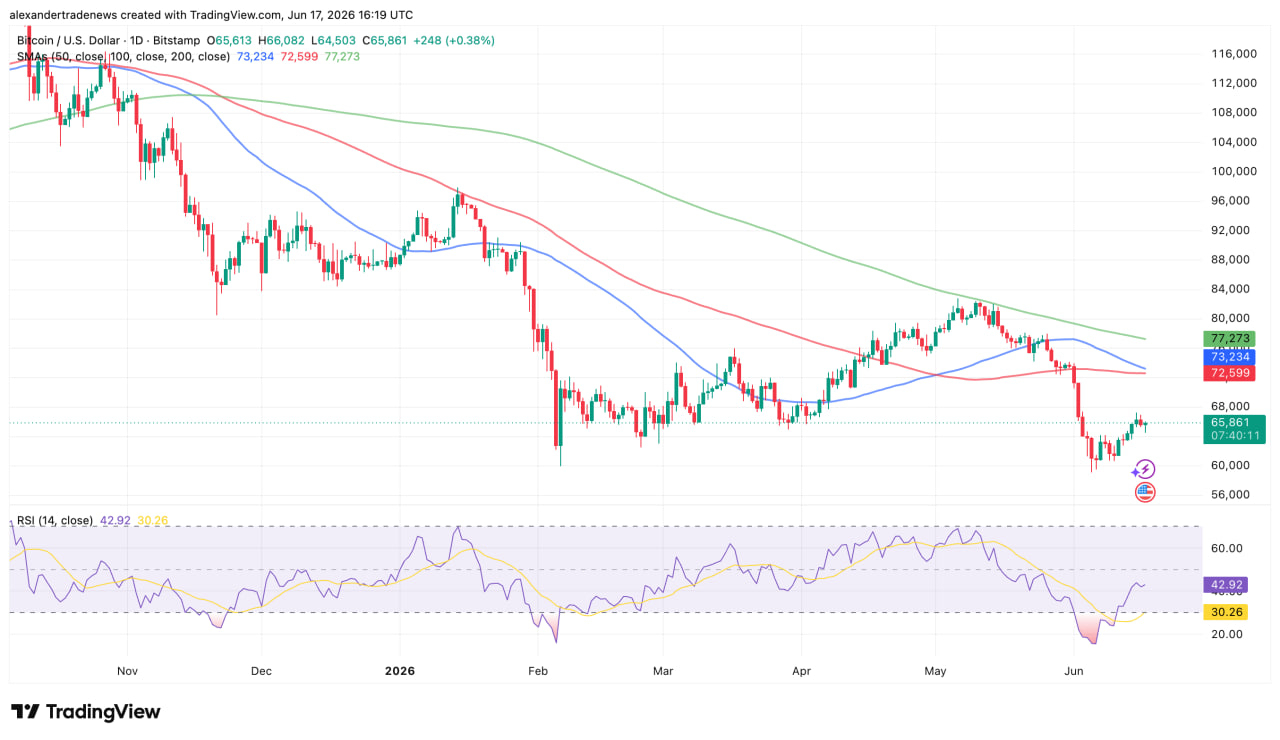
Today's setup is different: Bitcoin has rallied roughly 8% off early-June lows near $60K and trades around $65K, below the $66K resistance that has capped price on the 4-hour chart for two weeks.
What gets left out of the post-FOMC narrative is what happens on day 8 through day 30. January 2026: -7.2% in week one, then +4.40% by day 30. March 2026: -1.5% in week one, +3.16% by day 30. April 2026: -0.74% in week one, +3.04% by day 30. The FOMC window creates localized volatility, not structural direction.
What the On-Chain Data Shows
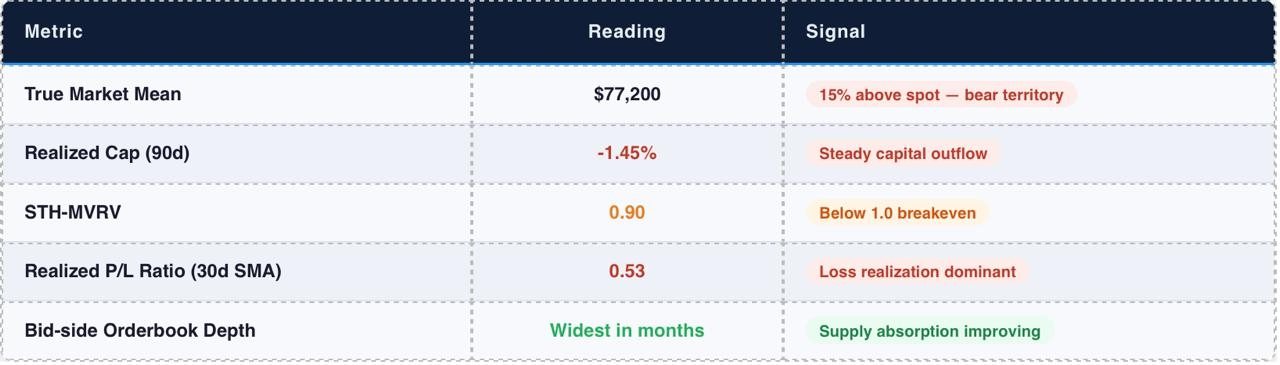
True Market Mean — the average acquisition price of actively transacted coins — sits at $77.2K, roughly 15% above current spot, according to Glassnode data. Price trading below this level has historically defined bear market regimes, and despite the recent bounce, the gap has not closed meaningfully since the mid-May peak briefly approached it before reversing.
The Realized Cap, which measures the aggregate cost basis of all coins in circulation, now stands at $1.07 trillion and has contracted 1.45% over 90 days, with the 30-day change at -1.39%. That is a sustained capital drain at cycle scale, not a single acute shock. Short-Term Holder MVRV has recovered from 0.81 to 0.90 but remains below the 1.0 breakeven, with the 30-day Realized P/L Ratio at 0.53 — loss realization still dominates. The one constructive signal is spot liquidity: Binance orderbook bid depth is at its widest margin in months, suggesting passive buyers are absorbing supply rather than the market depending on aggressive demand.
Geopolitics Keeps the Pressure On
Trump's statement that the Iran memorandum of understanding is not final — with warnings of returning to military action — leaves the situation unresolved rather than settled. Iran has accused Israel of sabotaging the peace process, and Israeli strikes on Lebanon have continued. For Bitcoin, the channel runs through energy prices: escalation risk in a crude-producing region keeps oil elevated, which keeps inflation above target, which keeps the Fed on hold, which removes the macro tailwind crypto needs for a regime change. Warsh inherits a central bank where inflation is running at more than twice the 2% target, and his acknowledged familiarity with digital assets changes none of that arithmetic.
The decision lands at 2:00 PM ET. The press conference follows at 2:30 PM ET. Whether the 7-day dip materializes or not, the 30-day data suggests the real trade begins after the noise clears.