
If you are still tracking the crypto market using an outdated playbook, you are likely missing the biggest structural shift in digital asset history. The market has firmly evolved from pure retail speculation to institutional utility.
At the absolute center of this evolution is **Real-World Asset (RWA) tokenization**—the process of converting physical or traditional financial assets (like government bonds, real estate, or private credit) into digital tokens on a blockchain.
Here is a breakdown of why RWAs have become the most high-traffic narrative on Binance, how the infrastructure works, and what it means for your portfolio.
## The Trillion-Dollar Bridge: What is RWA Tokenization?
For years, traditional finance (TradFi) and decentralized finance (DeFi) operated in completely separate silos. TradFi had massive capital but slow, expensive infrastructure. DeFi had lightning-fast, transparent infrastructure but lacked stable, low-risk yields.
RWA tokenization bridges this gap. By putting real-world assets on-chain, issuers unlock fractional ownership, 24/7 global trading, and near-instant settlement times.
> **Market Reality Check:** This isn't a hypothetical trend. Global banking giants and asset managers like BlackRock and J.P. Morgan are actively expanding their on-chain treasury funds, proving that Wall Street is no longer just experimenting with blockchain—they are building on it.
>
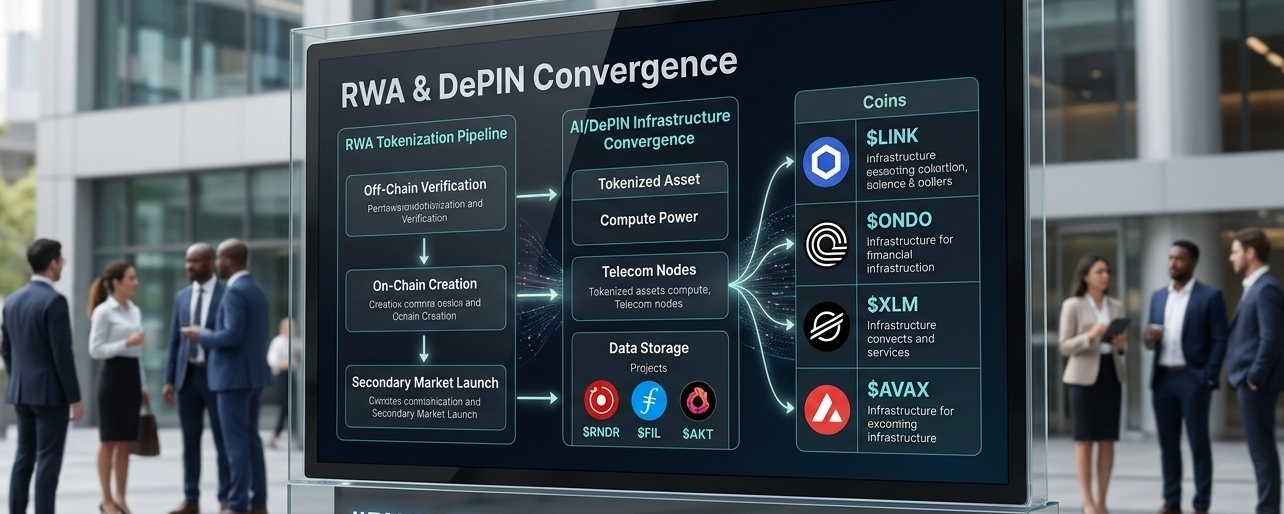
## How It Works: The Tokenization Pipeline
Tokenizing a physical or financial asset requires a highly secure, multi-step process to ensure that the digital token accurately reflects the real-world asset's value and legal standing.
1. Asset Acquisition & Verification
Off-Chain Foundation
The underlying asset (e.g., a US Treasury bond or a piece of commercial real estate) is legally verified, valued, and secured by a trusted custodian.
2. Smart Contract Architecture
On-Chain Creation
Developers write smart contracts that define the token's parameters, including dividend distributions, compliance rules, and voting rights.
3. Oracle Integration
Bridging the Data Gap
Decentralized oracle networks (like Chainlink) are connected to provide real-time, tamper-proof valuation feeds from the physical world to the blockchain.
4. Issuance & Distribution
Secondary Market Launch
The tokens are minted and distributed to eligible investors on compliant blockchain networks, allowing them to be traded or used as collateral in DeFi.
## The Three Pillars Driving the 2026 Narrative
The massive influx of capital into the RWA space isn't random. It is driven by three distinct advantages that traditional financial systems simply cannot match:
| Pillar | How it Works | The Core Benefit |
|---|---|---|
| **Fractional Ownership** | Splitting high-value assets (like a $10M building) into thousands of digital tokens. | Lowers the barrier to entry, allowing retail investors access to previously exclusive, high-yield asset classes. |
| **24/7 Liquidity** | Removing the restrictions of traditional banking hours and market closures. | Capital can be moved, traded, or used as collateral globally at any hour of the day. |
| **Programmable Yield** | Using smart contracts to automate dividend payouts and compliance checking. | Drastically reduces administrative costs, middlemen fees, and human error. |
## Top Tokens Leading the Infrastructure
As the RWA space evolves from a narrative into a sustainable, multi-billion-dollar business model, several core protocols are asserting dominance:
* **$LINK (Chainlink):** Functions as the undeniable backbone of RWA infrastructure. Its Decentralized Oracle Networks and Cross-Chain Interoperability Protocol (CCIP) bridge off-chain financial data securely onto the blockchain.
* **$ONDO (Ondo Finance):** A leading pioneer in institutional-grade tokenized treasury products, drawing substantial volume by unlocking US dollar yields and short-term US government bonds for on-chain users.
* **$XLM (Stellar) & $AVAX (Avalanche):** Both networks serve as major operational layers. Stellar leads heavily in tokenized US Treasuries and global payment settlements, while Avalanche's customizable subnet architecture has become a preferred hub for institutions deploying permissioned RWA products.
## The Secondary Wave: The RWA + DePIN Convergence
As RWA tokenization matures, it is colliding with another massive trending narrative: **DePIN (Decentralized Physical Infrastructure Networks)**.
While financial institutions tokenize bonds and real estate, Web3 protocols are tokenizing physical technology infrastructure—specifically GPU computing power, telecommunications nodes, and data storage. Driven by the global explosion of Artificial Intelligence (AI), the demand for decentralized compute has skyrocketed. DePIN allows individual operators to lease out their hardware capacity, creating a brand new, utility-backed asset class that functions exactly like an industrial RWA. Key assets in this cross-over ecosystem include **$RNDR (Render)**, **$FIL (Filecoin)**, and **$AKT (Akash Network)**.
## Closing Thoughts for Investors
The rotation of capital into utility-driven sectors like RWAs and DePIN shows that the digital asset market is growing up. Instead of chasing short-term hype cycles, smart money is flowing toward protocols that generate sustainable, real-world value.
As regulatory frameworks provide cleaner guidelines for stablecoins and tokenized assets globally, the line between traditional investing and crypto will continue to blur. For anyone looking to build a resilient Web3 portfolio, understanding the structural foundation of RWAs is no longer optional—it is essential.
*Disclaimer: This article is for educational purposes only and should not be taken as financial advice. Always conduct your own research (DYOR) before investing in digital assets.