
Gas fees aren't just a user problem—they're a design challenge. For smart contract engineers, every SSTORE operation and unchecked loop directly impacts your application's viability. In a landscape where unoptimized contracts can burn 20–50% more gas, optimization shifts from a best practice to a core competitive edge.
This guide provides a practical checklist focused on one of the heaviest on-chain operations: using oracle data. We'll move beyond generic tips to strategies that directly minimize settlement costs through batching, aggregation, and smart off-chain compute, with specific considerations for leveraging Binance Oracle (APRO) efficiently.
The Core Principle: Minimize On-Chain Work
The most expensive EVM operation is writing to storage (`SSTORE`), which can cost over 20,000 gas. The fundamental rule is simple: store only what is absolutely essential for logic or security on-chain. Everything else—complex computations, historical data, intermediary values—belongs off-chain.
Your Practical Gas Optimization Checklist
1. Architect with Batching & Aggregation in Mind
Bundle User Operations: Instead of requiring multiple transactions, design functions to accept arrays (e.g., arrays of amounts, addresses, or price update requests). A single batched transaction saves the 21,000 gas base fee repeatedly incurred.
Aggregate Off-Chain, Transmit Once: This is critical for oracles. Binance Oracle, for instance, aggregates price data from multiple trusted centralized and decentralized exchanges off-chain using a weighted formula before signing and publishing the result on-chain. As a developer, you should adopt a similar mindset: aggregate related logic off-chain in your backend and submit a single, consolidated state update.
2. Master Data Locations & Structures
Choose `calldata` for External Functions: Use `calldata` for read-only reference-type parameters (arrays, strings) in `external` functions. It's the cheapest memory location.
Use Mappings for Frequent Lookups: Opt for `mappings` over arrays for key-based access. Mappings provide O(1) constant-time lookups, while array searches are O(n) and become prohibitively expensive as data grows.
Pack Your Storage Variables: Solidity storage slots are 32 bytes. Group smaller-sized variables (like `uint128`, `bool`, `address`) contiguously so the compiler can pack them into a single slot, dramatically reducing storage costs.
How a Hybrid Compute Architecture Reduces On-Chain Load
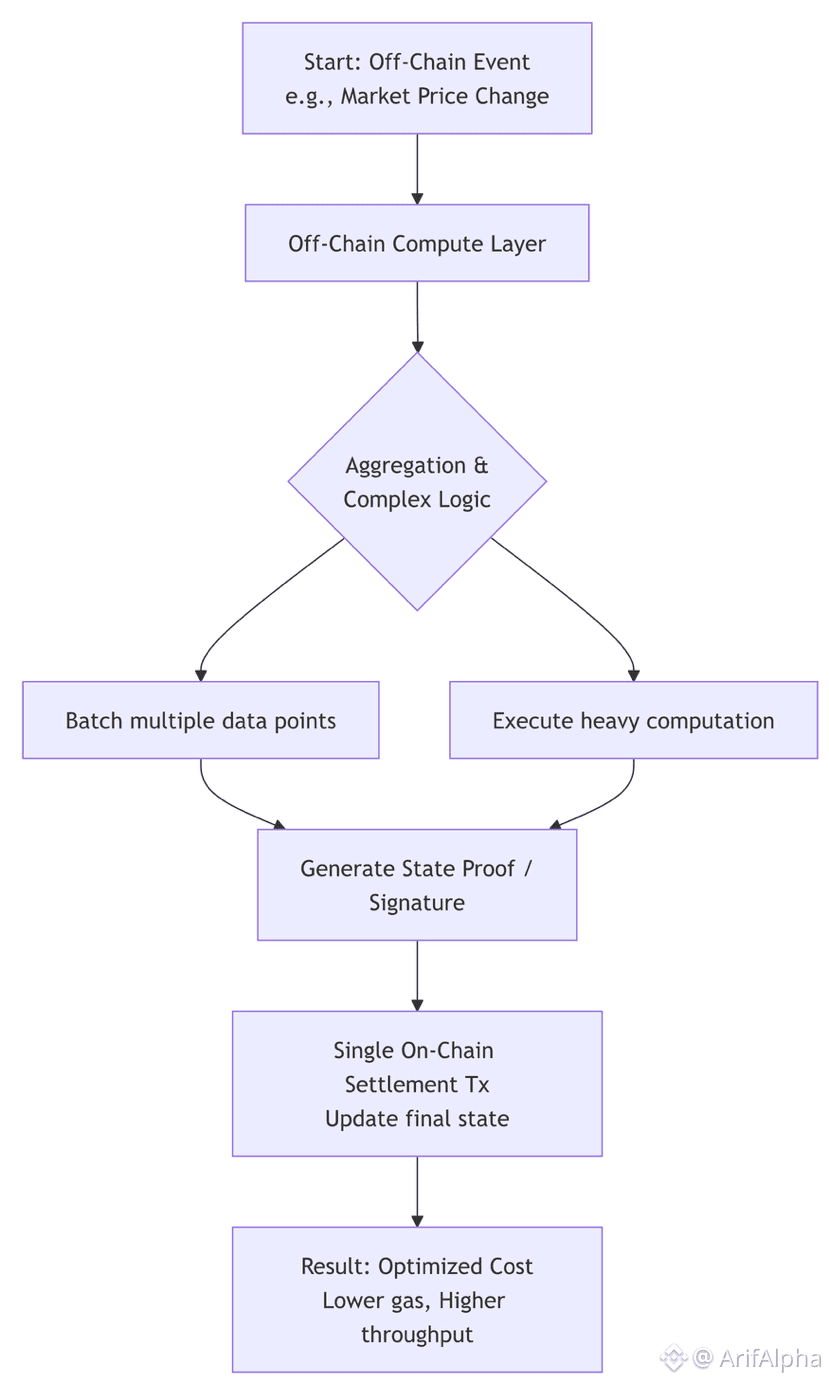
3. Integrate Oracles Efficiently
Trust the Aggregation, Verify the Signature: When using Binance Oracle, you are leveraging its off-chain aggregation and Threshold Signature Scheme (TSS). Your contract's primary job is to efficiently verify the signed data feed's authenticity using the public key. Avoid redundantly re-aggregating already-validated data on-chain.
Optimize Update Frequency: Match your data pull frequency to your application's needs. Not every liquidity pool needs sub-second updates. Use oracle configurations that align with your volatility tolerance to avoid paying for unnecessary on-chain updates.
4. Leverage Advanced Execution Patterns
Use `view` and `pure` Functions: For read-only logic that doesn't modify state, mark functions as `view` or `pure`. They can be called off-chain without gas costs.
Consider Minimal Proxies for Deployment: If deploying multiple instances of the same contract logic, use ERC-1167 minimal proxies. They delegate calls to a single, master implementation contract, slashing deployment gas costs.
Configure the Compiler Optimizer Wisely: Set the Solidity optimizer `runs` parameter based on your contract's purpose. Use a low value (e.g., 200) for contracts deployed often but called rarely (like factories). Use a high value (10,000+) for core logic contracts that will be executed thousands of times, as it optimizes for runtime efficiency.
Why This Matters on BNB Chain Now
The BNB Chain roadmap is explicitly focused on scaling for high-throughput trading and DeFi, targeting 20,000 TPS with sub-second finality. While protocol-level upgrades like the Fermi hardfork drive down base costs, efficient contracts are what will allow your dApp to scale sustainably within this high-performance environment.
Adopting these patterns isn't just about saving users money today; it's about future-proofing your application for the next wave of adoption, where gasless transactions and hybrid compute architectures become the norm.
What’s the most unconventional gas optimization trick you’ve implemented in production, and what did it save you? Share your battle-tested strategies below.

