
For years, prediction markets lived on the edges of crypto culture — niche tools for betting on elections, token prices, or headline-driven events. Useful, but limited.
That boundary is now shifting.
With Polymarket integrating Parcl’s real-time housing price indexes, real estate has officially entered onchain prediction markets. This is not just another partnership announcement. It’s a signal that prediction markets are evolving from narrative speculation into hard economic forecasting.
And investors should be paying attention.
From Opinions to Economic Signals
Real estate has always been difficult to hedge or forecast at a granular level. Traditional investors rely on lagging indicators, quarterly reports, or illiquid derivatives. Retail participants are mostly locked out entirely.
What Polymarket and Parcl are introducing is something fundamentally different:
A system where collective market intelligence can express real-time expectations about housing prices — city by city — and settle transparently onchain.
Instead of asking “Do you think prices will go up?”, the market asks:
What is the probability that New York housing prices cross this level by this date?
That shift — from opinion to probability — is where prediction markets become powerful.
How the System Actually Works (Without the Jargon)
At a product level, the architecture is clean and deliberate.
Polymarket does what it already does best:
It lists, manages, and settles prediction contracts.
Parcl plays a different but critical role:
It supplies daily, onchain housing price indexes, built specifically for crypto-native use. These indexes act as the final source of truth when markets resolve.
Each contract links to a transparent resolution page. Users can see historical index data, how prices are calculated, and why a market resolved the way it did. This transparency is essential — because trust is the currency of prediction markets.
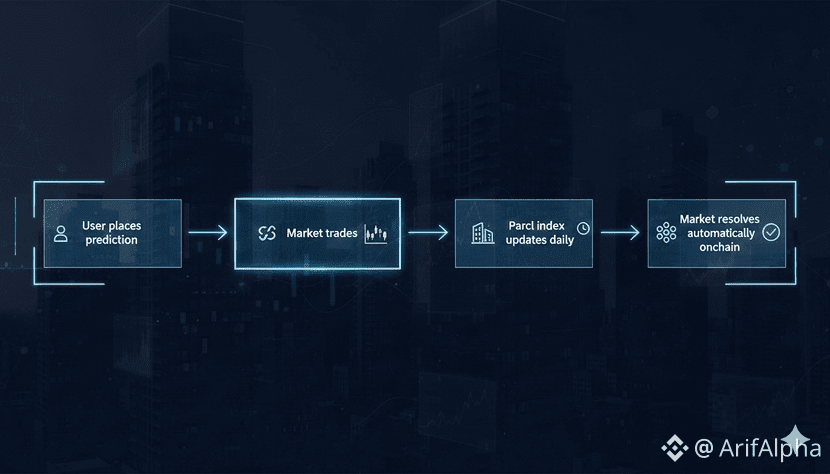
No black boxes. No manual intervention.
Why Solana Matters Here (More Than Speed)
Parcl is built on Solana, and that choice isn’t accidental.
Real estate data updates daily. Prediction markets need frequent settlement checks. Fees and latency matter. A slow or expensive chain would kill usability.
Solana enables:
Low-cost participation
Fast settlement
Composability with other onchain products
This opens the door to something bigger:
Real estate forecasts becoming building blocks — usable in DeFi strategies, analytics dashboards, or structured products.
Market Reaction Wasn’t Random
When the partnership was announced, PRCL surged over 100% in a short window. Price moves alone don’t define value — but they do reveal expectations.
The market wasn’t just reacting to hype. It was pricing in:
A new utility narrative for housing data
Increased visibility for Parcl’s indexes
Future fee and data monetization paths
In other words, investors recognized this as infrastructure, not a one-off integration.
Why This Matters Beyond Crypto
Prediction markets gained serious credibility after the 2024 U.S. elections, where they consistently outperformed traditional polling. Since then, platforms like Polymarket and Kalshi have moved from fringe experiments to multi-billion-dollar valuation discussions.
Real estate is the next logical expansion.
Housing prices influence:
Inflation expectations
Interest rate policy
Household wealth
Institutional portfolio allocation
Yet forecasting tools have remained slow, opaque, and centralized.
Onchain prediction markets offer something new:
Live sentiment backed by capital, updating every day.
That’s valuable data — not just for traders, but for analysts, funds, and eventually institutions.
Risks Still Exist — and They Matter
This is early infrastructure. That comes with real challenges.
Regulation remains the largest unknown. Real-world prediction markets sit at the intersection of derivatives, data markets, and financial instruments. Clarity will shape how fast this can scale.
Index credibility is another pillar. Parcl’s long-term success depends on maintaining trust in its methodology, data sources, and resistance to manipulation.
Liquidity will decide everything. Without active participation, even the best prediction markets fail. Adoption must extend beyond crypto natives into macro-aware capital.
These aren’t weaknesses — they’re checkpoints.
The Bigger Insight Investors Should Notice
This partnership isn’t really about housing.
It’s about what happens when real-world economic data becomes programmable.
Today it’s city-level home prices. Tomorrow it could be rent inflation, construction activity, or regional demand shocks. Once data is trusted and onchain, markets naturally form around it.
Prediction markets don’t replace traditional finance.
They surface information earlier.
And in markets, timing is everything.
Final Thought
Polymarket × Parcl represents a quiet but meaningful evolution — from speculative narratives to economic forecasting with real consequences.
If prediction markets succeed in real estate, they won’t stop there.
The question isn’t whether this model works.
It’s how many other real-world markets are still waiting to be priced onchain.
What real-world data do you think should enter prediction markets next — and why?
#RealEstateOnChain #PredictionMarkets #Web3Education #CryptoEducation #ArifAlpha