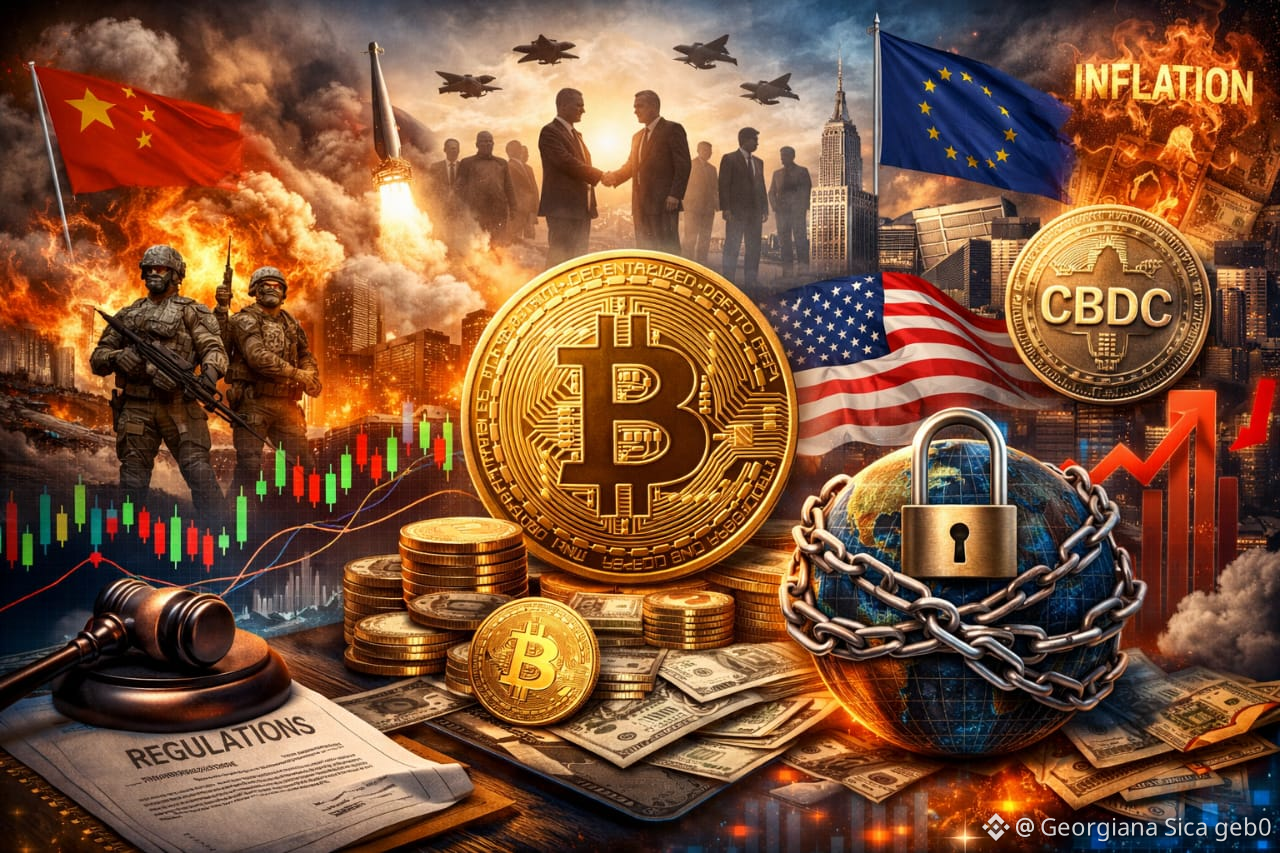
Impact of the Present Global Political Situation on Cryptocurrency
The global political landscape plays a major role in shaping financial markets, and cryptocurrency is no exception. In recent years, ongoing geopolitical tensions, regulatory shifts, economic uncertainty, and changing power dynamics have had a deep impact on the crypto ecosystem. As crypto continues to mature from a niche innovation into a global financial asset class, its relationship with world politics has become increasingly complex.
1. Geopolitical Conflicts and Market Volatility
Wars, regional conflicts, and political instability often trigger uncertainty in traditional financial markets. During such times, cryptocurrencies—especially Bitcoin—are sometimes seen as a “digital safe haven,” similar to gold. For example, during conflicts or sanctions, people in affected regions may turn to crypto to protect their wealth, bypass banking restrictions, or transfer funds across borders.
However, geopolitical crises also increase market volatility. Sudden political decisions, sanctions, or escalations can cause sharp price swings as investors react emotionally and move capital quickly. This makes crypto both an opportunity and a risk during unstable political periods.
2. Government Regulations and Policy Pressure
One of the strongest political influences on crypto comes from government regulation. Countries have taken very different approaches:
Some governments support crypto innovation and blockchain adoption.
Others impose strict regulations or outright bans due to concerns over money laundering, tax evasion, and financial stability.
Major economies like the United States, European Union, and China have a global impact. Regulatory uncertainty in these regions often causes fear in the market, leading to sell-offs. On the other hand, clear and supportive regulations can boost investor confidence and long-term adoption.
3. Sanctions, Capital Controls, and Crypto Adoption
Political sanctions and capital controls have increased crypto usage in certain countries. When governments restrict access to foreign currency or freeze bank accounts, citizens may use cryptocurrencies as an alternative financial system. This has strengthened the narrative of crypto as a tool for financial freedom and decentralization.
At the same time, global political pressure has pushed exchanges to comply with sanctions, reducing anonymity and increasing regulation. This creates tension between crypto’s decentralized ideals and real-world political control.
4. Inflation, Monetary Policy, and Trust in Governments
Rising inflation and aggressive monetary policies have weakened trust in traditional financial systems in many countries. Political decisions related to money printing, interest rates, and debt management directly influence investor behavior.
In politically unstable or economically mismanaged regions, people increasingly view crypto as protection against currency devaluation. This has helped drive long-term adoption, especially in developing nations.
Conclusion
The present global political situation has a profound and lasting impact on cryptocurrency. Political instability, regulation, sanctions, inflation, and power struggles all influence how crypto is used, traded, and perceived. While politics can create short-term volatility, it also drives long-term adoption by highlighting the weaknesses of traditional financial systems.
In a world of uncertainty, cryptocurrency sits at the intersection of technology, finance, and politics—making it both vulnerable to political decisions and empowered by them