


During the rapidly evolving world of Web3, decentralized data storage is one of the major components of the next internet. Walrus (WAL) leads this trend. It does not represent a storage tool, but a protocol that was designed specifically to address the massive data requirements of AI, decentralized apps, NFT markets, and big media storage.
Introduction: The Problem Walrus Solves.
Nowadays a lot of computers store information on large servers belonging to such corporations as Amazon, Google, or Microsoft. They are fast and can expand however they are expensive in the long run, can be blocked as well as fail when a single server becomes unavailable.
Older models of decentralization like IPFS, Arweave, or Filecoin attempted to decentralize data by distributing it to a large number of computers but all can be expensive, difficult to scale, and fail to integrate well with smart-contracts platforms.
Walrus is an attempt to address this with a decentralized, programmable, and scalable storage of large files, which is compatible with the latest blockchains, in particular Sui.
What Is Walrus?
Walrus is a decentralized data storage framework, which resides on the Sui blockchain. It allows the storage of large files such as videos, pictures, data sets, and chain data in a secure and inexpensive manner on a network of numerous computers.
Walrus is a file splitting system that distributes large files over erasure coded small segments unlike in traditional blockchain storage, which is costly when dealing with large files. This allows it to quickly access the information, and prevents a handful of computers from ceasing to function, as well as reducing the necessary storage without compromising the security.
Walrus can be used by not only the DeFi users or NFT users but also AI creators, companies, web3 creators, and any application where they need to store data that is reliable and proven.
How Walrus Works: Design and Technology.
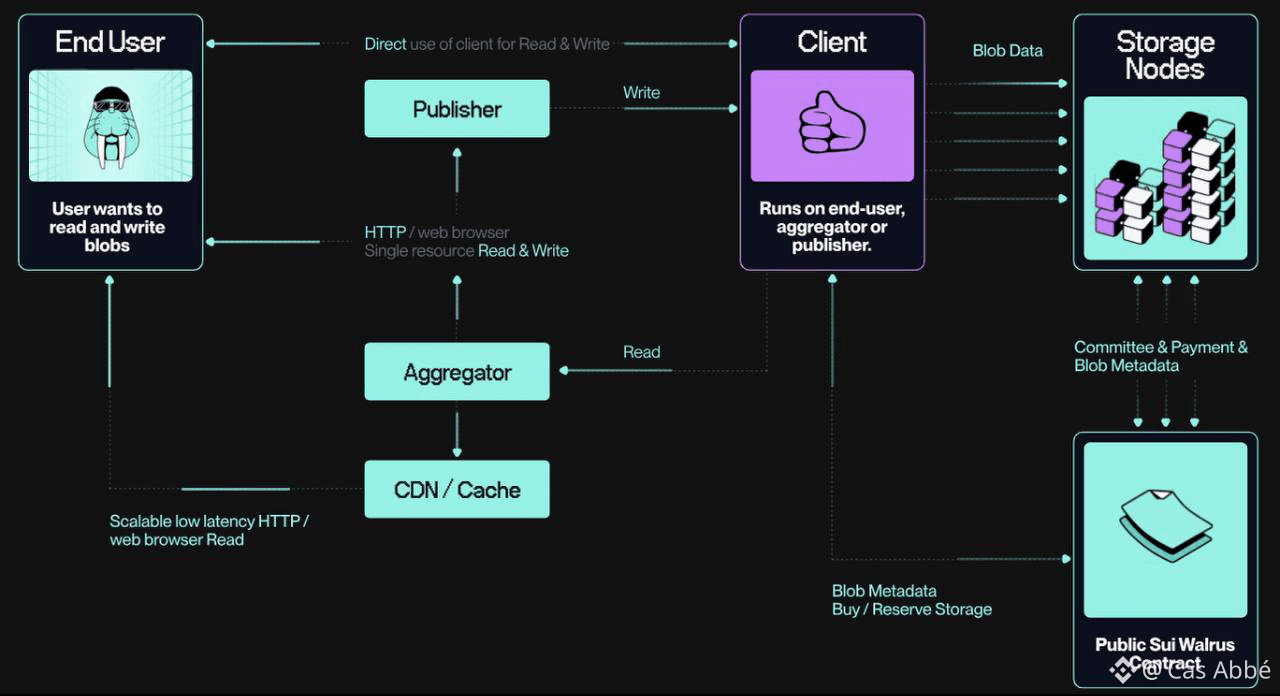
Walrus separates data storage and its implementation. That is the main idea.
Upon a user uploading content like videos, pictures, AI collections or NFTs, Walrus initially splits it into large parts known as blobs. The blobs are erasure coded and then dispersed to other storage nodes. Walrus does not store the full version of every piece; it only requires a few fragments in order to reassemble the data.
The Sui blockchain is the coordination and validation layer. Smart contracts record:
* Storage commitments
* Proofs of availability
* Payments and penalties
This configuration will allow Walrus to expand its storage without creating a large blockchain, but will allow the data stored to be verifiable on the blockchain.
Why it matters:
* Not as expensive as mere copying.
* Able to survive failures
* Smart contracts can be programmed.
Built on Sui
Walrus is constructed as part of the Sui blockchain, and thus runs using the low-latency and high-performance platform underlying Sui and the Move language to write smart contracts. This allows the entire storage operations to occur on the chain, which is easy to read and authenticate.
Red Stuff Encoding
A special method of encoding files is the core of Walrus. Walrus does not copy a complete file to a large number of nodes, but rather divides the information into fragments and disperses them such that the file can be reconstructed in case a few nodes become unavailable. This renders the system more robust and low in cost to operate.
Decentralized Blobs and Programmable storage.
Whereas on-chain assets are files that can be used in the code rather than raw data. This exposes opportunities to gated access, metadata alteration, digital content marketplaces and machine sets learning which reside on the chain.
Security and Proofs
Walrus has proof checks. Storage nodes should also demonstrate periodically that they continue to store the data. In the event of failure they can be reprimanded or put into another position. This makes the data secure and accessible in the long run, which is valuable to businesses and vital employment.
Tokenomics: The WAL Token.
The Walrus network has its own currency, the WAL, as the driving force of its economy. It is used for:
Utility Token
Storage fee payments- WAL allows users to purchase storage services at a constant price.
Staking + Security Staking WAL can support node operations and increased stakes are more likely to receive more data and rewards.
Governance - token holders have an opportunity to vote on significant changes made by the protocol.
Token Distribution & Supply
Aggregate supply: 5 billion WAL tokens.
Community: approximately 43 percent in terms of the community growth and a huge airdrop.
Subsidies & nodes: approximately 10 per cent to initiate storage and incentivise first mover nodes.
Share: a time-based share share with the founders.
Burn Mechanisms
Walrus burns tokens on doing things and punishes fast unstaking. This will minimize the total amount of tokens in circulation, and it promotes the long-term usage. Besides, each data write consumes SUI tokens, potentially draining SUI in large amounts every year, assisting Sui in long-term supply management.
Applications and Use Cases.
Walrus has obvious real-world advantages:
Machine learning and AI Data.
AI needs huge data sets. Walrus enables users to save training, model, and inference data safely and with evidence, without the expensive and risky costs of a private cloud.
NFT Metadata and Marketplaces.
NFTs require metadata storage that is stable. NFT markets are using Walrus to store data and media across chains and secure ownership and prevent censorship.
Decentralized Media Storage.
Walrus can be used by news sites or content networks that desire to remain accessible without one owner to retain articles, videos or archives that are approved and distributed in the network.
Web3 Applications and Metaverse Data.
Online games and virtual worlds require a significant amount of data that is not offline. Walrus offers a more efficient layer which fits such data-intensive apps.
Cross-Chain Data Markets
Walrus supports a wide range of blockchain types, which allows transferring data between Ethereum, Solana, Sui, and others, thereby facilitating the integration of various ecosystems.
Ecosystem and Partnerships
Walrus attracts rapidly by marriage:
Talus Labs - Walrus is used to workflow data of AI agents.
Itheum - extends Walrus with data tokenization.
Walrus is used to store assets by many NFT and media platforms.
Walrus also obtained significant support when it comes to big investors, such as Standard Crypto, a16z, and Electric Capital, which resulted in raising a significant sum of money of up to 140 million dollars.
Competitive Landscape and Comparisons.
Some people compare Walrus with Filecoin or Arweave, however, Walrus is unique in three aspects:
1. It does not deal with small files, but big data blocks and AI data.
2. It collaborates with a fast blockchain of Sui that allows smart contracts to communicate with stored information immediately.
3. It also allows you to code storage in such a way that the data can be directly utilized in the application as opposed to sitting around.
Filecoin and Arweave remain viable, but the combination of low cost, good speed and programmability of Walrus gives it a definite advantage in Web3 and AI career.
Market Adoptions Signals and Performance.
Towards the end of 2025 and the beginning of 2026, WAL is listed on multiple exchanges and its market cap reaches hundreds of millions of dollars.
Walrus demonstrates technical momentum and increased usage after launching its main network in March 2025, raising money, and additional integrations. The true measure will be the amount of data it saves, the number of AI apps utilizing it and the amount of business utilizing it, as that will indicate long-term success.
Risks and Challenges
Risk does exist in all projects, and Walrus is not an exception:
Existing storage network competition.
Failure to expand the ecosystem of Sui would damage the reach of Walrus.
The supply of the token may fluctuate as well as future releases and may impact the market.
It is difficult to get a new protocol to perform as it was promised, particularly with large objectives.
Conclusion: Walrus as a Web3 Backend to Data.
Walrus is a new form of decentralized infrastructure that extends beyond mere file storage to programmable, scalable, and safe data to Web3, AI, and other decentralized applications. It has Sui integration, good funding and numerous applications, so it might become a fundamental storage layer of the next generation of decentralized computing.
With the increasing need for reliable, programmable data, Walrus might facilitate the connection between blockchain logic and actual data requirements such that storage is viewed as a bottleneck instead of a strategic asset to those who build and use it.