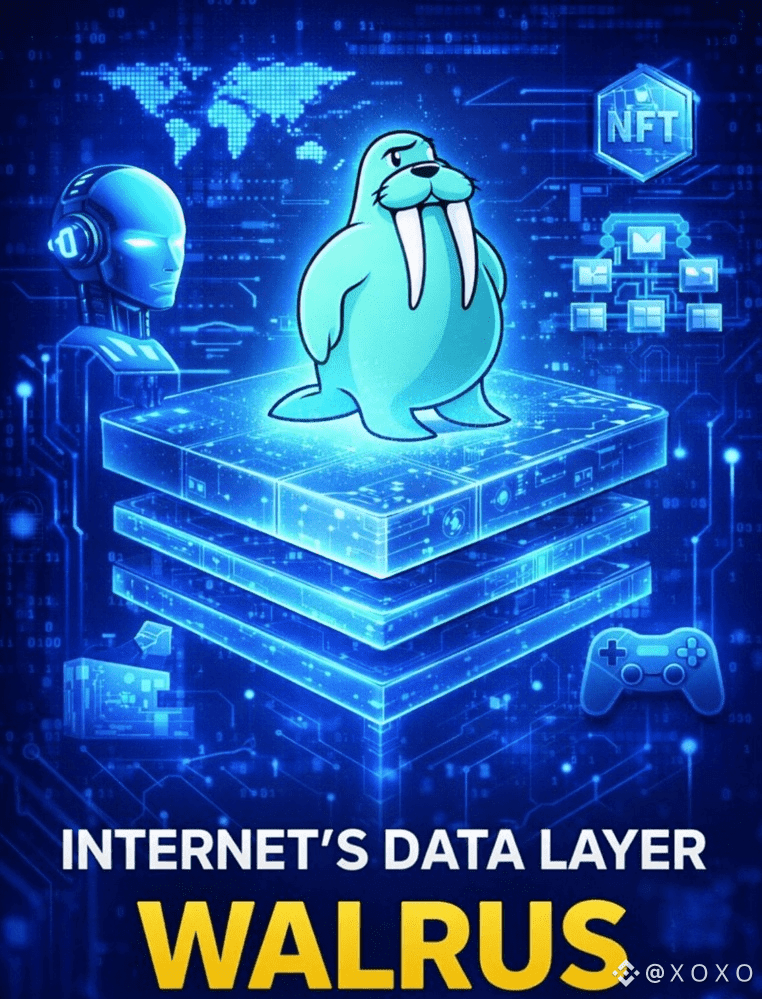
Most people still talk about Walrus as if it were “just another storage network,” and that’s understandable because storage is the first thing you can see. You upload something, it gets split, encoded, and held by a decentralized set of nodes. But if you look a little deeper, what Walrus is really building is not a hard drive for Web3, it’s a memory system for the internet’s next phase.
The difference matters.
Modern blockchains, rollups, AI agents and on-chain applications are producing more data than blockchains were ever designed to hold. Proof systems generate large verification files. Games generate constant state updates. AI agents produce logs, models, and interaction histories. Social and media apps create images, video, and rich content. None of this fits comfortably on a base layer chain, but all of it still needs to be available, verifiable, and neutral.
This is where Walrus quietly changes the architecture.
Walrus doesn’t just store files. It turns data into something that can be proven to exist, proven to be intact, and recovered even when nodes come and go. The Red Stuff encoding system behind Walrus is not about compression, it is about resilience. By slicing data into two-dimensional shards and spreading them across independent operators, Walrus makes it possible to lose large parts of the network and still reconstruct the original content. That’s what allows proofs, app state, and digital assets to stay available without trusting any single host.
That sounds technical, but the implication is simple. When a rollup publishes a proof, or when an NFT points to a piece of media, or when an AI model references its training data, those things don’t have to live on fragile web servers anymore. They can live on Walrus, where anyone can fetch them later and know they haven’t been altered or quietly removed.
This is why calling Walrus “just storage” is like calling the early internet “email.” It misses the layer that actually matters.
The internet didn’t change the world because it moved files. It changed the world because it created a shared, always-available data space that anyone could build on. Walrus is trying to give blockchains and decentralized applications the same thing: a neutral, censorship-resistant place where the heavy data that powers everything else can safely live.
You can already see where this leads. Proof-heavy chains no longer have to choose between scalability and data availability. AI agents can store their memory and reasoning trails without relying on cloud providers. Games can keep player state and assets in a way that survives even if a studio disappears. Digital identity, social graphs, and content libraries can exist outside any single platform.
All of those systems need a backbone that does not care who owns the app or which company is hosting the front end. Walrus is being designed as that backbone.
So when people say Walrus is “the data layer for the internet’s future,” it’s not marketing. It’s a recognition that the next generation of decentralized systems needs somewhere to put the things that make them real. Walrus is where that reality is meant to live.