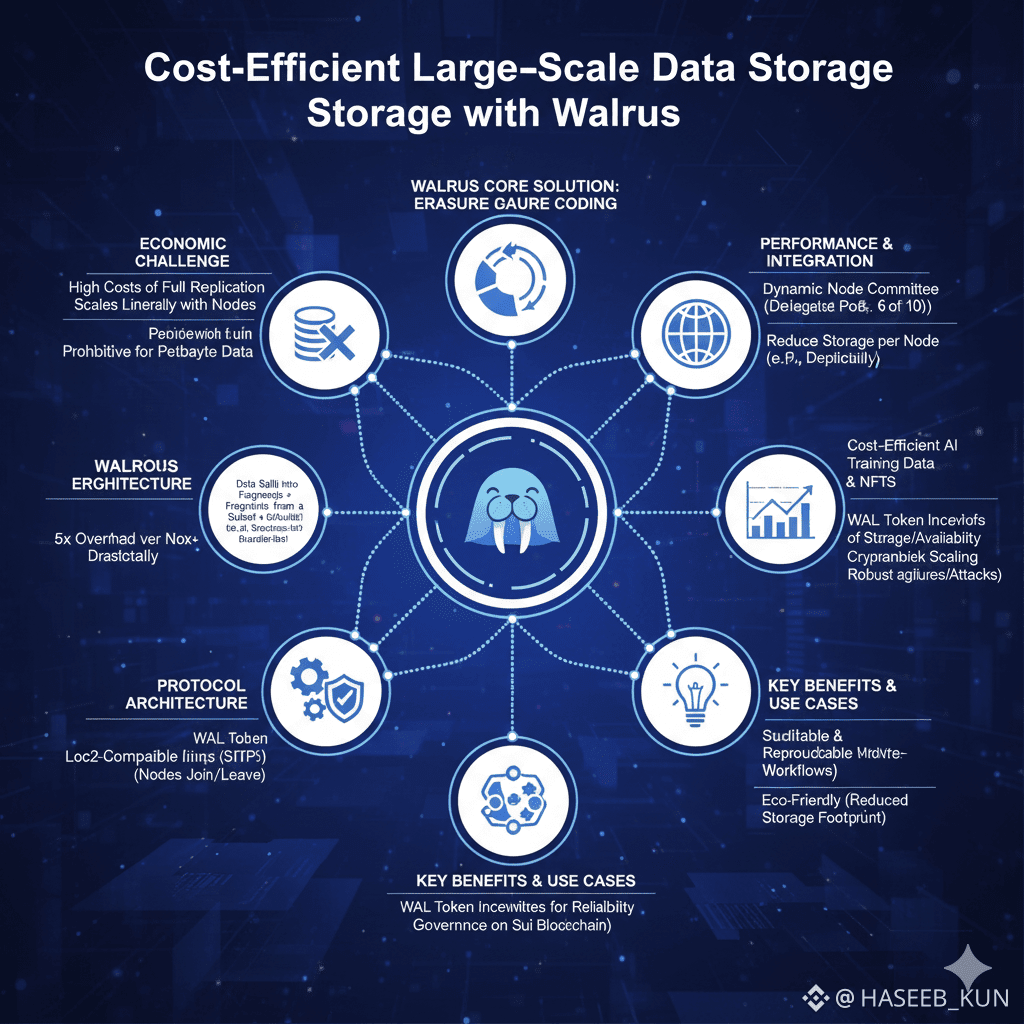
In today’s rapidly evolving blockchain and decentralized application landscape, storage has become more than a technical requirement—it is an economic challenge that shapes how networks scale and innovate. As decentralized ecosystems grow, the demand for reliable, accessible, and verifiable storage is rising sharply, especially for data-intensive fields such as artificial intelligence, gaming, and decentralized finance. Traditional storage approaches, whether on-chain or off-chain, often rely on full replication across nodes to ensure redundancy and fault tolerance. While effective in maintaining high availability, these methods come with prohibitive costs that scale linearly with network size, making terabyte- or petabyte-scale datasets difficult and expensive to manage. Walrus addresses this challenge by combining decentralized storage with advanced erasure coding, offering a cost-efficient, scalable alternative that preserves both reliability and integrity.
At the heart of Walrus’s efficiency is its use of erasure coding—a method of splitting data into fragments and adding mathematically generated parity blocks so that the original dataset can be reconstructed even if some fragments are lost. Unlike traditional replication, where each node stores a full copy of the data, Walrus distributes these encoded fragments across the network, allowing any subset to reconstruct the dataset. For instance, a file encoded into ten fragments may only require six to recover fully. This approach drastically reduces storage per node while maintaining resilience against failures or malicious behavior. By balancing redundancy with efficiency, Walrus delivers high reliability at a fraction of the cost of full replication, making it a practical solution for large-scale, data-heavy applications.
Walrus transforms the economics of decentralized storage. In full replication models, storage overhead grows directly with the number of nodes, quickly becoming unsustainable for massive datasets. Walrus limits overhead to approximately five times the original dataset size, a balance that maintains fault tolerance while significantly reducing costs. By storing only encoded fragments rather than full copies, the protocol enables organizations to manage terabytes or even petabytes of data without the exponential expense of traditional approaches. This cost efficiency unlocks new possibilities for AI training datasets, media assets, blockchain archives, and other large-scale digital assets that previously faced financial barriers to decentralized storage.
The protocol’s architecture reinforces both efficiency and reliability. Walrus operates through a dynamic committee of storage nodes, elected via delegated proof-of-stake using the WAL token. These nodes store and serve data during defined epochs, with their performance continuously validated through cryptographic proofs of storage and availability. Underperforming nodes risk losing delegated stake or future selection, creating strong economic incentives for reliability. Coupled with erasure coding, this governance framework ensures data remains accessible even in the presence of network disruptions or Byzantine faults, while eliminating inefficiencies inherent in static full-replication systems.
Comparing Walrus to conventional blockchain storage models illustrates its economic advantage. In Sui’s full replication system, a one-terabyte dataset replicated across ten nodes would occupy ten terabytes of storage. With Walrus, the same level of fault tolerance is achieved with a 5x overhead, reducing total network storage to just five terabytes. As networks expand and datasets grow, these savings compound, allowing decentralized applications and AI pipelines to scale efficiently without incurring unsustainable costs.
Cost-efficiency in Walrus does not compromise performance or accessibility. The network integrates seamlessly with Web2 interfaces, command-line tools, and software development kits, enabling developers to maintain existing workflows while leveraging decentralized storage. Frequently accessed data can be cached locally or delivered via content delivery networks for optimal performance, while the Walrus network guarantees long-term availability and verifiable integrity. This combination of usability, efficiency, and reliability positions Walrus as an attractive solution for enterprises, research institutions, and AI developers requiring scalable, trusted storage.
Flexibility is another hallmark of Walrus’s design. Because data is encoded and distributed as fragments, storage space can be dynamically managed across nodes. Nodes can join or leave the network without disrupting data integrity, allowing the system to scale organically with demand. This adaptability is particularly valuable for AI workflows, where datasets expand rapidly and computational needs fluctuate. Walrus ensures that even massive datasets remain cost-effective and highly available, preventing storage from becoming a bottleneck in AI training or decentralized application development.
Walrus also enhances sustainability. Traditional replication consumes significant storage and energy resources, whereas erasure coding reduces the overall storage footprint, lowering energy consumption across the network. This dual focus on economic and ecological efficiency benefits organizations seeking both cost savings and environmental responsibility. By optimizing storage and energy use, Walrus demonstrates a practical, scalable model for decentralized storage that aligns with modern operational priorities.
Security and governance are deeply integrated into Walrus’s storage model. Each fragment is linked to cryptographic proofs, allowing verifiable auditing of availability and integrity. Smart contracts on the Sui blockchain interact with stored objects to monitor compliance, extend storage periods, or reclaim resources if nodes underperform. This ensures that all digital assets—AI datasets, model weights, blockchain archives, and NFT media—are actively managed, economically accountable, and verifiably available, transforming storage from a passive cost into a strategic resource.
The implications of this architecture are wide-ranging. AI developers gain reliable, cost-predictable storage for massive datasets and model checkpoints, enabling reproducible experiments and auditable results. Decentralized applications and NFT platforms acquire secure, scalable storage for media and content without dependence on expensive centralized providers. Blockchain infrastructure benefits from efficient archiving of historical data, checkpoints, and proofs. Across all use cases, the combination of erasure coding, incentive-driven governance, and decentralization ensures high reliability and availability while maintaining cost efficiency.
Walrus also fosters a more open and competitive storage ecosystem. By distributing encoded fragments efficiently, smaller or specialized nodes can participate without bearing prohibitive costs. This democratization strengthens decentralization and resilience, as the network does not rely on a few high-capacity providers. On-chain governance and cryptographic verification coordinate a broad network of nodes, turning reliability and availability into emergent properties of the system. The result is a robust, flexible, and economically optimized storage layer capable of supporting large-scale applications across industries and geographies.
In conclusion, Walrus represents a paradigm shift in decentralized storage. By combining erasure coding, dynamic node committees, and incentive-driven governance, it reduces storage costs dramatically while ensuring high reliability and verifiable availability. Compared to full replication methods used in many blockchain ecosystems, Walrus achieves comparable or superior fault tolerance with a fraction of the storage overhead, enabling large-scale AI, decentralized applications, and blockchain infrastructure to thrive. In an era of exploding data volumes and rising storage costs, Walrus transforms storage from a limiting factor into a strategic enabler, providing scalable, cost-efficient, and accountable infrastructure for the next generation of digital systems.