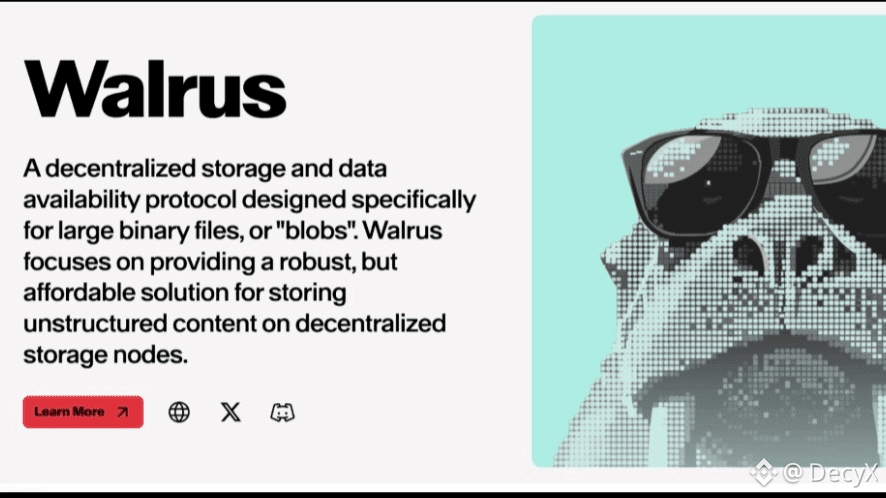
In the world of decentralized systems, the promise of Web3 has always been bigger than the tools available to deliver it. For years, developers and innovators have dreamed of applications that could operate seamlessly without centralized dependencies, yet the reality often fell short. The missing piece has always been reliable, scalable, and verifiable infrastructure capable of handling real-world workloads without compromise. Enter Walrus, a system designed to address these limitations and transform how decentralized platforms operate.
Walrus tackles one of the core contradictions in decentralized ecosystems: blockchains excel at immutability and verification, but fail at handling large datasets efficiently. Traditional storage systems, whether centralized cloud services or hybrid IPFS nodes, either compromise decentralization or introduce fragility. Walrus solves this by providing a highly optimized network where data is distributed intelligently, stored redundantly, and retrievable on demand, all while remaining verifiable through cryptography. This combination allows developers to finally build decentralized applications that can scale and perform consistently, something the industry has struggled with for years.
The technical elegance of Walrus lies in its approach to data partitioning and distribution. Instead of replicating entire datasets across every node, the system fragments, encodes, and distributes pieces strategically. Each node holds data in a way that maximizes availability and minimizes resource waste, creating a resilient network that can handle massive workloads without slowing down. This is particularly crucial for platforms managing large media files, application states, or AI datasets. By eliminating the bottleneck caused by conventional decentralized storage solutions, Walrus makes high-performance decentralized apps not just possible, but practical.
Verification is central to the Walrus philosophy. Unlike traditional storage, where trust is often implicit, Walrus integrates cryptographic verification into every layer. Users and applications can confidently retrieve data knowing that what is delivered is exactly what was stored. This assurance shifts the paradigm from faith-based trust to mathematical certainty, aligning perfectly with the ethos of Web3. Every interaction with Walrus becomes a verifiable, auditable event, removing uncertainty that has historically hindered adoption.
For developers, Walrus opens up a new era of experimentation. No longer constrained by unreliable storage or inconsistent data retrieval, engineers can focus on building innovative applications rather than patching architectural weaknesses. This has profound implications for sectors like gaming, decentralized finance, AI, and social networks. Imagine a decentralized social platform where media content loads instantly and reliably, or a gaming environment where state persistence is guaranteed, or AI applications that can access enormous datasets without relying on centralized intermediaries. These scenarios become achievable because Walrus eliminates the infrastructure bottleneck.
Economic incentives are another core feature. Walrus rewards nodes based on performance metrics such as uptime, responsiveness, and data integrity. This moves away from traditional token emission schemes or speculative incentives and instead focuses on long-term operational value. Nodes that perform consistently are recognized and compensated, creating a sustainable ecosystem where infrastructure reliability is directly tied to tangible rewards. This ensures that the network is not only technically robust but also economically aligned with its intended purpose.
What sets Walrus apart is its adaptability. Many infrastructure solutions in Web3 are rigid, designed around a single use case or protocol. Walrus, however, is modular and versatile. Its architecture supports integration with a wide range of decentralized protocols, from lending platforms to marketplaces to AI-powered applications. This flexibility allows developers to experiment without fear of outgrowing the system or hitting technical ceilings. Walrus provides a foundation that grows with innovation, enabling a more dynamic and resilient ecosystem.
The cultural shift Walrus represents is just as important as the technical one. The early days of Web3 were defined by experimentation and hype, but also by fragility and inconsistency. Projects often promised the world, yet struggled under the weight of their own technical limitations. Walrus signals a new phase: one where infrastructure is reliable, scalable, and aligned with real-world performance rather than empty metrics. This reflects a broader maturation of the space, where practical functionality is valued as highly as innovation and speculation.
From a user perspective, the implications are tangible. Applications built on Walrus feel faster, more reliable, and more polished. Users can interact with decentralized systems without constantly questioning whether their data will persist or whether content will load. This enhanced user experience is crucial for driving mainstream adoption of decentralized technologies. Without infrastructure that inspires confidence, even the most groundbreaking applications struggle to gain traction beyond early adopters.
Walrus also addresses one of the most pressing issues in decentralized storage: efficiency. Excessive replication across nodes has historically led to wasted resources, energy, and storage. Walrus uses smart redundancy, balancing availability with resource optimization. This not only improves performance but also contributes to the environmental sustainability of decentralized networks, which has become an increasingly important consideration in Web3 design.
The evolution enabled by Walrus extends to governance as well. By creating a system that is auditable, transparent, and secure, it lays the groundwork for decentralized applications to implement more robust governance models. Communities can make decisions based on reliable data, vote with confidence, and manage protocol parameters without worrying that technical weaknesses will undermine their choices. This integration of infrastructure with community governance strengthens the integrity of decentralized ecosystems.
Looking forward, Walrus positions itself as a foundational element in the next wave of decentralized innovation. As applications demand more complex functionality and handle increasingly larger datasets, infrastructure that cannot keep up becomes a limiting factor. Walrus removes that limitation, offering a platform that grows alongside developers’ ambitions. By focusing on performance, reliability, and verifiable trust, Walrus is not just solving a technical problem - it is shaping the trajectory of what decentralized systems can achieve.
In conclusion, Walrus represents a significant step toward functional, scalable, and sustainable decentralized infrastructure. It combines efficient data distribution, rigorous verification, modular architecture, and economically aligned incentives to create a system capable of supporting real-world applications. For anyone building or interacting with decentralized systems, Walrus provides confidence that infrastructure will no longer be a weak link. This is infrastructure designed to be invisible when it works - yet profoundly transformative in what it enables. As the Web3 ecosystem continues to mature, platforms like Walrus will be remembered not for their hype, but for their indispensability.