

Blockchain always sounded like a dream for finance fast, transparent, global but for banks and other regulated players, there’s always been a big catch. Most public blockchains just show too much. If anyone can see your transactions, your balances, or even the fine print in your contracts, you’re never going to get traditional finance on board. In that world, privacy, compliance, and legal clarity aren’t optional they’re a must. That’s where Dusk Network comes in. It’s built from the ground up to meet those exact standards, but without throwing out what makes blockchain useful in the first place.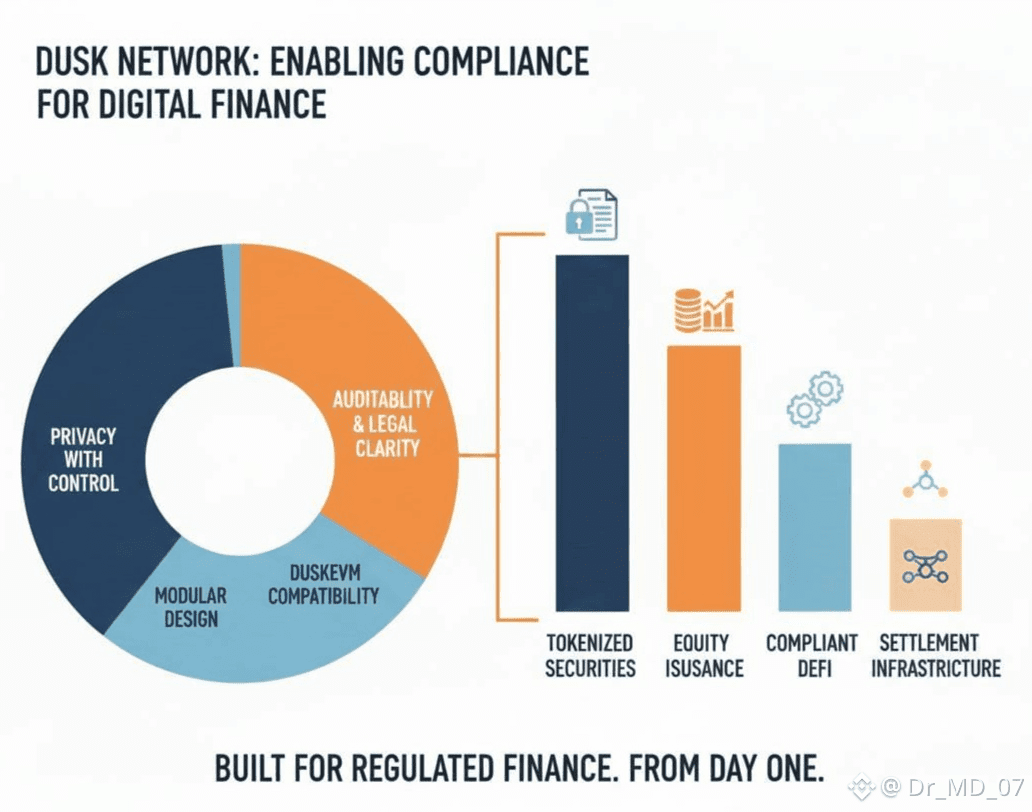
Dusk launched in 2018 as a Layer 1 blockchain designed for regulated finance. Its mission isn’t to dodge the rules it’s to make blockchain work inside the existing legal system. Right from the start, Dusk made privacy and auditability part of its core protocol. These aren’t afterthoughts or add-ons; they’re baked in.
Here’s the thing: Financial institutions need to keep things confidential, but regulators still need to see what’s going on. Dusk’s approach is all about privacy with control. It uses advanced cryptography so transactions get validated without spilling sensitive details to the world. So the network can check that a transaction follows every rule, but nobody outside the inner circle can see the amounts, the identities, or the business logic behind it.
This matters most when you’re dealing with tokenized securities or real-world assets. In those cases, investor info and ownership details have to stay private, but still be provable. Dusk lets institutions share these details only with the right people regulators, auditors, or legal folks when needed. Nothing is public unless it has to be. This way, blockchain activity fits real compliance standards instead of trying to sneak around them.
Another thing that gives Dusk an edge is its focus on legal certainty. A lot of blockchains are fuzzy about governance and responsibility, which just scares off big organizations. Dusk is built for structured financial assets that follow clear rules. That helps institutions explain how things work to their own teams and to regulators. Compliance officers know exactly who can see what, and under which circumstances.
Dusk also knows developers don’t want to reinvent the wheel. With DuskEVM, developers can use Ethereum tools and smart contracts they already understand, but in an environment where privacy and compliance are front and center. That means less hassle, faster projects, and no need to sacrifice security or regulatory needs.
On a practical level, Dusk is ready for the kinds of projects institutions actually want to do tokenized bonds, equity issuance, compliant DeFi, or settlement infrastructure for regulated markets. All of these rely on confidentiality, but they also need verifiable integrity. Dusk’s modular design means it can support all these applications without forcing everyone into the same box.
What makes Dusk really different is its realistic take on trust in finance. It doesn’t pretend transparency alone solves everything. In the real world, trust also comes from privacy, rules, and accountability. Dusk builds all of that into its foundation, clearing away one of the biggest roadblocks that’s kept institutions away from blockchain.
As finance moves toward digital assets and on-chain settlement, compliance-ready infrastructure isn’t just nice to have it’s necessary. Dusk saw this coming and built for it from day one. It’s not trying to replace open blockchains made for experimentation. Instead, it complements them with a space where regulated finance can finally work with confidence.
Bottom line: Dusk brings compliance to blockchain by making privacy and regulation work together, not against each other. Its design lets financial institutions get on board with blockchain without risking legal trouble or exposing sensitive data. For anyone in traditional finance looking for a real, workable path into on-chain assets, Dusk is the solution that gets it.
