
Governance is one of those things crypto talks about loudly and understands quietly. Everyone likes the idea of voting, proposals, and decentralization. Fewer people like thinking about what happens when a governance decision actually affects something that exists outside the blockchain.
Real assets.
Real obligations.
Real consequences.
This is where most governance models start to feel thin.
From the outside, Dusk Foundation doesn’t look radical in how it approaches governance. There’s no constant drama, no performative votes, no endless ideological debates. But that’s exactly the point. Dusk treats governance less like community theater and more like system design.
Because once finance is involved, governance stops being expressive and starts being responsible.
When Governance Stops Being a Conversation
In early crypto projects, governance is mostly about direction. What feature should we add? Which parameter should change? It’s informal, flexible, and forgiving.
That works when mistakes are cheap.
In regulated financial systems, mistakes are not cheap. They leave records. They create liability. They can be questioned years later by people who were never part of the original discussion.
That’s why governance in finance looks boring from the outside. It’s structured. Documented. Traceable. Not because institutions hate decentralization, but because they hate ambiguity.
Dusk builds with that mindset already in place.
The Problem With “The Community Decided”
Crypto loves the phrase “the community decided.” It sounds inclusive and decentralized. It also collapses under scrutiny.
Who exactly is the community?
Who had voting power at the time?
What information did they act on?
Was the decision reversible?
Can it be defended later?
In regulated environments, these questions aren’t philosophical. They’re procedural.
Dusk’s governance philosophy doesn’t rely on vague social consensus. It prioritizes clarity of process. Decisions are expected to be explainable, not just popular. Authority is defined, not assumed.
That doesn’t reduce decentralization. It reduces confusion.
Why Privacy Still Matters in Governance
Here’s something crypto doesn’t like admitting: public governance can distort behavior.
When every vote is visible, participants don’t always vote honestly. They vote defensively. Strategically. Performatively. Institutions especially avoid public governance when it exposes intent or strategy.
Dusk understands this dynamic.
Governance participation doesn’t need to be a spectacle to be legitimate. What matters is accountability — the ability to verify decisions, not broadcast every internal signal.
That balance allows serious actors to engage without turning governance into a reputational or strategic risk.
Auditability Isn’t Just for Transactions
Most people think about audits in terms of money moving on-chain. That’s only half the picture.
In real financial systems, decisions themselves are audited.
Why was a rule changed?
Why was an exception allowed?
Why did parameters shift at a specific time?
If a blockchain can’t answer those questions cleanly, it doesn’t matter how transparent the ledger is. The system becomes hard to trust once scrutiny increases.
Dusk implicitly treats governance decisions as part of system integrity. They’re not side conversations. They’re part of the historical record that must make sense later, not just in the moment.
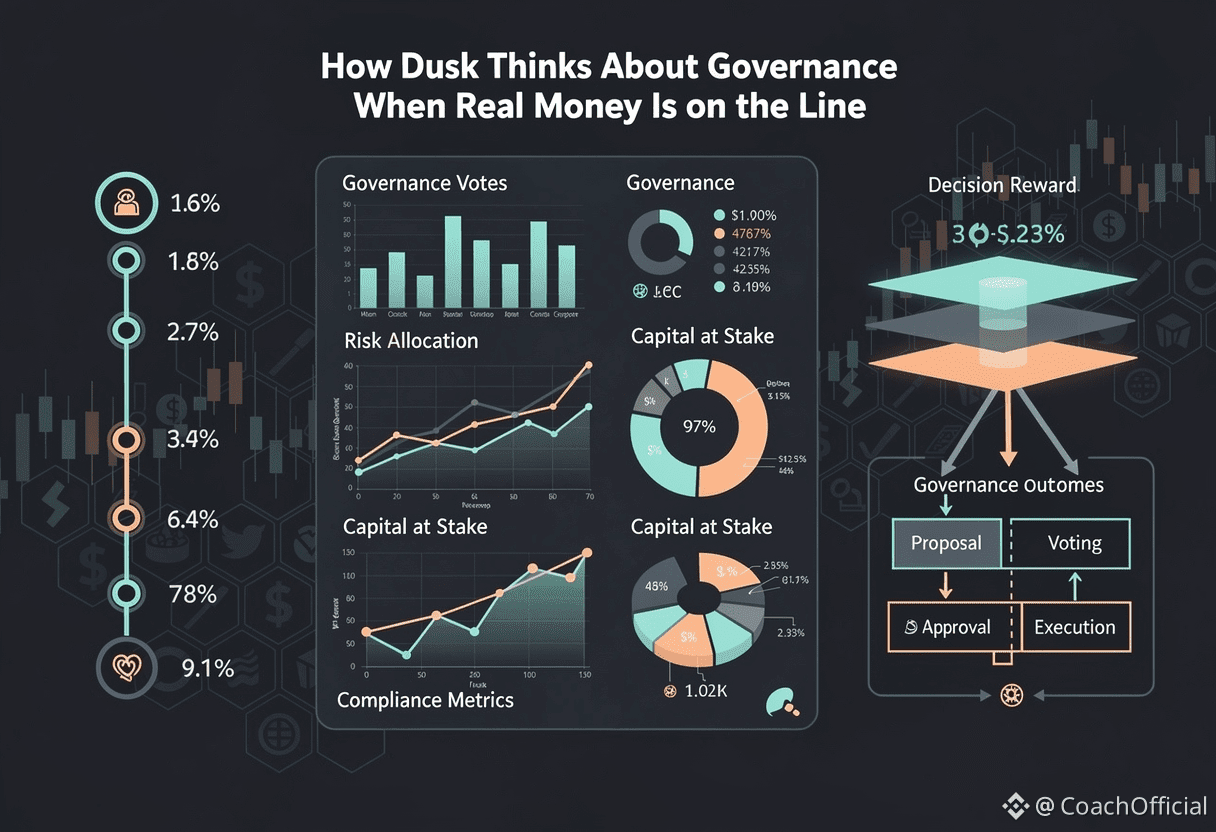
Governance as Risk Reduction, Not Participation Theater
A lot of crypto governance models optimize for participation numbers. How many wallets voted. How much turnout there was. How active the forum is.
Institutions don’t measure governance that way.
They care about:
predictability
consistency
reversibility (or lack of it)
decision boundaries
In other words, governance is evaluated as a risk surface, not a community metric.
Dusk’s approach reflects this. The goal isn’t maximum noise. It’s minimum uncertainty.
That’s less exciting. It’s also why systems like this are usable when stakes rise.
Real-World Assets Raise the Bar Instantly
Once governance decisions affect tokenized real-world assets, tolerance for ambiguity drops to zero.
A parameter change can affect ownership rights.
A rule update can impact compliance obligations.
A poorly documented vote can become a legal problem.
At that point, “experimental governance” stops being charming.
Dusk’s architecture assumes governance will touch assets with legal weight. That assumption forces discipline early, when changes are still manageable.
Most projects learn this late. Dusk doesn’t wait for the lesson.
Why This Governance Model Won’t Trend — and That’s Fine
Governance built for responsibility doesn’t trend well on social media. There’s no drama cycle. No viral debates. No visible power struggles.
But infrastructure doesn’t need to trend. It needs to function.
The blockchains that last won’t be the ones with the loudest governance. They’ll be the ones whose decisions still make sense when reviewed by people who weren’t emotionally invested at the time.
Dusk appears to be building for that audience — even if it never applauds.
Decentralization Without Pretending Rules Don’t Exist
Dusk doesn’t reject decentralization. It rejects the fantasy that decentralization means the absence of rules.
Rules exist whether a protocol acknowledges them or not. The difference is whether they’re enforced transparently and predictably, or discovered painfully later.
By encoding governance as a system — not a vibe — Dusk decentralizes responsibility instead of avoiding it.
That’s harder.
That’s slower.
That’s far more durable.
Final Thought
Governance only feels theoretical until something important depends on it.
Dusk builds as if something important already does.
That mindset won’t excite everyone.
But when blockchains are judged not by belief, but by consequence, it’s exactly the mindset that survives.
If you want, say Next
and I’ll continue with another fully fresh, human-native DUSK article for today, same standard.
@Dusk $DUSK #Dusk
