

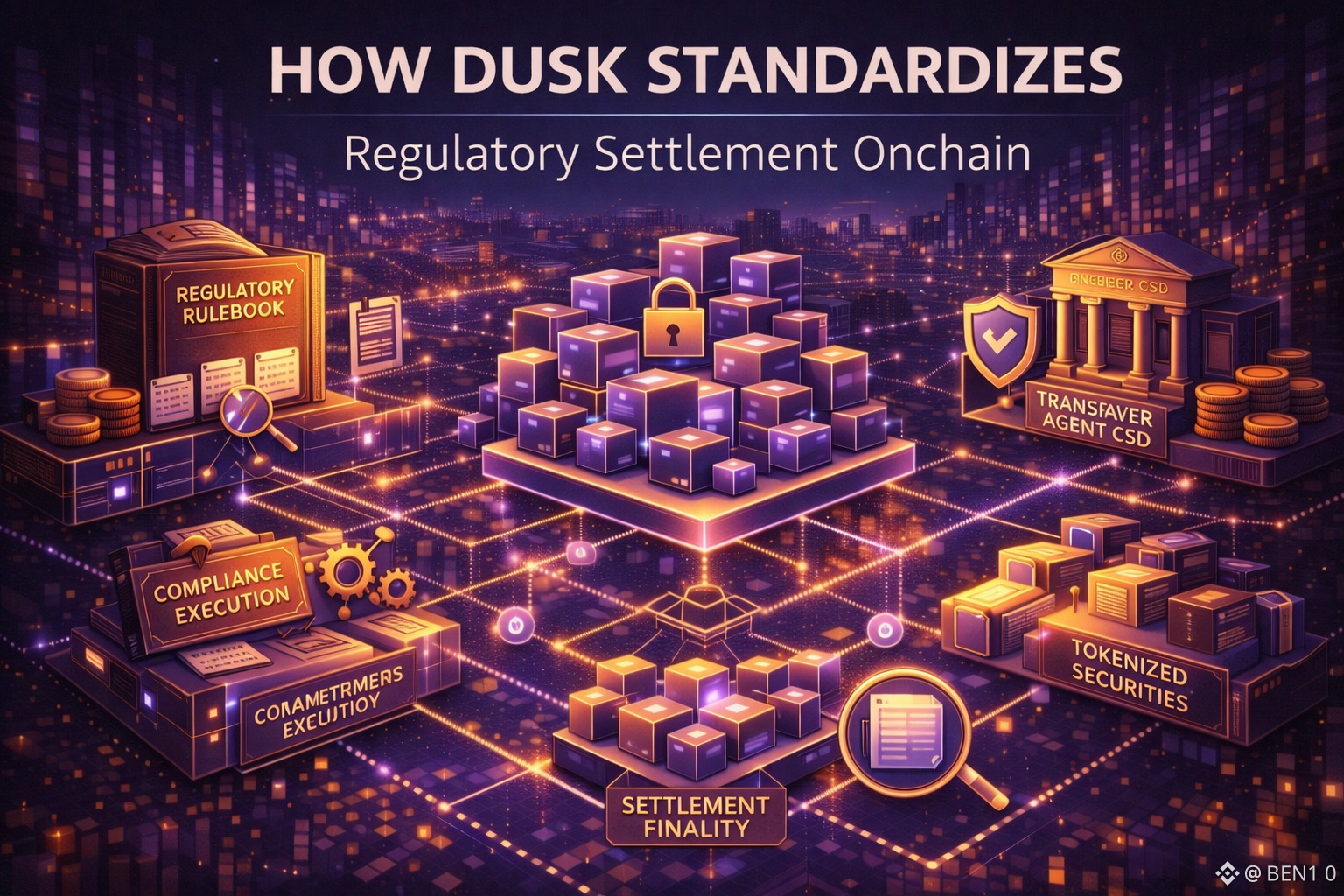
 Regulated markets do not treat settlement as a mere transfer of balances. Settlement is the point at which legal ownership changes, regulatory conditions are validated, reporting obligations are triggered, and beneficial ownership records are updated. In traditional infrastructure, this legal machinery is distributed across transfer agents, custodians, clearing houses, and CSDs, each enforcing fragments of the settlement rulebook. The process works, but it is ad-hoc, jurisdiction-specific, and dependent on contractual interoperability rather than computational guarantees. Tokenization has struggled not because securities cannot be represented digitally, but because this regulatory settlement stack cannot be standardized on blockchains.
Dusk introduces a settlement environment where compliance conditions are not external paperwork but executable protocol logic. Instead of treating eligibility checks, jurisdictional restrictions, lock-up windows, and reporting triggers as administrative afterthoughts, Dusk makes them part of the valid state transition model. If a transfer does not satisfy the regulatory rulebook defined for the instrument, the system does not settle the transfer. Settlement becomes a function of compliance, not a process followed by compliance. This shift is what allows Dusk to standardize regulatory settlement rather than outsourcing it to off-chain intermediaries.
The standardization emerges from Dusk’s design choices. Rather than encoding every security as bespoke smart contract logic, the network provides native compliance primitives that issuers can parameterize. Settlement becomes consistent across instruments while allowing rule differentiation where regulation demands it. Jurisdictions do not need separate middleware to handle residency restrictions. Issuers do not need transfer agents to update shareholder registries. Custodians do not need to reconcile positions across multiple ledgers. Regulators do not need batch reports to verify compliance outcomes. The protocol ensures that only compliant ownership transitions enter the canonical ledger, eliminating reconciliation risk entirely.
This model changes how regulators keep things in check. In old systems, you only find out if you’re compliant after the fact sometimes way after when everything gets reconciled. That lag opens up a risky gap. Trades might need to be reversed, reworked, or even dragged through legal fixes. With Dusk, though, it’s different. Regulatory checks and settlement happen at the exact same time. You never end up with a “pending compliance” situation because a non-compliant trade just doesn’t go through. The legal side is built right into the moment ownership changes hands. That’s really the heart of it. If you want regulated secondary liquidity on-chain, you need this. Market makers and brokers won’t put money into places where compliance and settlement aren’t locked together.
Regulatory standardization also matters for interoperability between jurisdictions. Today, digital asset pilots stall when crossing borders because regulatory requirements do not translate into executable logic. Dusk creates a shared substrate where these requirements can be expressed as composable conditions rather than negotiated workflows. The advantage is not simply technical; it reduces legal overhead and provides regulators with deterministic supervisory surfaces. Audit trails become protocol outputs rather than reconciled documents.
Issuers get a boost too. Securities aren’t just sitting there they go through all sorts of changes, like paying dividends, voting, getting redeemed, splitting, or converting. To keep these things running smoothly, you need up-to-date shareholder lists and you have to stick to the rules, even as the securities get traded around. Dusk keeps everything in line by making sure the issuer’s rules and ownership details stay intact all the way through settlement. Once you’ve got a standardized settlement process, you can automate all those lifecycle events without needing a custodian in the middle.
The broader implication is that regulated markets do not require new asset classes they require new settlement infrastructure. Standardizing regulatory settlement onchain collapses the mismatch between tokenization pilots and production environments. It transforms blockchains from record-keeping systems into capital markets infrastructure. In that context, Dusk is not competing with consumer L1s or privacy chains; it is competing with the post-trade plumbing that underpins modern securities markets.