

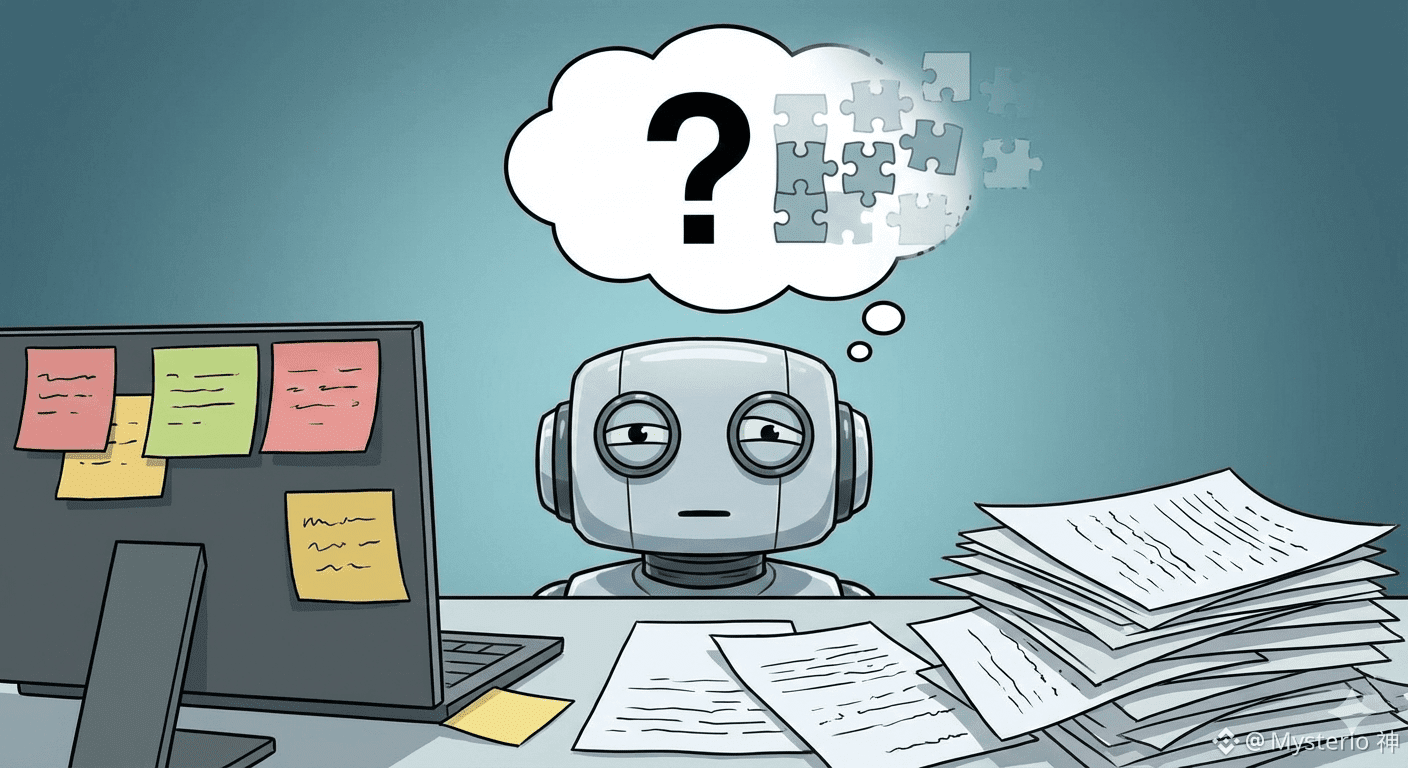
@Walrus 🦭/acc Imagine hiring the world’s smartest consultant. They have read every book in the Library of Congress, can solve complex physics equations in their head and speak 50 languages. But there is a catch: every time they walk out of the room, they completely forget who you are, what project you are working on and what they just advised you to do.#Walrus $WAL
Frustrating, right?
This is the "Goldfish Problem" that has plagued the world of AI agents for years. We have built incredibly powerful engines of logic, but we have starved them of long-term, reliable memory. Agents have been brilliant but scattered, trapped in isolated sessions or reliant on centralized servers that can be shut down at a moment's notice.
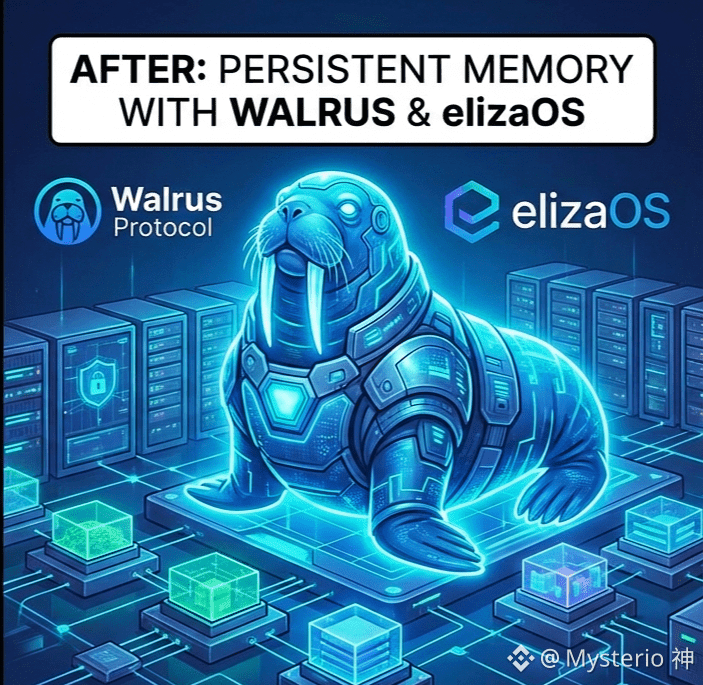
But that era is ending. elizaOS, the open-source heavy hitter for autonomous agents, has just teamed up with Walrus Protocol to solve this exact problem. By baking Walrus directly into the core of elizaOS V2, they aren't just giving agents a notepad; they are giving them a permanent, verifiable, and decentralized brain.
The "Stateless" Struggle
To understand why this partnership is such a big deal, we have to look at how broken the current system is. Right now, most AI agents are "stateless." They exist in the moment. Sure, you can feed them a context window, but that is expensive and temporary. If you want an agent to remember a user’s preference from three months ago, or share a dataset with another agent owned by a different company, you hit a wall.
Developers usually patch this with messy solutions renting AWS buckets, spinning up local databases, or just accepting that their agents will remain somewhat amnesiac. But this creates fragmented "data silos." Your travel agent bot can't talk to your calendar bot because they don't share a language or a storage locker. They are islands of intelligence in a sea of forgotten data.
Walrus: The Unshakeable Memory Layer
This is where Walrus enters the chat. Think of Walrus not as a cloud server, but as a global, indestructible public library.
Walrus is designed specifically for this new age of "Agentic AI." It handles large data files images, video, massive datasets efficiently and cheaply. But the secret sauce is its integration with the Sui blockchain. Every time an agent uploads something to Walrus, it gets a "proof-of-availability" certificate.
In plain English? It’s a digital receipt that proves, mathematically, that a piece of data exists, hasn't been tampered with, and is available to anyone with the right permissions. It transforms data from a "maybe it's there" file into a "verified fact."
elizaOS V2: Flipping the Switch
The genius of this partnership is in the friction it removes. In the past, hooking an AI agent up to a decentralized storage network was a headache involving wallet keys, node configurations, and three different documentation tabs open at once.
With elizaOS V2, Walrus is now the default memory layer. It’s not an optional plugin you have to hunt for; it’s the engine under the hood.
When a new developer spins up an agent on elizaOS, they are immediately plugged into this decentralized grid. To sweeten the deal, the integration includes time-limited credits. It’s like moving into a new apartment and finding the fridge already stocked. You don't have to worry about buying groceries (or storage credits) while you are still unpacking; you can just start building.
The "Trinity" of Trust: Walrus, Seal, and Nautilus
Memory is great, but what about secrets? If I tell my AI financial advisor my bank details, I don't want that permanently etched onto a public billboard.
This is where the partnership gets really professional. It’s not just about storage; it’s about the full lifecycle of data. The integration supports two critical companions to Walrus: Seal and Nautilus.
Seal acts as the bouncer. It handles encrypted access control. It ensures that while the data lives on the decentralized network, only the agents (or people) with the right digital keys can actually read it.
Nautilus is the clean room. It enables confidential off-chain computation. It allows agents to process sensitive data without ever exposing the raw information to the public blockchain.
Together with Walrus, they form a "Trinity of Trust." You get the permanence of Walrus, the privacy of Seal, and the processing power of Nautilus. This allows developers to define exactly how agents access, process, and—crucially—monetize data. We are talking about a future where agents can buy and sell datasets from each other securely, forming a true data economy.
From Chatbots to Economic Agents
"One of the biggest challenges in agentic AI is creating persistent, verifiable memory for agents that can be shared securely across workflows," said Rebecca Simmonds, Managing Executive of the Walrus Foundation.
She’s spot on. The future isn't about a chatbot that writes poems. It’s about a supply chain agent negotiating a contract with a logistics agent. For that to happen, they need a shared reality. They need to look at the same invoice, stored on Walrus, and verify its provenance on Sui.
Shaw Walters, the founder of elizaOS, echoed this: “Developers can now focus on creating advanced agent workflows without worrying about fragmented data management.”
This is the shift from "toy AI" to "enterprise AI." When you can audit the decision-making trail of an agent seeing exactly what data it looked at to make a decision you can finally trust it with real responsibility.
What This Means for You (The Developer)
If you are a developer, your life just got easier.
No more database management: Stop worrying about maintaining SQL instances for your bots.
Instant Auditability: Your agents come with a built-in "paper trail" that enterprise clients love.
Cross-Agent Collaboration: Your agent can now leave a "package" (data) for another developer's agent to pick up, cryptographically secured.
The integration comes with production-ready recipes and documentation. They aren't just throwing the tool at you; they are giving you the manual.
Conclusion: The Elephant Never Forgets
We are witnessing the maturity of the AI ecosystem. We are moving past the "wow, it can talk!" phase and into the "wow, it can work!" phase.
By combining the orchestration power of elizaOS with the elephant-like memory of Walrus, we are finally giving AI the stability it needs to become a reliable part of our economy. Whether you are building a personal assistant that remembers your anniversary or a swarm of trading bots managing millions of dollars, the foundation has just been laid. The future of AI is not just smarter; it’s unforgetting.