#Walrus continues to evolve as a core decentralized storage platform, delivering new features that enhance security, efficiency, and usability for developers and enterprises. The latest upgrades focus on controlled access to data and optimized small-file storage.
The Seal integration introduces programmable access control, allowing developers to manage encryption and permissions at a granular level. Sensitive files like identity data, encrypted documents, or private media remain secure while accessible only to authorized users.
The Quilt upgrade significantly improves small-file storage efficiency. By batching multiple files into optimized storage blocks, developers can reduce costs and simplify workflows for NFT metadata, logs, and other frequently used small assets.
These updates are built on Walrus’ decentralized, fault-tolerant network, supported by multiple independent nodes. Users can confidently publish, retrieve, and manage data at scale, knowing the network is reliable, scalable, and predictable.
With these enhancements, Walrus positions itself as a practical, programmable storage layer for Web3 applications. Its focus on privacy, accessibility, and cost-efficiency makes it ideal for NFT platforms, privacy-focused dApps, AI datasets, and decentralized media storage.

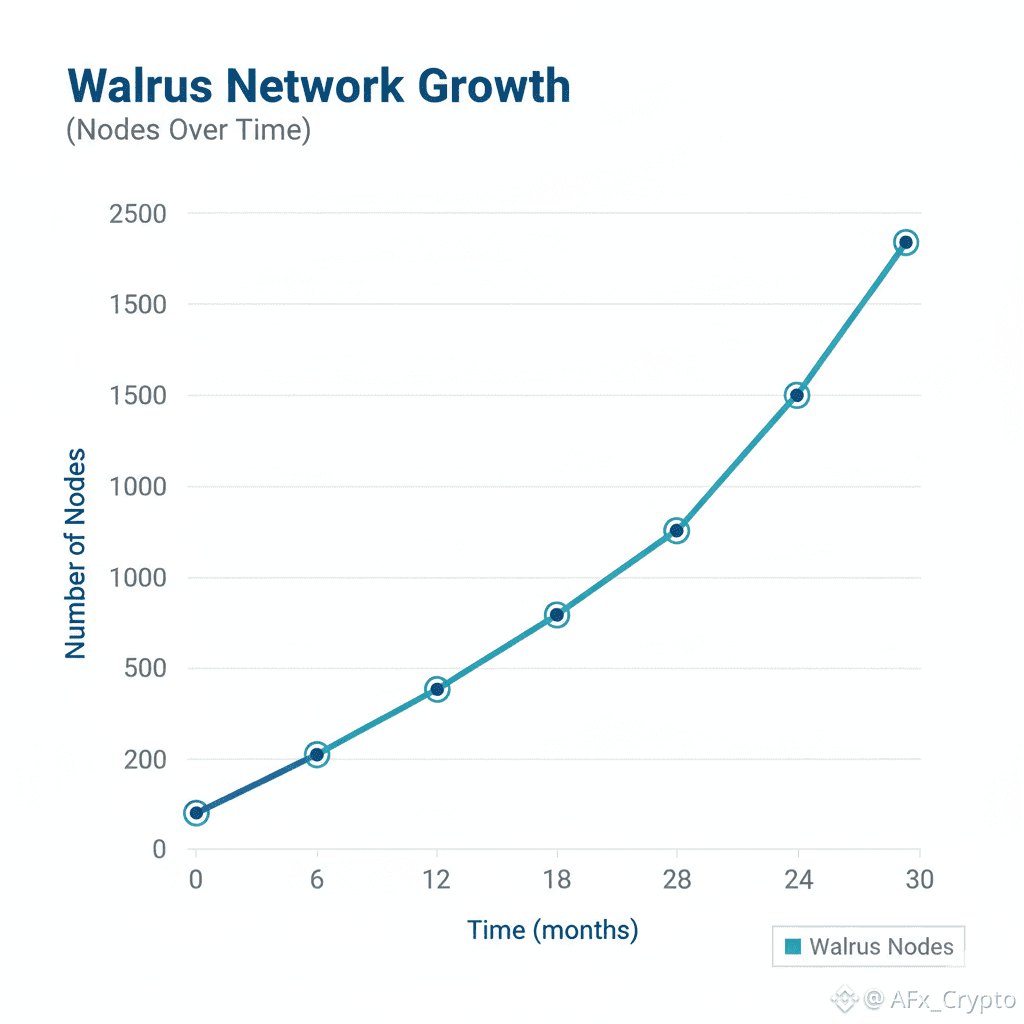
Walrus Network Growth (Nodes Over Time)
Line chart showing the growth of Walrus decentralized storage nodes over time.
X-axis: Time (months)
Y-axis: Number of Nodes