

@Walrus 🦭/acc is built around a reality that many blockchain projects prefer to ignore: while blockchains excel at transferring value and enforcing rules, they struggle when it comes to storing large volumes of data. As decentralized applications expand into areas such as NFTs, artificial intelligence, gaming, DeFi front ends, and even fully on-chain websites, data quickly becomes a bottleneck. Keeping information directly on-chain is prohibitively expensive, yet relying on centralized cloud providers undermines decentralization by introducing single points of failure. Walrus was created to resolve this tension. It is a decentralized storage protocol developed on the Sui blockchain that enables large datasets to be stored securely, verifiably, and cost-effectively without burdening the blockchain itself.
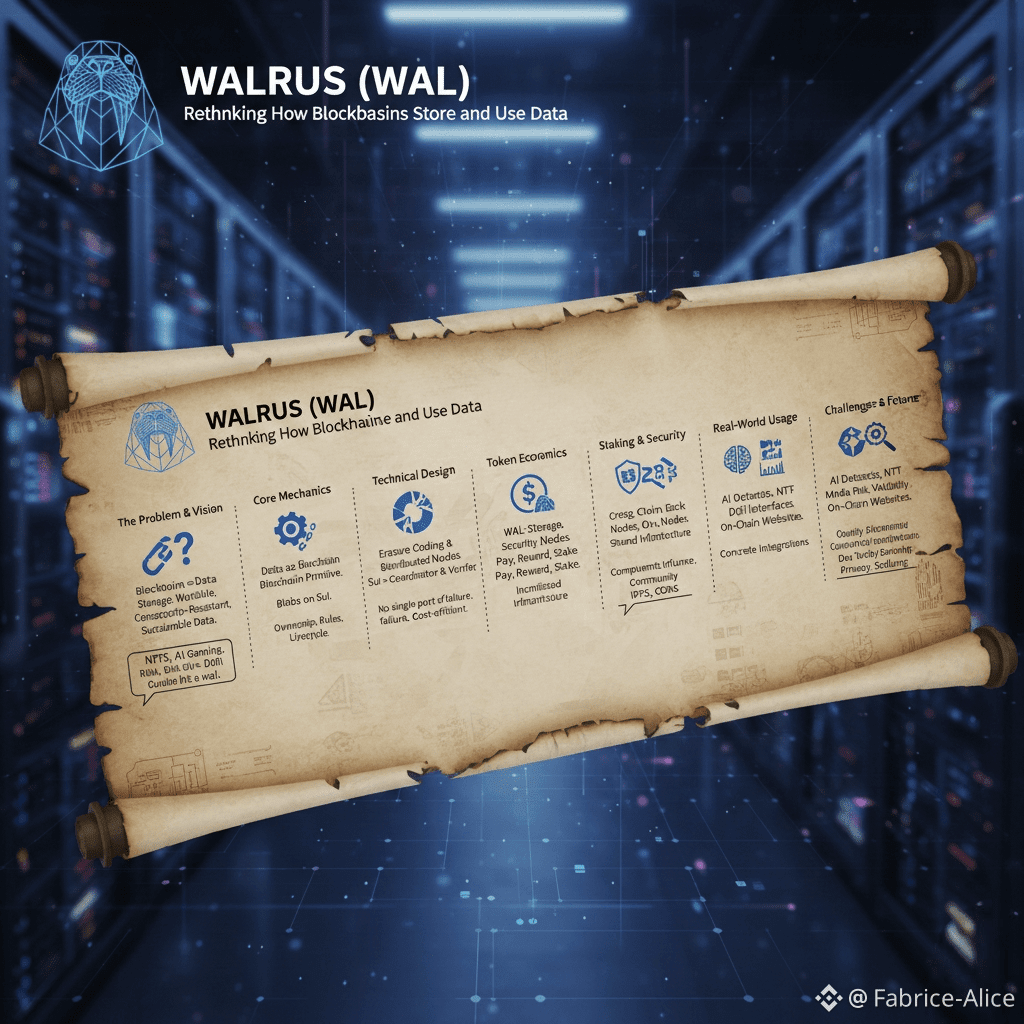
At a fundamental level, Walrus treats storage as a core blockchain capability rather than an external add-on. Instead of having smart contracts merely reference off-chain files, Walrus allows stored data to be natively recognized by the blockchain. Every stored file, referred to as a blob, is represented as an object on Sui with defined ownership, rules, and duration. This allows smart contracts to reason about data directly, verifying its existence, determining how long it should persist, identifying who funded its storage, and enforcing conditions for renewal or deletion. As a result, decentralized applications can handle large files in a way that feels integrated rather than improvised.
Walrus’s technical architecture is sophisticated but conceptually straightforward. When data is uploaded, it is not replicated in full across many machines. Instead, the file is split into smaller fragments and encoded using an erasure coding technique. These encoded pieces are distributed among numerous independent storage nodes. No single node possesses enough information to reconstruct the original data on its own. Even if a significant number of nodes go offline or act maliciously, the system can still recover the data. This design greatly lowers storage costs compared to simple replication while maintaining strong guarantees of durability and availability.
Within this system, the Sui blockchain acts as a coordinator and verifier rather than a repository for raw data. It records which blobs exist, assigns responsibility for data fragments to specific nodes, and manages payments and rewards. Storage providers are required to regularly prove on-chain that they still hold the data they are assigned. Nodes that fail these checks lose rewards and may be removed from participation. This mechanism enforces honest behavior through economic incentives rather than trust. For users, accessing data is similar to retrieving standard web content, often accelerated by caching or delivery layers, but with the added assurance that the underlying storage is decentralized and cryptographically verifiable.
The WAL token underpins Walrus’s economic and governance structure. It functions as more than a tradable asset; it is the medium through which storage services are paid for, security is enforced, and governance decisions are made. Users pay for storage in WAL, usually upfront for a specified time period. These payments are distributed gradually to storage nodes that maintain the data, as well as to WAL holders who stake their tokens in support of those nodes. This creates a direct feedback loop where demand for storage increases demand for WAL, and token rewards incentivize reliable infrastructure. To reduce volatility and keep storage costs predictable, Walrus incorporates mechanisms such as reserves and subsidies, particularly during its early development.
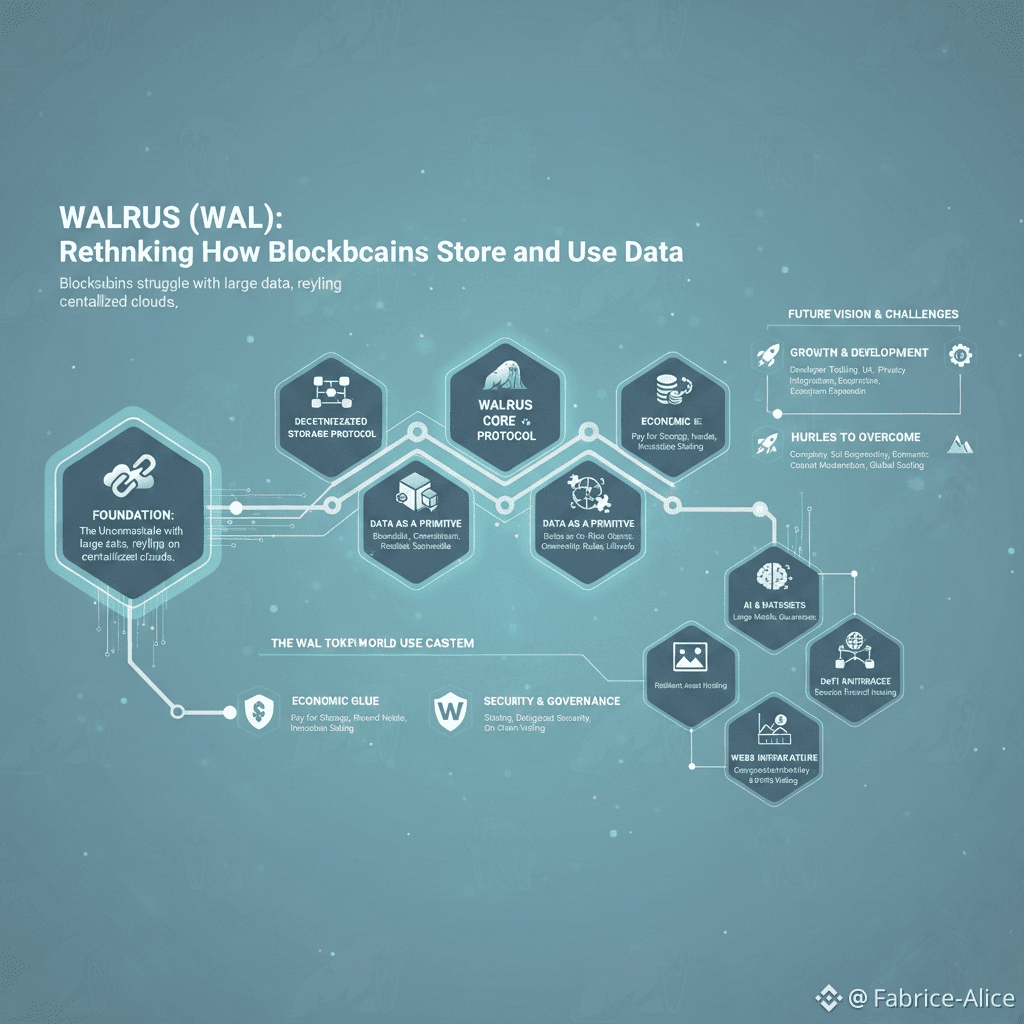
Staking plays a critical role in securing the network. WAL holders can delegate their tokens to storage nodes, effectively endorsing their reliability. Nodes backed by greater stake are trusted with larger storage responsibilities and receive higher rewards. This alignment encourages node operators to act honestly to retain delegated stake, while delegators are motivated to support dependable operators. Governance decisions, including protocol upgrades, pricing changes, and penalty structures, are determined through on-chain voting by WAL holders, giving the community direct control over the protocol’s evolution.
Another notable strength of Walrus is its interoperability. Although it is tightly integrated with Sui, it is not restricted to Sui-based applications. Projects on other blockchains can also use Walrus as a decentralized storage backend through standard interfaces. While Sui handles coordination and programmability, the stored data itself can support applications on Ethereum, Solana, or hybrid Web2–Web3 systems. In this sense, Walrus functions as shared infrastructure rather than a closed ecosystem, complementing tools like IPFS or traditional content delivery networks by providing a decentralized and verifiable data foundation.
Walrus is already seeing practical adoption. AI-driven projects rely on it to store large models and datasets with cryptographic guarantees of availability. NFT projects use it to host media files so assets remain accessible even if centralized servers fail. DeFi platforms store interfaces, historical data, and audit information in a tamper-resistant manner. Some teams have gone further by hosting entire websites on Walrus, ensuring their applications remain accessible as long as the network exists. These use cases demonstrate that decentralized storage can deliver tangible benefits beyond theory.
Despite its promise, Walrus faces real challenges. Its advanced design introduces complexity that developers must learn to navigate, particularly around storage lifecycles and token economics. Its close integration with Sui provides performance benefits but also creates dependency risk if Sui’s roadmap changes. From an economic standpoint, the protocol must carefully balance affordability for users with sufficient incentives for storage providers, especially during volatile market conditions. Like all permissionless storage systems, Walrus must also contend with broader issues such as handling harmful content and scaling globally without compromising its guarantees.
Looking ahead, Walrus appears focused on becoming essential infrastructure rather than chasing short-term hype. Future development is likely to emphasize improved developer tools, smoother user experiences, stronger privacy features such as encryption and access control, and gradual expansion across ecosystems. As decentralized applications grow more data-intensive, solutions like Walrus become increasingly necessary. Blockchains alone cannot support modern application data needs, while centralized cloud services weaken decentralization. Walrus positions itself between these extremes, offering a practical and balanced solution.
Ultimately, Walrus does not aim to replace blockchains or the internet. Its goal is far more specific: to enable reliable, decentralized data storage in a world where data is essential. If successful, it will likely operate quietly beneath the surface, powering applications users interact with daily and proving that some of the most impactful innovations in Web3 happen behind the scenes.