

Plasma is a Layer 1 blockchain designed around a clear and narrow understanding of how cryptocurrency is used outside of speculation. Rather than positioning itself as a universal platform for every imaginable application, Plasma concentrates almost exclusively on stablecoin settlement. Its creators begin with a straightforward insight: for most individuals and businesses, crypto is primarily a tool for transferring dollars quickly, affordably, and across borders. Stablecoins, particularly USDT, already fulfill this role at enormous scale, yet the blockchains supporting them were not purpose-built for that task. Plasma was created to address this structural mismatch.
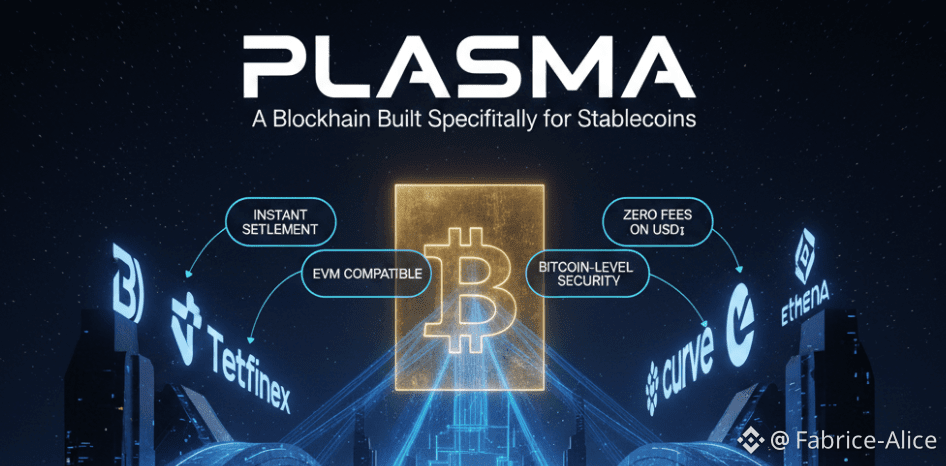
The issue Plasma targets is the inefficiency and fragility of existing stablecoin rails. On Ethereum, stablecoin transfers benefit from strong security but often suffer from high fees and slow confirmations during peak demand. Faster networks offer quicker finality, but they frequently involve compromises around security, decentralization, or validator diversity, which can concern institutional users. Fee tokens are volatile, making transaction costs unpredictable, and users are often forced to manage multiple assets simply to send dollars. For businesses, this added complexity introduces operational and financial risk. Plasma’s core belief is that stablecoins require a dedicated settlement layer, optimized specifically for speed, predictable costs, and neutrality.
From a technical perspective, Plasma assembles well-known components in a way that serves this objective. It maintains full Ethereum execution compatibility by using Reth, a modern Ethereum client written in Rust. As a result, existing smart contracts, developer tools, and wallets from the Ethereum ecosystem can run on Plasma without changes. Developers are not required to adopt a new paradigm, and users interact with applications in familiar ways. This approach is practical rather than ideological. Plasma does not aim to replace Ethereum as a general-purpose platform but instead leverages Ethereum’s mature environment to accelerate real-world adoption.
Plasma’s main departure from Ethereum lies in its consensus mechanism. Instead of relying on proof of work or lengthy confirmation windows, it employs a Byzantine Fault Tolerant system known as PlasmaBFT. This allows the network to reach agreement on transactions in under a second. Once a stablecoin transfer is confirmed on Plasma, it is effectively final. There is no extended waiting period and no meaningful chance of reversal. For payment use cases, this level of certainty is critical. Merchants, payment processors, and financial institutions require immediate and deterministic settlement.
Fee handling is another defining feature of Plasma’s design. For end users, stablecoin transfers, especially USDT transfers, are gasless. Users do not need to hold a separate, volatile token to pay transaction fees. The protocol absorbs these costs through built-in mechanisms. When more complex operations are involved, fees can still be paid directly in stablecoins or even Bitcoin, rather than through a mandatory native gas asset. Internally, these fees are converted into Plasma’s native token, XPL, which is distributed to validators. From the user’s perspective, however, the experience resembles a conventional payment application rather than a typical crypto network.
Plasma also takes a distinctive stance on security. The chain periodically anchors its state to Bitcoin via checkpoints. By committing Plasma’s history to Bitcoin’s blockchain, it inherits some of Bitcoin’s censorship resistance and neutrality. This makes it extremely challenging for any entity to rewrite Plasma’s transaction history or censor activity without also compromising Bitcoin. For institutions handling large transaction volumes, this linkage provides an additional layer of confidence beyond Plasma’s own validator set.
The XPL token serves an understated but vital function within the ecosystem. It is not positioned as a speculative centerpiece, but as the economic backbone of the network. Validators stake XPL to secure the chain and earn rewards for honest behavior. Transaction fees are ultimately settled in XPL, with a portion burned to counterbalance inflation and apply long-term supply pressure. As stablecoin activity on Plasma increases, demand for XPL is intended to arise from network usage and security needs rather than narrative-driven speculation. Governance is also expected to be mediated through XPL, enabling token holders to guide protocol upgrades and system parameters over time.
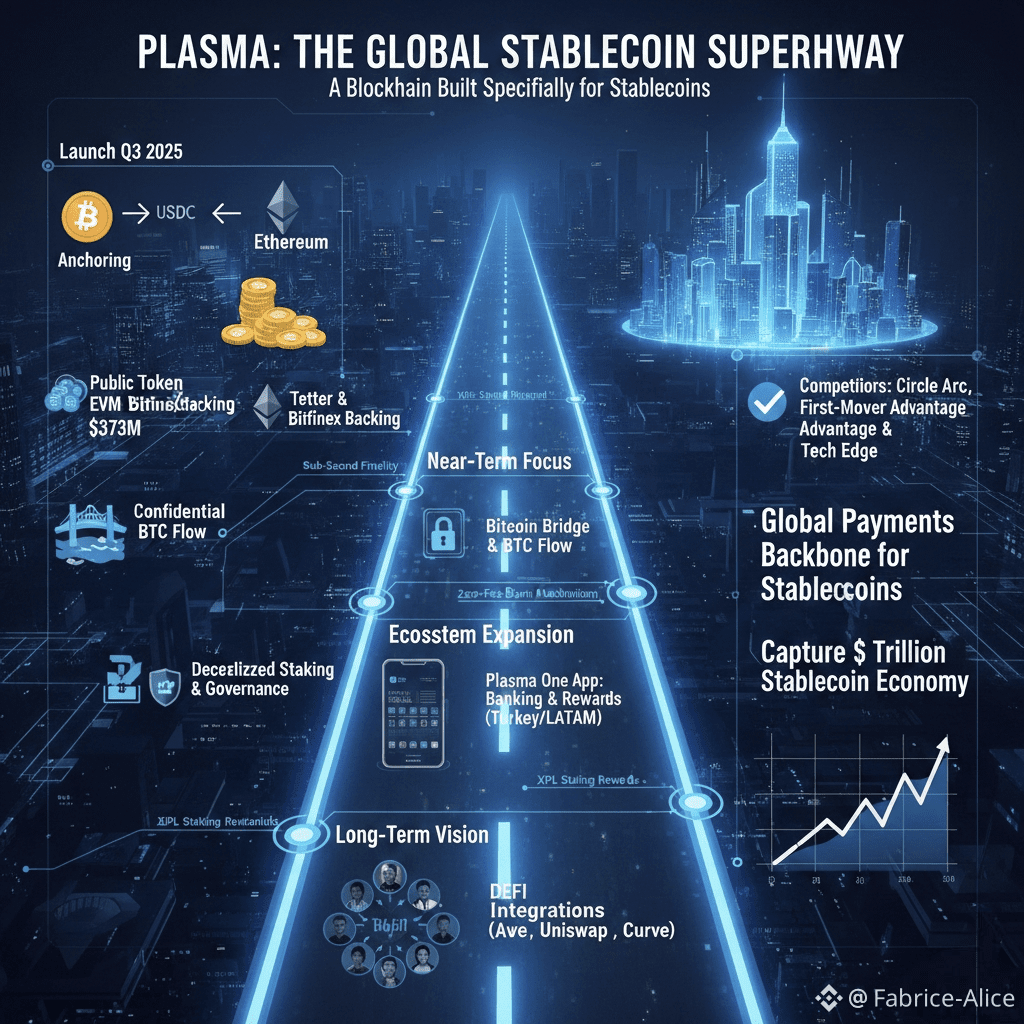
Plasma is designed to integrate seamlessly with the broader crypto landscape. Its full EVM compatibility allows DeFi protocols such as lending platforms, exchanges, and liquidity providers to deploy with minimal friction, benefiting from an environment where stablecoin transfers are inexpensive and fast. This has already drawn interest from major DeFi projects and centralized exchanges. At the same time, Plasma’s close ties to stablecoin issuers and large liquidity providers give it access to significant capital from the outset. A native Bitcoin bridge further strengthens this position by allowing Bitcoin to participate in stablecoin-centric finance without relying on custodial solutions.
In practical terms, Plasma targets both individual users in regions with high stablecoin adoption and institutions engaged in payments and settlement. For people in countries with limited access to dollars or unstable local currencies, Plasma offers a way to hold and transfer digital dollars instantly, without concerns about congestion or gas fees. For businesses operating internationally, Plasma can function as a settlement layer that is faster and more cost-effective than traditional correspondent banking systems. The rollout of consumer-facing products, including stablecoin wallets with yield features and card integrations, shows that Plasma is focused not only on infrastructure but also on everyday user experience.
Development has moved quickly. Plasma launched its mainnet with substantial liquidity commitments and rapidly became one of the largest networks by USDT held. This early momentum signals real demand for a stablecoin-centric blockchain. However, it also exposes a challenge. Much of the initial activity has been driven by incentives and yield programs. Turning that early engagement into consistent, organic payment usage remains an open question. Gasless transfers and subsidies are effective growth levers, but they come with real costs. Over time, Plasma must generate sufficient transaction volume and institutional adoption to sustain its economic model.

Broader risks remain. Plasma’s strong focus on USDT ties it closely to the regulatory environment surrounding stablecoins. Its early dependence on a relatively concentrated group of partners raises decentralization concerns in the short term. Additionally, advanced features such as confidential transactions and full Bitcoin bridging still need to be delivered and proven at scale. These challenges are not insurmountable, but they emphasize that Plasma is still in an early phase.
Looking forward, Plasma’s goal is straightforward: to become the default settlement layer for stablecoins, much as Bitcoin became synonymous with digital gold. If successful, users may not even perceive Plasma as a blockchain. It would simply operate as invisible infrastructure, moving digital dollars instantly and reliably around the globe. Achieving this vision will depend less on novelty and more on execution, discipline, and sustained adoption. What is clear is that Plasma represents a serious effort to design blockchain infrastructure around how money is actually used, rather than how the crypto ecosystem often imagines it should be used.
