
As Walrus Protocol moved from concept to implementation, architecture became its defining feature. The network was designed to break data into verifiable chunks that could be distributed across nodes while remaining easy to reconstruct. I’m noticing how much attention was given to redundancy and retrieval speed. Data availability only matters if data can actually be accessed when needed.
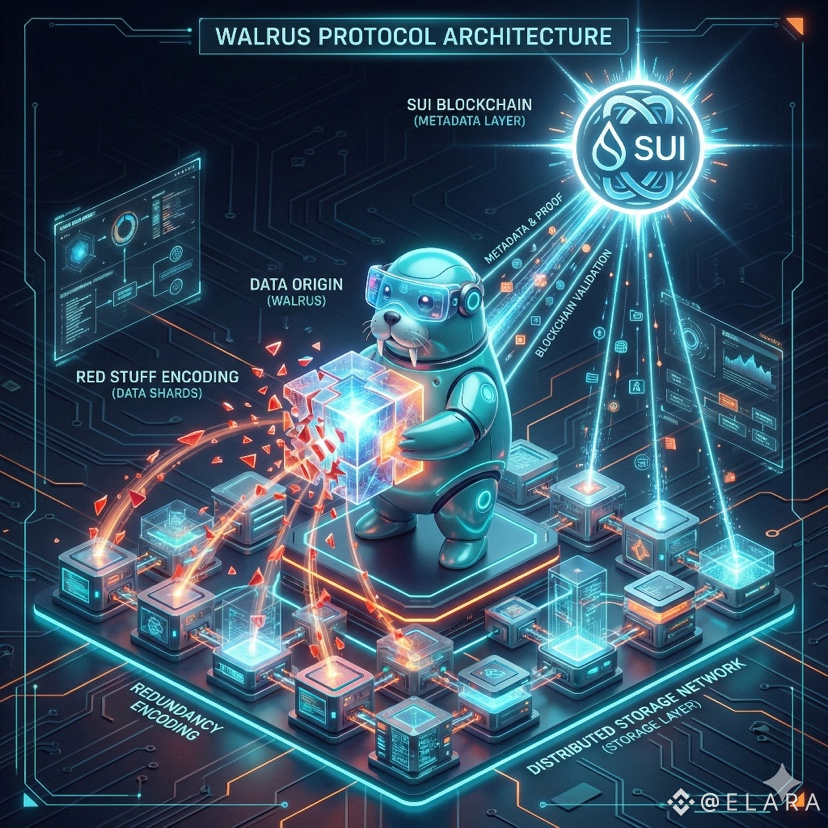
They’re also thinking about developers first. Walrus is not positioned as a consumer-facing product but as infrastructure that applications quietly rely on. This is where @Walrus 🦭/acc branding started to appear more frequently across technical discussions. If developers can integrate Walrus without rethinking their entire stack, adoption becomes more natural.
The $WAL token was introduced to coordinate incentives across the network. Its role connects node operators, data publishers, and users into a shared economic system. Rather than focusing purely on speculation, $WAL is tied to storage commitments, data availability guarantees, and network participation. I’m seeing that this design reflects lessons learned from earlier storage protocols where incentives often drifted away from real usage.
Security and resilience became central during testing phases. Walrus was stress-tested under simulated load and adversarial conditions to ensure data remained accessible even when parts of the network failed. They’re approaching decentralization as a gradient rather than a switch, improving reliability over time instead of claiming perfection from day one.