

@Dusk There’s a certain kind of honesty you only learn by spending time near regulated money. It is not dramatic honesty. It’s the quiet kind that shows up when a compliance officer asks a simple question and you realize the whole system has to answer it without flinching. Dusk exists inside that question. Not as a philosophical argument for privacy, but as a practical attempt to let sensitive financial activity happen on-chain without turning every participant into public evidence.
Most people talk about “transparency” as if it’s always a virtue. In real markets, visibility is a tool, not a moral stance. Too little visibility and you lose accountability. Too much and you invite front-running, intimidation, reputational harm, and the kind of second-order chaos that makes institutions pull back even when they believe in the technology. Dusk’s bet is that a market can be verifiable without being voyeuristic, and that this is not a luxury feature but an emotional requirement for participants who have real names and real consequences. 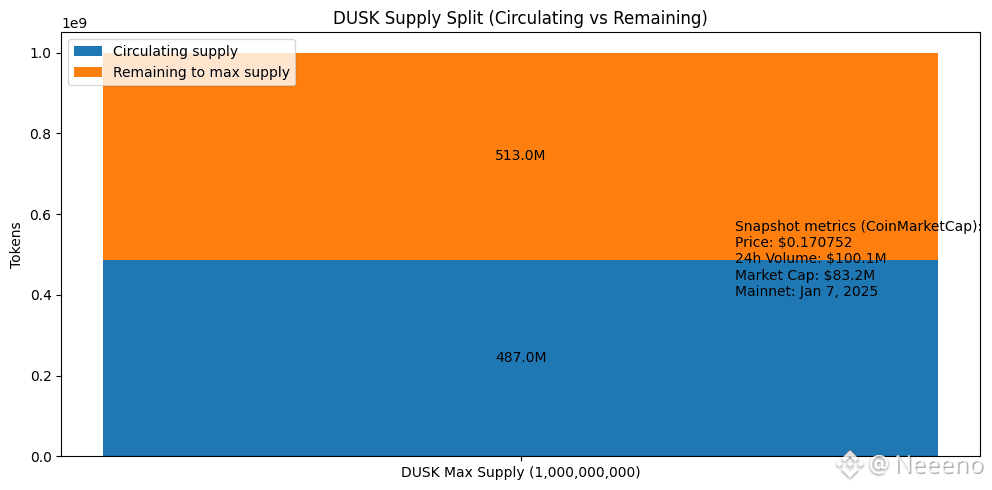
If you’ve ever watched a deal move from intent to execution, you know where things actually break. It’s rarely the big headline risks. It’s mismatched data between parties, timing disputes, settlement expectations that don’t align, and the creeping fear that you can’t prove what happened without exposing far more than you should. Dusk is built around the idea that proof should be available when demanded, while day-to-day activity stays quiet enough to be safe. That changes how people behave. It reduces the instinct to “wait for certainty” because the system is designed to produce certainty without demanding public confession.
This is also why the conversation around Dusk keeps circling back to regulated venues rather than purely retail narratives. When a regulated market participant considers using a chain, they don’t start with throughput graphs. They start with governance risk, disclosure obligations, and whether a mistake can be contained. The NPEX partnership is one of those moments where the story becomes less theoretical, because it explicitly frames the chain as plumbing for regulated instruments rather than a generic playground.
That partnership matters psychologically as much as commercially. In regulated settings, confidence is a resource that gets consumed quickly and replenished slowly. A single incident can rewrite internal policy for years. So systems that aim to host regulated assets must be built for the bad day: the delayed signature, the disputed record, the regulator who asks for a timeline, the issuer who needs to enforce rules without humiliating every holder. Dusk’s posture is essentially a refusal to pretend those days are rare.
You can see the same seriousness in how Dusk talks about its mainnet timeline, because timelines are another place where trust is either earned or lost. The rollout communications weren’t framed as fireworks; they were framed as staged activation: early deposits, genesis preparation, and the expectation of an “immutable block” on a specific date. That date—January 7, 2025—became a psychological anchor for the ecosystem because it moved Dusk from “we’re building” into “we’re accountable now.”
Once a network crosses that line, every small operational detail becomes human. Staking isn’t just a yield mechanic; it’s an agreement to keep showing up. Waiting periods aren’t just protocol parameters; they’re the difference between feeling in control and feeling stuck. Dusk’s documentation is explicit about a maturity delay before rewards begin—measured in blocks and roughly translated into hours based on expected block timing—and that kind of clarity is not cosmetic. It’s what prevents misunderstandings from becoming resentment, and resentment from becoming churn.
Token mechanics sit right at the center of this, because “the token” is where ideals meet incentives. DUSK is described as the native currency of the protocol and the incentive for consensus participation, and the project has had to manage a real transition: DUSK existing as ERC-20 or BEP-20 representations, while mainnet enables migration to a native form via a burn-and-mint style flow. That migration isn’t just a technical footnote. It’s a test of operational calm: can you move value without spiking user anxiety, without confusing custodians, without creating the kind of fragmented liquidity that makes institutions hesitate?
The market data around DUSK right now tells its own story about attention and pressure. In mid-January 2026, DUSK has been trading around $0.17 with daily volume on the order of roughly $100M, and a market cap around the low-$80M range, with circulating supply reported near 486,999,999 against a stated maximum of 1,000,000,000. Those numbers can feel abstract until you remember what volume really is: stress testing by strangers. It’s liquidity that can vanish, slippage that can hurt, and sudden volatility that drags emotion into every decision. A network designed for regulated markets can’t pretend that token turbulence is separate from user trust.
When volume spikes, the human question becomes: does the chain behave like a steady room, or like a crowded hallway? This is where the quiet engineering shows up—less in marketing claims and more in release notes, in the unglamorous work of making data queries reliable, making event indexing more usable, and adding the pieces developers need to integrate without building fragile workarounds. Even if you never read the code, you can see ongoing iteration in the core node software releases through late 2025, including improvements around APIs, metadata access, and more scalable querying. That’s the kind of progress that doesn’t trend on social media but determines whether real teams can ship without living in fear of edge cases.
The deeper point is that regulated finance is full of disagreements that aren’t malicious. Two parties can honestly believe different versions of the same event because their systems timestamp differently, reconcile differently, or apply different rules. A chain that wants to host regulated assets must be built to survive those disagreements without forcing everyone into a single public narrative. Dusk’s framing—privacy by default with the ability to prove when required—is essentially an attempt to let disputes be resolved through controlled disclosure rather than public spectacle. That’s how you keep markets functional when trust is thin. 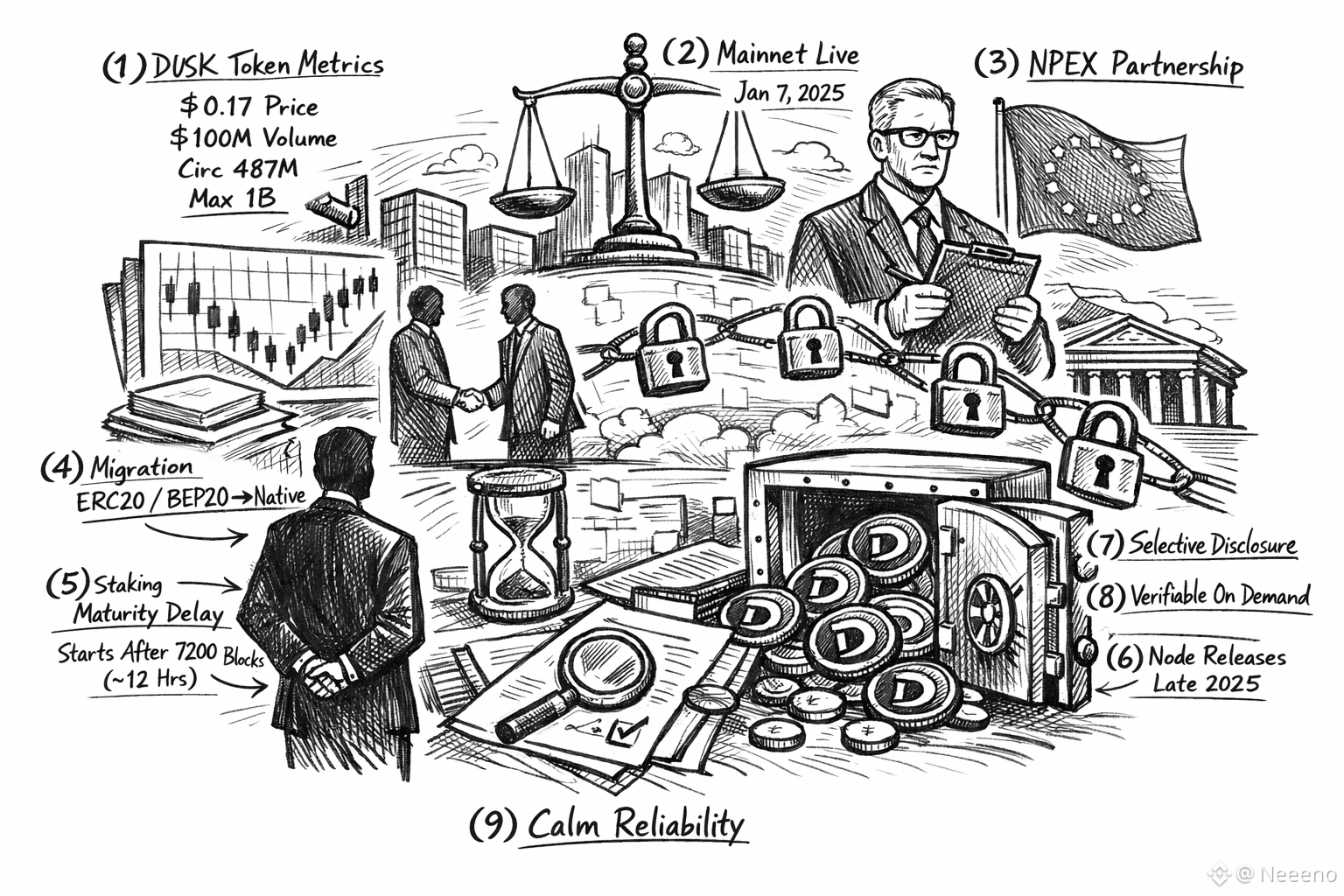
It also changes the economics of honesty. In open networks, honesty is often treated as a moral preference. In regulated markets, honesty is enforced through incentives, audits, and the constant awareness that “we might have to explain this later.” Dusk leans into that reality by designing around verifiability as a normal outcome, not a heroic exception. When you design the system so that correct behavior can be demonstrated without destroying confidentiality, you reduce the temptation to hide behind ambiguity, and you reduce the collateral damage of compliance itself.
Recent exchange activity and listings add another layer of social reality: accessibility draws in new participants who do not share the same context or patience. Around mid-January 2026, coverage notes additional exchange exposure for DUSK, and you can feel how that widens the emotional range of the user base—more newcomers, more speculation, more impatient expectations. The chain can’t control that. What it can control is whether it remains predictable under load, whether users can stake and transfer without mystery, and whether the system’s privacy posture holds even when attention gets loud.
There’s a temptation, especially in crypto, to treat “being talked about” as the same thing as progress. Dusk’s trajectory pushes against that. The real work is slower and more disciplined: aligning a privacy-preserving on-chain environment with the procedural world of regulated instruments, and doing it in a way that doesn’t demand that institutions abandon their risk instincts. The NPEX effort to prepare for the EU DLT Pilot Regime is a good example of how unglamorous that alignment is. Applications, frameworks, and permissions are not fun. But they are how markets become real.
And then there’s the simplest metric of all: do people feel safe using it when they’re under pressure? Safety here isn’t ideological. It’s the ability to send value without wondering if you’ve exposed your position to the entire world, the ability to participate without being forced into performative transparency, the ability to satisfy oversight without sacrificing dignity. Dusk’s entire reason for existing is that regulated markets already know what happens when information leaks. They’ve lived it. The chain is trying to make those lessons native, not bolted on.
If you want to be honest about Dusk, you have to say this: it’s built to be dependable, not entertaining. Around mid-January 2026, it’s near $0.17, doing roughly $100M in 24-hour volume, with about 487M tokens circulating out of a 1B maximum. That kind of data can create a lot of chatter. But the real signal is in the timeline: January 7, 2025 turned important mainnet work into something real, development kept moving through late 2025, and the commercial direction stays tied to regulated finance and market infrastructure rather than abstract theory.
Quiet responsibility is a strange thing to build toward in an industry that rewards attention. Yet invisible infrastructure is what people rely on when they can’t afford surprises. If Dusk succeeds, it won’t be because it was the loudest chain in the room. It will be because, in the moments when something went wrong—or almost did—the system stayed calm, preserved confidentiality without sacrificing proof, and let real people move through real financial obligations without becoming public collateral. Reliability doesn’t ask to be noticed. It just asks to be there, every time.
