

@Walrus 🦭/acc I didn’t start thinking about Walrus because of its technology stack or its token design. What caught my attention was something far less glamorous: how little drama there seemed to be around its pricing model. In Web3, pricing is usually where systems reveal their weakest assumptions. Either storage becomes artificially cheap until operators disappear, or it becomes so volatile that serious users quietly walk away. Walrus didn’t appear to be optimizing for either excitement or speed. It looked like it was optimizing for continuity. That alone made me pause, because continuity is rarely the goal in early-stage decentralized infrastructure.
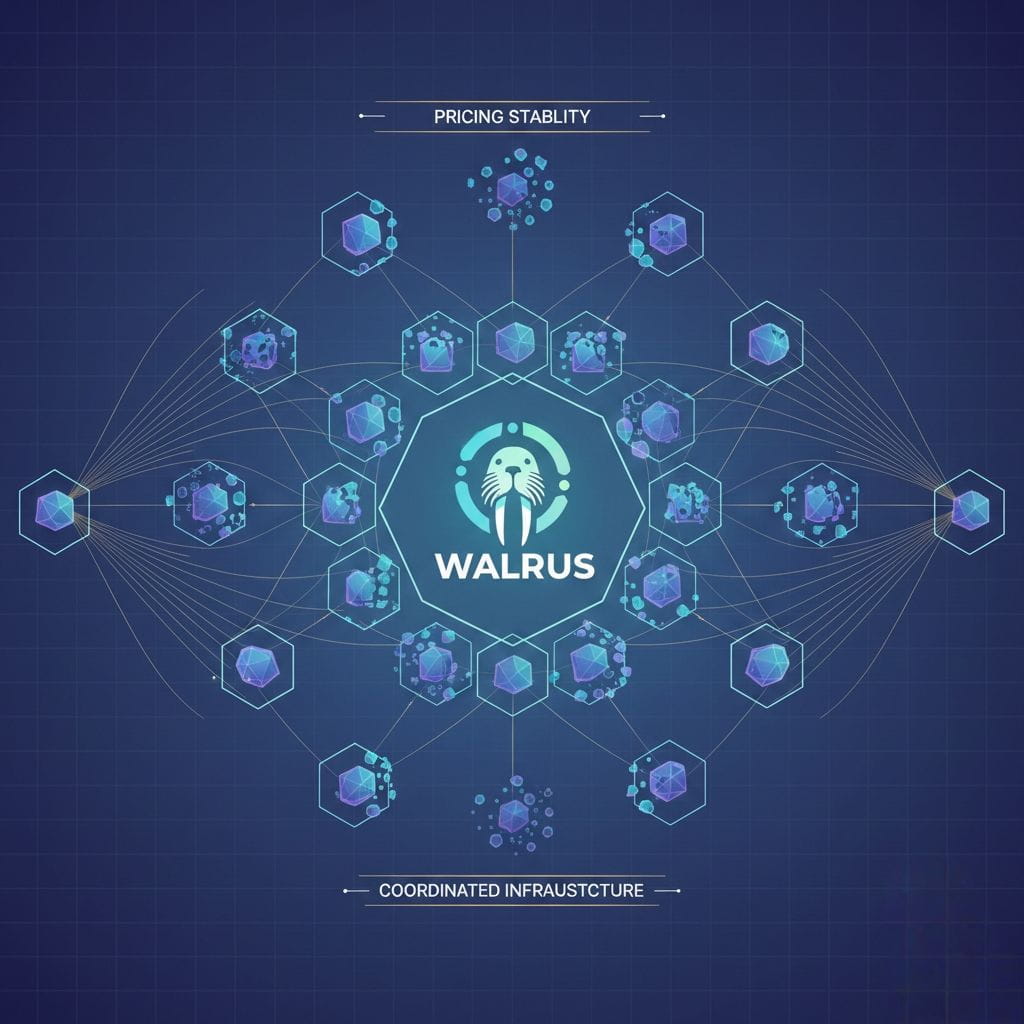 Walrus approaches storage pricing with a premise that feels almost old-fashioned: storage is a long-term responsibility, not a one-off transaction. Data isn’t written and forgotten. It has to remain available, reconstructable, and verifiable over time. That reality shapes how payments for writes and storage are handled. Instead of treating storage as a pure spot market where nodes constantly undercut each other on price, Walrus frames it as a coordinated service with competitive edges. Users pay for writes with an implicit expectation of durability, and storage operators are compensated for maintaining availability over time, not just for showing up at the beginning. The system doesn’t eliminate competition, but it narrows where competition actually makes sense.
This is where the technical design quietly supports the economic one. Walrus relies on blob storage combined with erasure coding, meaning data is fragmented and distributed across many nodes, with only a subset required for reconstruction. That structure prevents any single operator from controlling availability or pricing. At the same time, it discourages short-term participation. Nodes can’t cheaply enter, collect rewards, and exit without undermining their own incentives. Payments align with that reality. They reward consistency and uptime rather than opportunistic behavior. For users, this translates into storage costs that are easier to reason about. For operators, it creates a clearer trade-off between efficiency and responsibility.
The WAL token sits in the background of this system, doing coordination work rather than demanding attention. WAL supports staking, governance, and long-term incentive alignment, but it isn’t used to turn every storage write into a speculative moment. That separation matters more than it sounds. In many decentralized systems, pricing is tightly coupled to token volatility, making budgeting nearly impossible for applications that want to operate beyond experimentation. Walrus tries to decouple these forces. Storage pricing is meant to reflect resource usage and commitment, not short-term market sentiment. It’s not a perfect separation, but it’s a meaningful one.
From experience, this approach feels shaped by what has already failed elsewhere. I’ve seen decentralized storage networks race to the bottom on pricing, only to collapse once incentives dried up. I’ve also seen the opposite: over-coordinated systems where governance fixed prices and slowly suffocated efficiency. Walrus appears to be aiming for a middle ground. Competition exists, but within constraints that protect the network from self-destructive behavior. Coordination exists, but without freezing the system in place. It’s not an exciting balance, but infrastructure rarely survives by being exciting.
There are still open questions, and Walrus doesn’t hide them. How pricing adapts as demand grows will matter. How governance responds if storage provision begins to concentrate will matter even more. Whether WAL incentives remain aligned through different market cycles is an open test, not a solved problem. But what stands out is that these questions are being addressed at the level of system design, not deferred until something breaks. Payments for storage and writes aren’t treated as a marketing feature. They’re treated as part of the protocol’s long-term health.
In a broader Web3 context, this feels timely. Builders and enterprises are becoming less interested in theoretical efficiency and more interested in predictability. They want to know what storage will cost next month, not just today. Walrus doesn’t promise the cheapest storage or the fastest writes. It promises something quieter: a system where pricing behaves rationally over time. If that holds, Walrus won’t win because it outcompetes everyone on cost. It will win because it makes decentralized storage feel like something you can plan around. And for infrastructure, that’s usually the difference between being tested and being trusted.