


DUSK Network is a blockchain platform designed for privacy-preserving smart contracts and regulated decentralized finance (DeFi) services. At its core is the DUSK token, which powers the network's operations, security, and governance. As of January 2026, with a circulating supply of approximately 500 million tokens and a market cap around $125 million, DUSK's tokenomics emphasize long-term sustainability through controlled emissions, staking incentives, and subtle burn elements. This article delves into the intricacies of DUSK's burn mechanisms and overall supply dynamics, drawing from official documentation and economic models to provide a clear picture of how these elements influence the token's scarcity and value.
Overview of DUSK Token Supply
The DUSK token has a capped maximum supply of 1 billion tokens, split evenly between an initial allocation and future emissions. The initial supply consists of 500 million DUSK tokens, originally issued as ERC-20 on Ethereum and BEP-20 on Binance Smart Chain. These have been progressively migrated to native DUSK tokens on the DUSK Network mainnet via a specialized burner contract, which burns the old tokens and mints equivalents on the new chain.
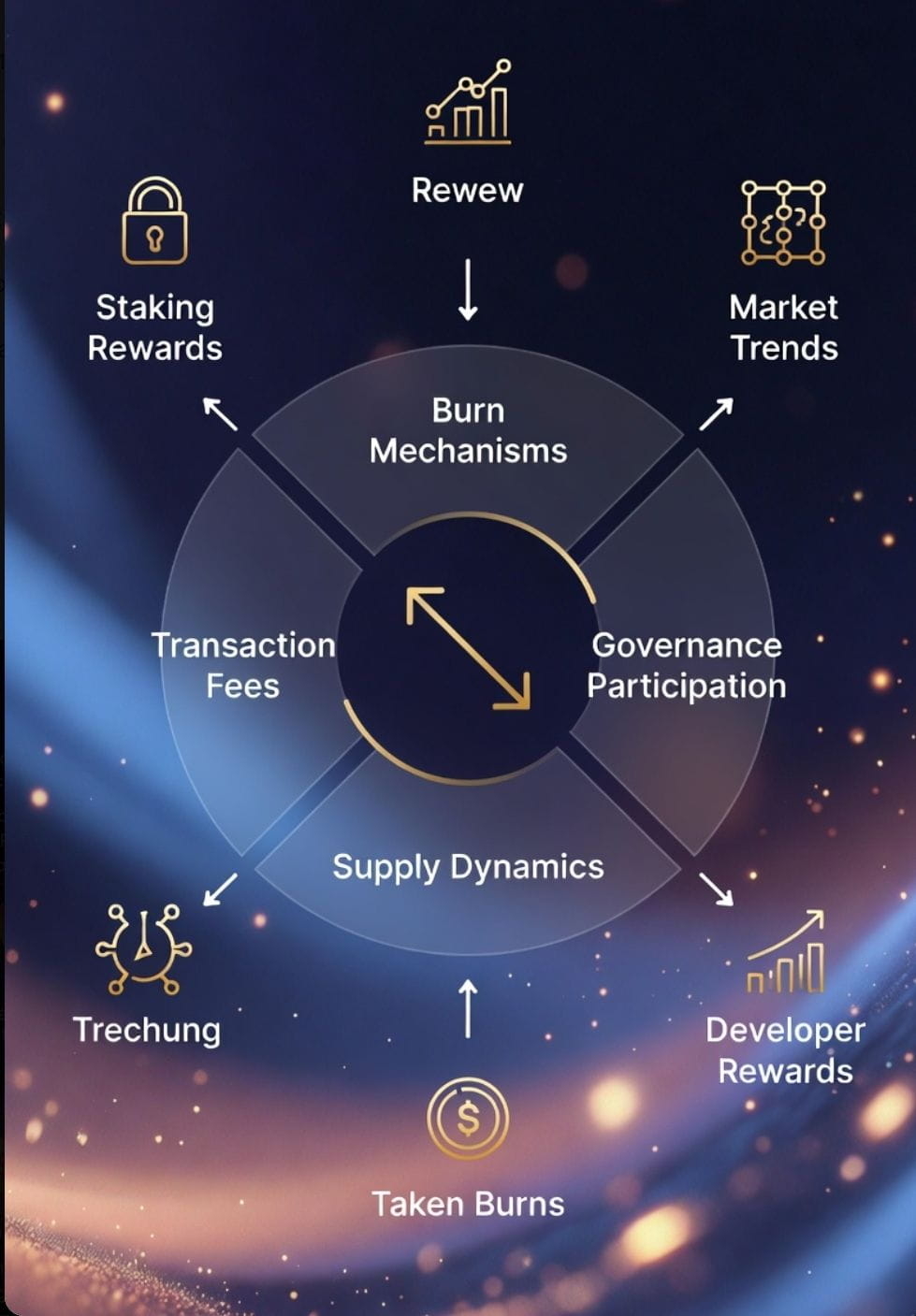
The remaining 500 million tokens are designated for emission over a 36-year period to reward network participants, primarily stakers. This extended timeline is intended to foster early adoption while gradually tapering inflation. As of now, the circulating supply stands at around 500 million, reflecting the initial tokens minus those still held by the project's deployer wallet. This structure contrasts with many cryptocurrencies that rely heavily on aggressive burns; instead, DUSK prioritizes utility-driven demand and locked supply through staking.
The Emission Schedule: A Geometric Decay Model
DUSK's supply inflation is managed through a structured emission schedule that halves rewards every four years, similar to Bitcoin's halving but extended over nine periods totaling 36 years. This geometric decay starts with a reduction rate of 0.5, ensuring rapid initial incentives to build network participation while slowing over time to minimize long-term dilution.
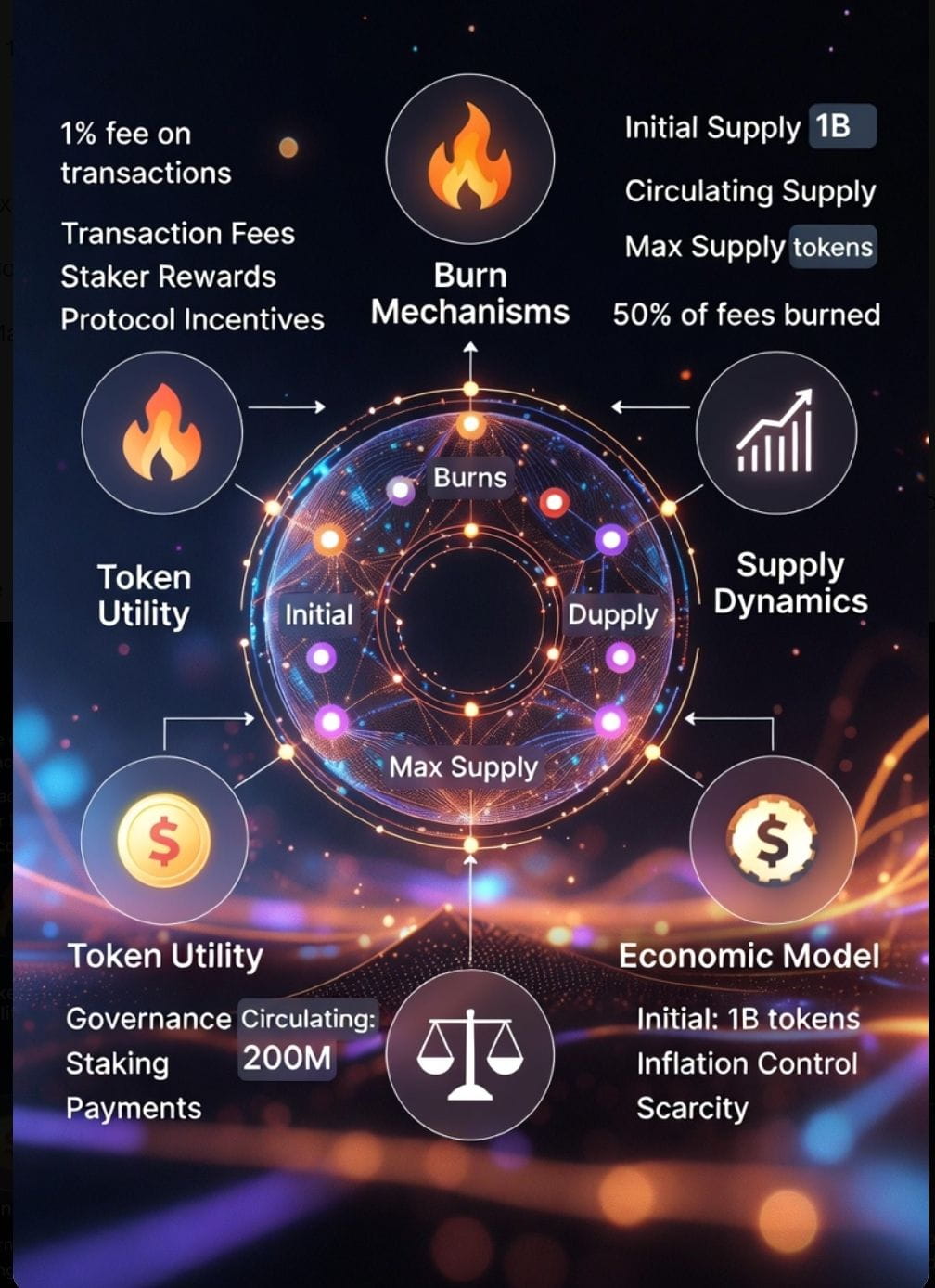
Here's a breakdown of the emission periods:
Years 0-4: 250.48 million DUSK emitted (approximately 19.86 DUSK per block).
Years 4-8: 125.24 million DUSK (9.93 DUSK per block).
Years 8-12: 62.62 million DUSK (4.96 DUSK per block).
Years 12-16: 31.31 million DUSK (2.48 DUSK per block).
Years 16-20: 15.65 million DUSK (1.24 DUSK per block).
Years 20-24: 7.83 million DUSK (0.62 DUSK per block).
Years 24-28: 3.91 million DUSK (0.31 DUSK per block).
Years 28-32: 1.95 million DUSK (0.16 DUSK per block).
Years 32-36: 0.98 million DUSK (0.08 DUSK per block).
By the end of this schedule, the cumulative emitted supply will approach 500 million, bringing the total to nearly 1 billion. Each period spans about 12.6 million blocks, aligning with the network's block production rate. This model is designed to create predictable scarcity, encouraging long-term holding and participation without abrupt supply shocks.
Burn Mechanisms in DUSK Network
Unlike projects that burn a portion of transaction fees (e.g., Ethereum's EIP-1559 or BNB's auto-burn), DUSK does not feature a primary ongoing burn tied to network activity. However, there are targeted burn mechanisms that contribute to supply reduction:
Migration Burner Contract: During the transition from ERC-20/BEP-20 to native DUSK, tokens are sent to a burner contract that permanently removes them from circulation on the original chains while minting equivalents on DUSK Network. This one-time process has already handled much of the initial supply migration, effectively burning legacy tokens to prevent double-spending or inflation across chains.
Undistributed Rewards Burn: In the network's reward distribution, 10% of block rewards are allocated based on a credit system for consensus participants. Any undistributed portion of this 10% is burned via the gas-burning mechanism. This ensures that unclaimed rewards do not inflate the supply indefinitely, adding a deflationary pressure tied to network efficiency.
These burns are not the dominant force in DUSK's tokenomics. Instead, the project emphasizes that its "utility-driven supply and demand dynamic is far healthier than a simple burn mechanism." Analysts note that while burns exist, they are secondary to staking and utility, which naturally reduce liquid supply without destroying tokens outright.
Staking and Its Role in Supply Dynamics
Staking is central to DUSK's proof-of-stake consensus, requiring a minimum of 1,000 DUSK to participate. There's no upper limit, and stakes mature over two epochs (about 4,320 blocks). Importantly, unstaking carries no penalties or lock-up periods, making it flexible for users.
Rewards are drawn from block emissions plus transaction fees, distributed as follows:
70% to the block generator.
10% credit-based (with undistributed amounts burned).
10% to the Dusk Development Fund.
5% each to validation and ratification committees.
Staking locks tokens out of circulation, effectively reducing the liquid supply. As more users stake for rewards and security, this creates a flywheel: higher staking leads to fewer tokens available for trading, potentially supporting price stability. Combined with growing demand from real-world asset (RWA) tokenization and zero-knowledge proof usage, staking helps counterbalance emissions. Soft slashing for misbehavior reduces effective stakes without burning tokens, further incentivizing good behavior.
Token Utilities and Demand Drivers
DUSK's value proposition extends beyond speculation, with utilities that drive organic demand:
Network Fees: Paid in LUX (1 LUX = 10^-9 DUSK), covering gas for transactions and smart contracts. Fees are added to block rewards, redistributing value to stakers.
dApp Deployment and Services: Tokens are used to deploy and interact with privacy-focused applications, including compliance checks for RWAs.
Governance and Consensus: Staking enables participation in network decisions and security.
As adoption grows--particularly in regulated DeFi and RWA trading--demand for DUSK increases. This utility loop (more assets on-chain - more transactions - higher fees and staking rewards - more locked tokens) creates a self-reinforcing ecosystem, reducing reliance on burns for scarcity.
Overall Supply Dynamics: Balancing Inflation and Scarcity
DUSK's supply dynamics prioritize equilibrium over aggressive deflation. Early high emissions (e.g., 250 million in the first four years) bootstrap the network, while halvings ensure inflation drops to negligible levels by year 36. Burns play a supportive role, primarily through migration and undistributed rewards, but the real deflationary pressure comes from staking and utility lock-ups.
This approach mitigates risks like those in high-burn models, where scarcity can lead to volatility if demand falters. Instead, DUSK aims for "healthier token dynamics" through reduced liquid supply and real utility. With max supply capped at 1 billion and emissions tapering, long-term holders may benefit from gradual scarcity as network activity ramps up.
In summary, DUSK Network's tokenomics blend controlled inflation with strategic burns and staking to foster a sustainable ecosystem. While not as burn-heavy as some peers, this model positions DUSK for growth in privacy-centric blockchain applications, potentially driving value through demand rather than destruction alone. Investors should monitor adoption metrics, such as staking participation and RWA integrations, to gauge future dynamics.