
In the rapidly maturing cryptocurrency landscape of 2026, where institutional capital flows increasingly dictate market directions and regulatory scrutiny intensifies, privacy has emerged as both a premium feature and a compliance necessity. Traditional blockchains like Ethereum offer transparency that regulators adore but investors often resent, exposing positions, strategies, and balances to front-running, copy-trading, or competitive intelligence gathering. Pure privacy coins, while shielding users effectively, frequently clash with anti-money laundering (AML) and know-your-customer (KYC) mandates, limiting their appeal to sophisticated financial entities. Enter Dusk Network and its groundbreaking Hedger Alpha—a technological bridge that reconciles these opposing forces, enabling confidential yet fully auditable transactions on an Ethereum Virtual Machine (EVM)-compatible chain. This innovation is not merely a technical upgrade; it represents a paradigm shift toward generating genuine alpha in regulated decentralized finance (DeFi) and tokenized real-world assets (RWAs), where privacy becomes a competitive edge rather than a regulatory liability.
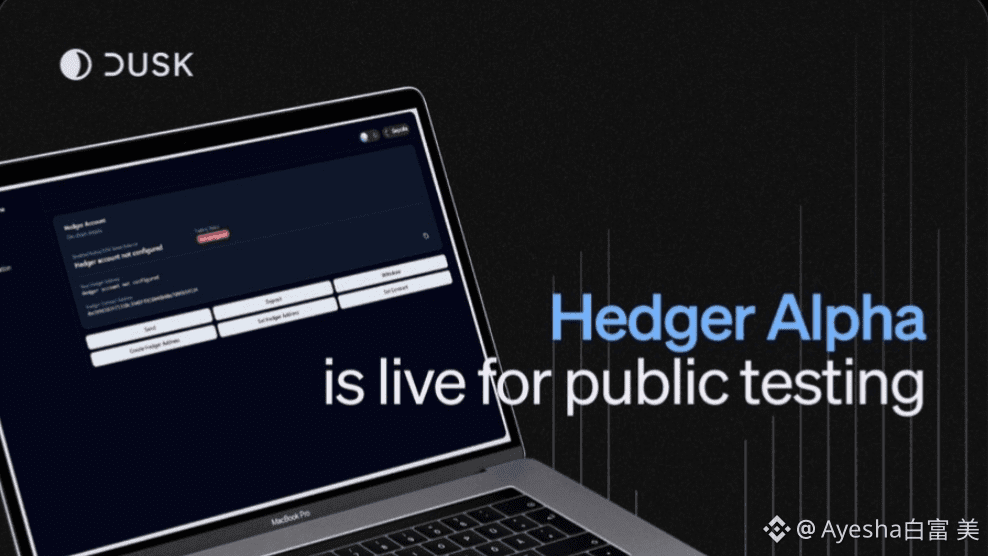
Dusk Network, founded with the explicit mission of unlocking economic inclusion by bringing institution-level assets to everyday wallets, has long positioned itself at the intersection of privacy-first blockchain design and real-world financial utility. Unlike many Layer-1 projects that prioritize speed or scalability at the expense of confidentiality, Dusk builds its architecture around privacy as a core primitive. The network's evolution into a modular system has culminated in DuskEVM, an execution layer that maintains full compatibility with Ethereum tooling while layering on advanced privacy mechanisms. At the heart of this lies Hedger, a dedicated privacy engine purpose-built for the EVM environment. Launched in alpha for public testing in late 2025, Hedger Alpha allows developers, users, and institutions to experiment with confidential transactions—shielding balances and transfer amounts from public view—while preserving the auditability required by regulators. This dual capability stems from a sophisticated blend of zero-knowledge proofs (ZKPs) and homomorphic encryption, technologies that enable mathematical verification of transactions without revealing underlying data.
The mechanics of Hedger are elegant in their complexity. Traditional EVM transactions broadcast amounts, sender, and recipient addresses in plaintext, making them vulnerable to analysis. Hedger defaults to encryption, utilizing ElGamal-style schemes for additive homomorphism, which permits computations (like balance updates) directly on encrypted values. When a private transfer occurs, the sender encrypts the amount and recipient details; the network processes these ciphertexts using homomorphic properties to adjust balances without decryption. ZKPs then prove the validity of these operations—ensuring no double-spending, sufficient funds, and correct arithmetic—before the state is updated. This creates a system where transactions remain private to participants and observers alike, yet regulators or authorized auditors can selectively decrypt or verify compliance through predefined keys or proofs. Unlike fully shielded protocols that offer blanket opacity, Hedger's design incorporates selective disclosure, making it MiCA-compliant in Europe and adaptable to other jurisdictions pushing for traceable yet protected financial flows.
Hedger Alpha's rollout on the Sepolia testnet marked a pivotal moment, inviting the community to test core functions like shielding (converting public assets to private), unshielding, and private transfers. Early feedback highlighted the seamless integration with standard wallets and tools, a testament to Dusk's commitment to developer accessibility. By running natively on DuskEVM, Hedger avoids the fragmentation plaguing other privacy solutions that require custom chains or bridges. This compatibility opens doors for existing Solidity smart contracts to deploy with built-in privacy, transforming DeFi applications from transparent to confidential without extensive rewrites. For hedge funds and institutional players, this means executing sophisticated strategies—arbitrage across exchanges, yield optimization in DeFi pools, or proprietary trading signals—without leaking alpha-generating information to the market.
The true power of Hedger Alpha lies in its implications for alpha generation in crypto markets. In traditional finance, hedge fund alpha derives from information asymmetry, superior risk management, and uncorrelated returns. Crypto's 24/7 nature and high volatility amplify these opportunities but also heighten risks from visible on-chain activity. Front-running bots scan mempools for large trades; competitors reverse-engineer strategies from wallet clusters; even casual observers can track whale movements. Hedger mitigates these by cloaking positions, allowing funds to accumulate or distribute assets discreetly. Imagine a hedge fund spotting undervalued tokenized securities on Dusk—perhaps RWAs like European equities or bonds—then privately accumulating via shielded transfers. The privacy preserves the edge until execution, while auditability satisfies compliance teams and custodians. This is particularly relevant in 2026, as tokenized assets surge, with initiatives like NPEX's multi-hundred-million-euro securities programs leveraging Dusk for compliant issuance and trading.
Dusk's focus on regulated finance positions Hedger as a catalyst for institutional adoption. Privacy coins like Monero excel at anonymity but struggle with mainstream integration due to delistings and regulatory pressure. Hedger flips the script: privacy serves compliance rather than evading it. Regulators gain verifiable oversight—transaction graphs remain intact for AML monitoring, with encrypted payloads decryptable under warrant or automated selective disclosure—while users retain confidentiality. This hybrid model aligns perfectly with the tokenized economy's growth, where institutions demand both security and transparency. Dusk's partnerships and roadmap emphasize RWAs, with plans to onboard billions in assets through privacy-preserving tokenization. Hedger enables confidential smart contracts for dividend distributions, voting rights, or automated compliance checks, all while keeping sensitive financial data hidden from competitors.
Community and ecosystem momentum further underscore Hedger Alpha's potential. Since its public alpha launch, thousands have engaged via testnet interactions, with forums buzzing about real-world applications. Developers praise the low-friction onboarding—deploy a private ERC-20 equivalent or build a confidential DEX in familiar Solidity. Institutions eye the infrastructure for private lending pools, where borrowers shield collateral without exposing portfolios. In DeFi, Hedger could enable private yield farming or options trading, reducing liquidation risks from visible positions. The network's native token, DUSK, captures value through staking, governance, and fees from private transactions, creating aligned incentives as adoption scales.
Challenges remain, as with any alpha-stage technology. Hedger's reliance on advanced cryptography demands rigorous auditing to prevent vulnerabilities in encryption schemes or proof systems. Performance overhead from ZKPs and homomorphic operations, though mitigated by Dusk's optimized architecture, could impact throughput compared to plain EVM chains. User experience in managing shielded versus public balances requires refinement to avoid confusion. Yet these are growing pains typical of transformative tech. As Hedger progresses toward mainnet integration, iterative improvements based on alpha feedback will address them.
Looking ahead, Hedger Alpha heralds a future where privacy is not a niche but a standard for institutional-grade crypto. In a world of increasing tokenization—equities, debt, commodities moving on-chain—confidentiality becomes essential for protecting alpha while meeting regulatory demands. Dusk Network, through Hedger, is not just building a blockchain; it's engineering the rails for compliant, private, and inclusive finance. For hedge funds, traders, and institutions seeking an edge in volatile markets, this compliant privacy layer could prove the difference between alpha and average returns. As 2026 unfolds with more RWAs, stricter regulations, and sophisticated crypto strategies, Hedger stands ready to power the next wave of decentralized yet regulated innovation, proving that privacy and transparency need not be adversaries but allies in unlocking true economic potential.
