
Sometimes the most interesting blockchain projects are not the ones gaining attention today. They are the ones preparing for an audience that has not arrived yet. Dusk Foundation feels exactly like that.
From the beginning, Dusk has focused on institutional finance. Not retail users. Not traders. Not hype cycles. Institutions move slowly. They require compliance. They operate under regulation. They need certainty.
Most public blockchains simply cannot offer that.
I remember thinking how strange it is that we expect banks to use systems where every transaction is public forever. That is not transparency. That is exposure. Dusk understands this difference deeply.
The network is built around confidential smart contracts. These contracts allow financial logic to execute privately while still being verifiable. That means business rules can be enforced without revealing private data.
This is crucial for real world assets. Ownership limits. Eligibility checks. Settlement rules. All of this must happen without leaking sensitive information.
Dusk treats privacy as infrastructure, not a feature.
Their architecture separates execution and verification in a way that allows auditing without exposure. Regulators can verify activity. Institutions can operate securely. The network remains decentralized.
This balance is extremely difficult to achieve, which is why few projects even attempt it.
The consensus mechanism focuses on fast and deterministic settlement. In financial markets, finality matters more than speed. Uncertainty creates risk. Dusk is built around predictable outcomes.
I’m noticing that this design mirrors traditional market systems more than crypto experiments. That is intentional. Institutions do not want to learn new behavior. They want familiar processes delivered more efficiently.
The DUSK token supports staking and network security. Validators are economically aligned to act honestly. This is standard in crypto, but in Dusk’s case it reinforces trust rather than speculation.
They’re not selling a dream of disruption. They’re offering continuity.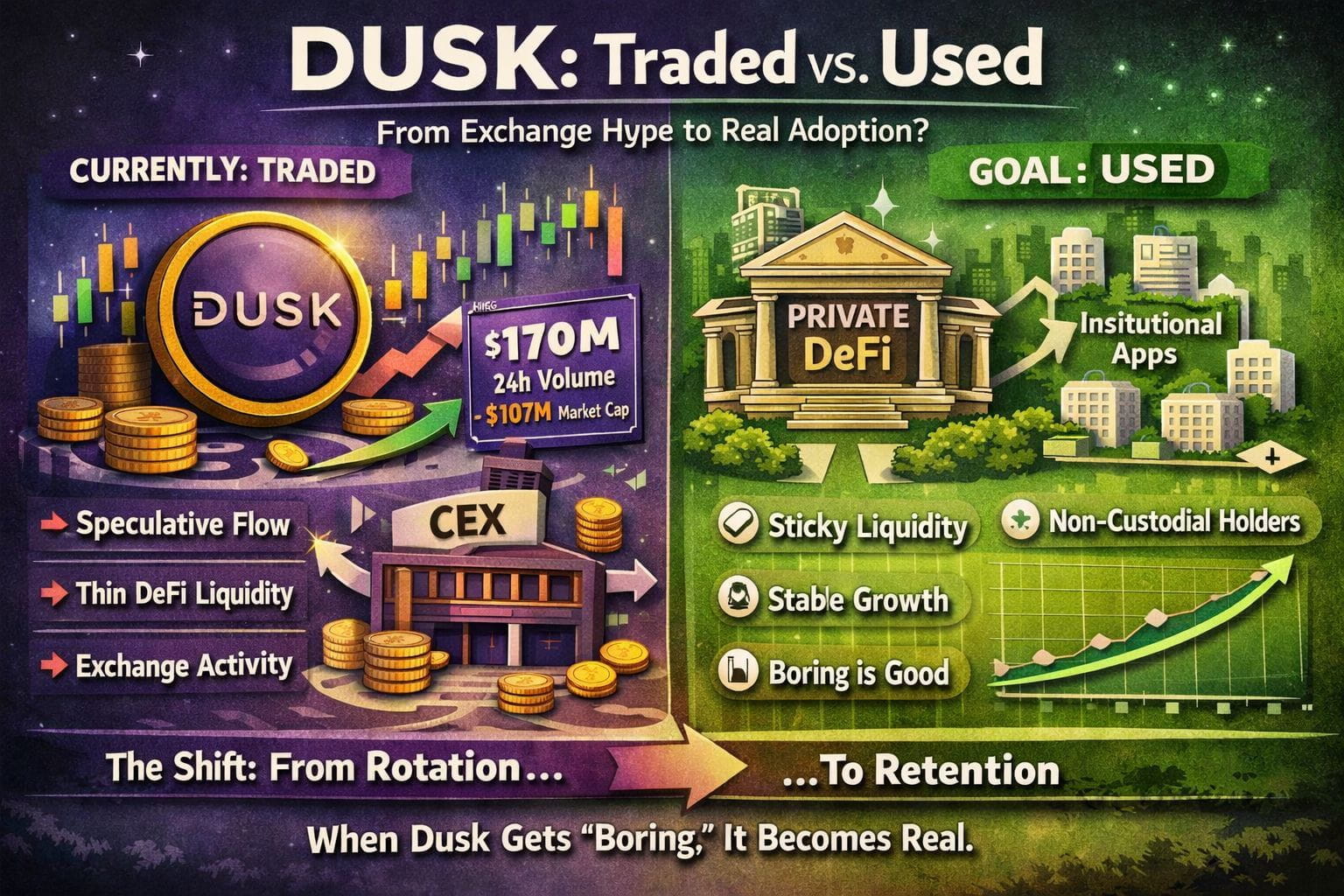
As global regulators continue exploring tokenization frameworks, blockchains that already align with compliance will stand out. Dusk does not need to pivot. It was built for this moment from day one.
Adoption may come through pilot programs. Small issuances. Limited trials. Then gradually expand.
This is not explosive growth. It is compounding trust.
I believe the biggest mistake people make when evaluating Dusk is expecting visible activity. Institutional systems operate quietly by design. The absence of noise is not absence of progress.
If Dusk succeeds, it will not look like a typical crypto success story. It will look like infrastructure becoming normal.
And normal is where real value lives.
