
When I first started paying attention to Dusk Foundation, I realized something quickly. This project was never trying to compete with fast chains or trending narratives. They were building something slower, heavier, and far more serious. Dusk was not asking how crypto could move faster. It was asking how finance could safely move on chain without breaking the rules that already exist.
At its core, Dusk Foundation focuses on regulated finance. That alone sets it apart. Most blockchains are built for open participation where everything is transparent by default. That works well for experimentation, but it collapses the moment real institutions get involved. Banks, asset issuers, and financial entities cannot operate with full public exposure. They need confidentiality, but they also need proof.
This is where Dusk begins to make sense.
The idea behind the network is simple but difficult to execute. Financial data should remain private, yet transactions must still be verifiable. Regulators must be able to audit activity, while the public network must be able to confirm correctness without seeing sensitive details. Dusk builds this balance directly into its architecture rather than adding it later.
I’m seeing how they treat privacy not as secrecy, but as controlled visibility. This distinction matters deeply. It allows institutions to operate legally while still benefiting from decentralized settlement.
Dusk uses zero knowledge cryptography to enable confidential transactions and smart contracts. That means activity can happen on chain without revealing underlying information. What is revealed is proof that rules were followed. This structure allows ownership, settlement, and compliance to exist together rather than in conflict.
The network is designed as a Layer 1 built specifically for this purpose. It is not trying to support everything. It focuses on one area extremely well. Regulated assets. Securities. Financial instruments that must follow strict rules.
I find it interesting how Dusk does not frame itself as disruptive. Instead, they’re positioning blockchain as an upgrade to existing financial systems. This mindset shows maturity. Finance does not like chaos. It prefers predictability.
The DUSK token plays a functional role in this system. Validators stake $dusk to secure the network and participate in consensus. Fees are paid in DUSK. Economic incentives ensure honest behavior. Nothing here feels decorative. Everything has a purpose.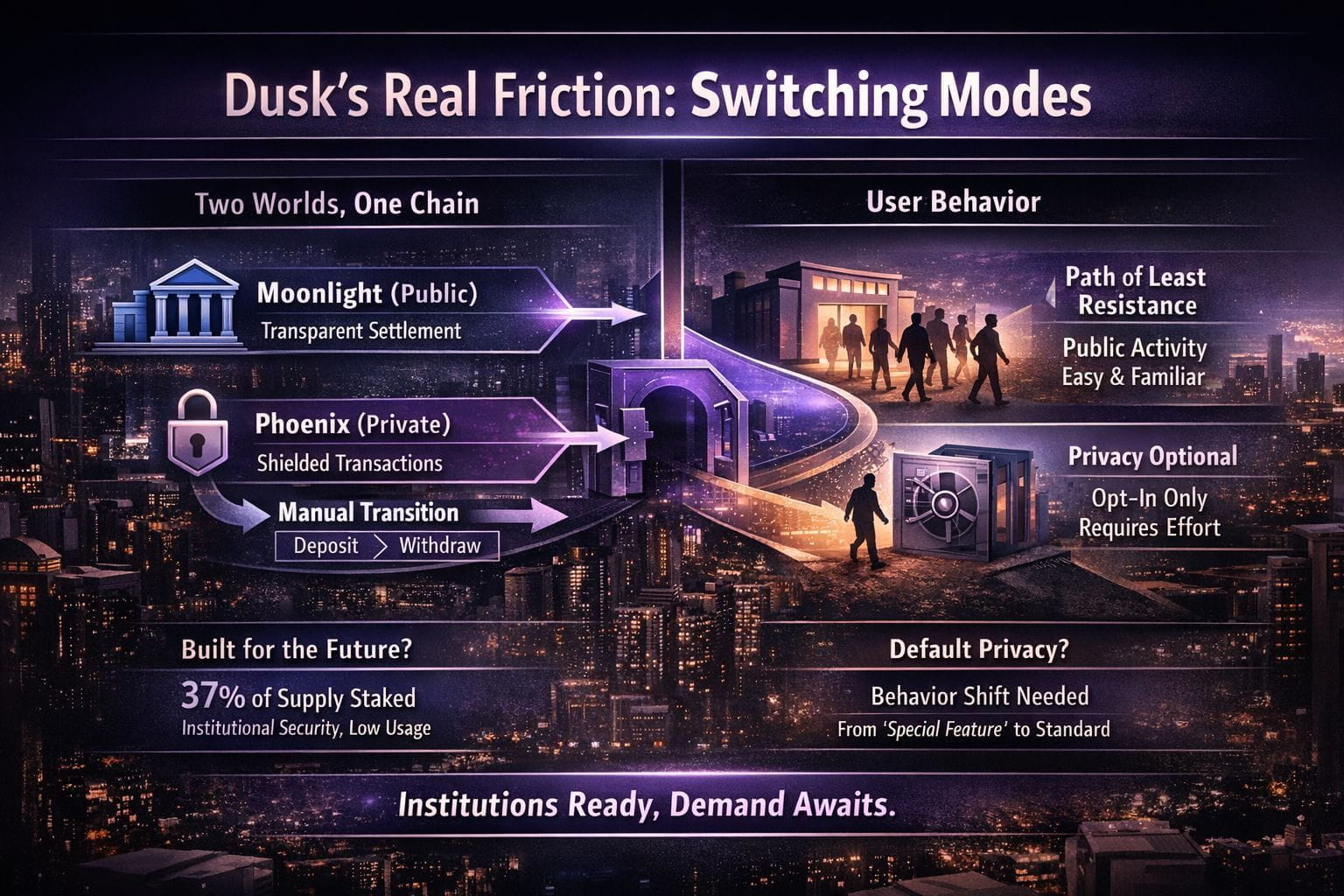
What stands out to me is how Dusk thinks in years, not months. Their roadmap focuses on infrastructure rather than features meant to trend. Institutions do not adopt technology quickly. They test. They audit. They wait. Dusk appears comfortable with that pace.
We’re seeing a broader global push toward tokenization of real world assets. Stocks, bonds, funds, and structured products are increasingly discussed as on chain instruments. But without privacy and compliance, those ideas remain theoretical. Dusk exists to make them practical.
If adoption happens, it will not be loud. Banks will not announce every transaction. Users will not celebrate every settlement. Systems will simply begin working.
That quiet adoption may be the strongest signal of success.
When I think about the future of blockchain, I no longer imagine speculation first. I imagine infrastructure quietly replacing outdated systems. Dusk feels aligned with that future.
