
The first time I tried using stablecoins the way people use real money, I realized something was off. On paper, everything looked perfect. Transfers were global, fast, and independent of banks. But in practice, it never felt effortless. One day the transaction was instant, the next day the fee made no sense. Sometimes I had to hold a separate gas token. Other times I had to double check which network I was on before hitting send. None of this felt like money. It felt like I was managing a system instead of using one.
That uncomfortable gap is exactly where Plasma steps in. The project is built around a simple but powerful idea: stablecoins should not feel experimental anymore. They should behave like finished financial tools. Not clever workarounds. Not temporary bridges. Just money that moves when you need it to move.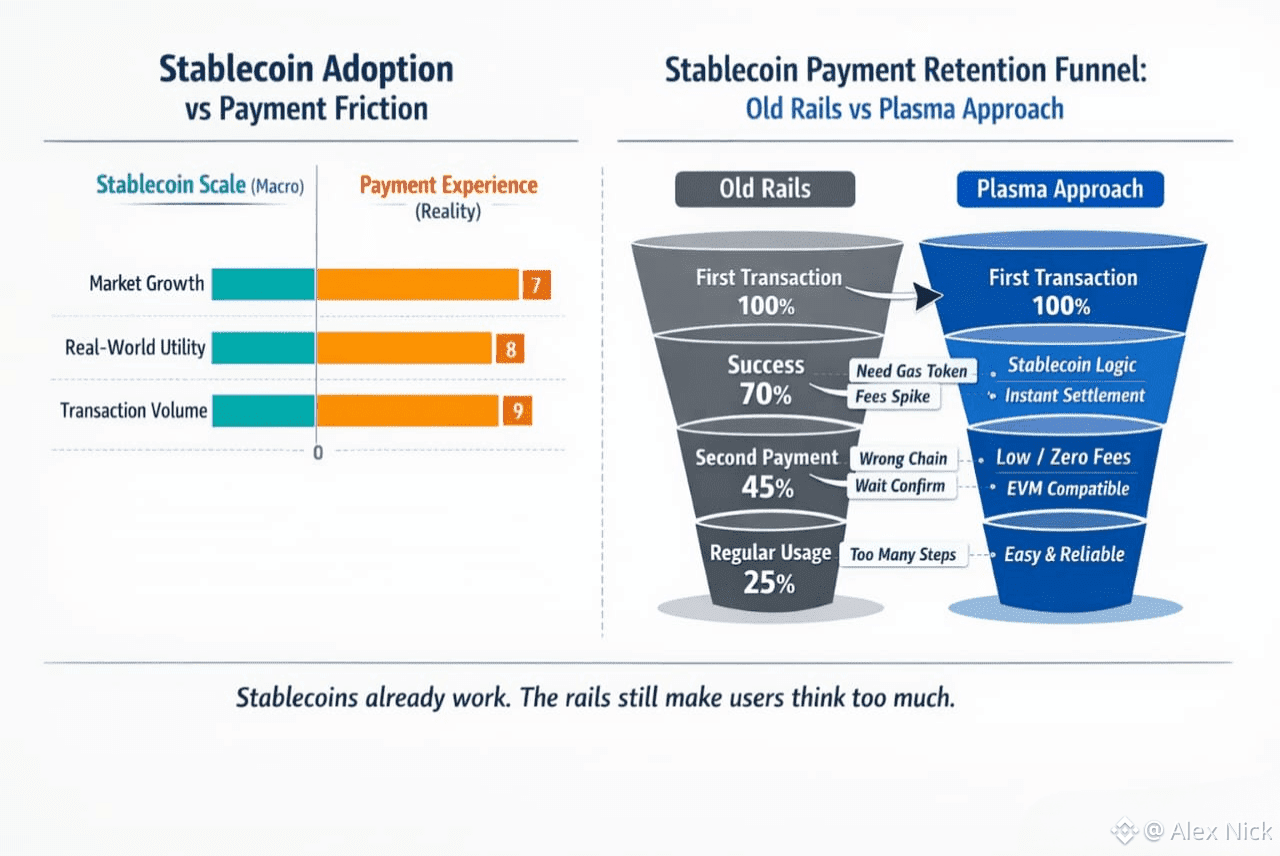
Stablecoins have already proven their importance. They are no longer just trading pairs on exchanges. They are used for cross border payments, remote salaries, treasury operations, and settlements between companies that never want to touch traditional banking rails again. Reports across the industry show stablecoin circulation well above one hundred sixty billion dollars, with trillions in yearly transaction volume. That scale alone tells a clear story. Stablecoins are no longer a niche. They are infrastructure in waiting.
Yet the irony is hard to ignore. Most of this activity still runs on blockchains that were never designed specifically for payments. Ethereum offers security and depth, but costs can rise without warning. Tron offers speed and low fees, but brings concentration concerns. Other networks compete, but users still face confusion, inconsistency, and operational friction.
Plasma is built on the belief that this problem cannot be solved by tweaking existing systems. It needs a chain designed from the beginning around stablecoin behavior. Not added later. Not adapted awkwardly. Designed deliberately.
According to Plasma’s published architecture and documentation, the network positions itself as a Layer one focused on stablecoin settlement above all else. The goal is near instant finality, predictable behavior, and a user experience that removes as many decisions as possible from the payment process. One of the most talked about aspects is its support for zero fee USDT transfers, a design choice that directly targets one of the biggest psychological blockers in digital payments. People dislike paying fees to move dollars, especially small fees that repeat over time.
This is not about saving cents. It is about trust. When money behaves unpredictably, people hesitate to rely on it. When money behaves consistently, it becomes part of routine life.
I keep thinking about how this plays out in the real world. Imagine a trading intermediary coordinating payments between a buyer in Turkey, a supplier in Vietnam, and a logistics partner elsewhere. These transfers might happen daily. Even small inefficiencies compound. Holding a gas token becomes accounting overhead. Fee spikes turn into hidden costs. Delayed confirmations become business risk. In that environment, stablecoins stop feeling like working capital and start feeling like an experiment.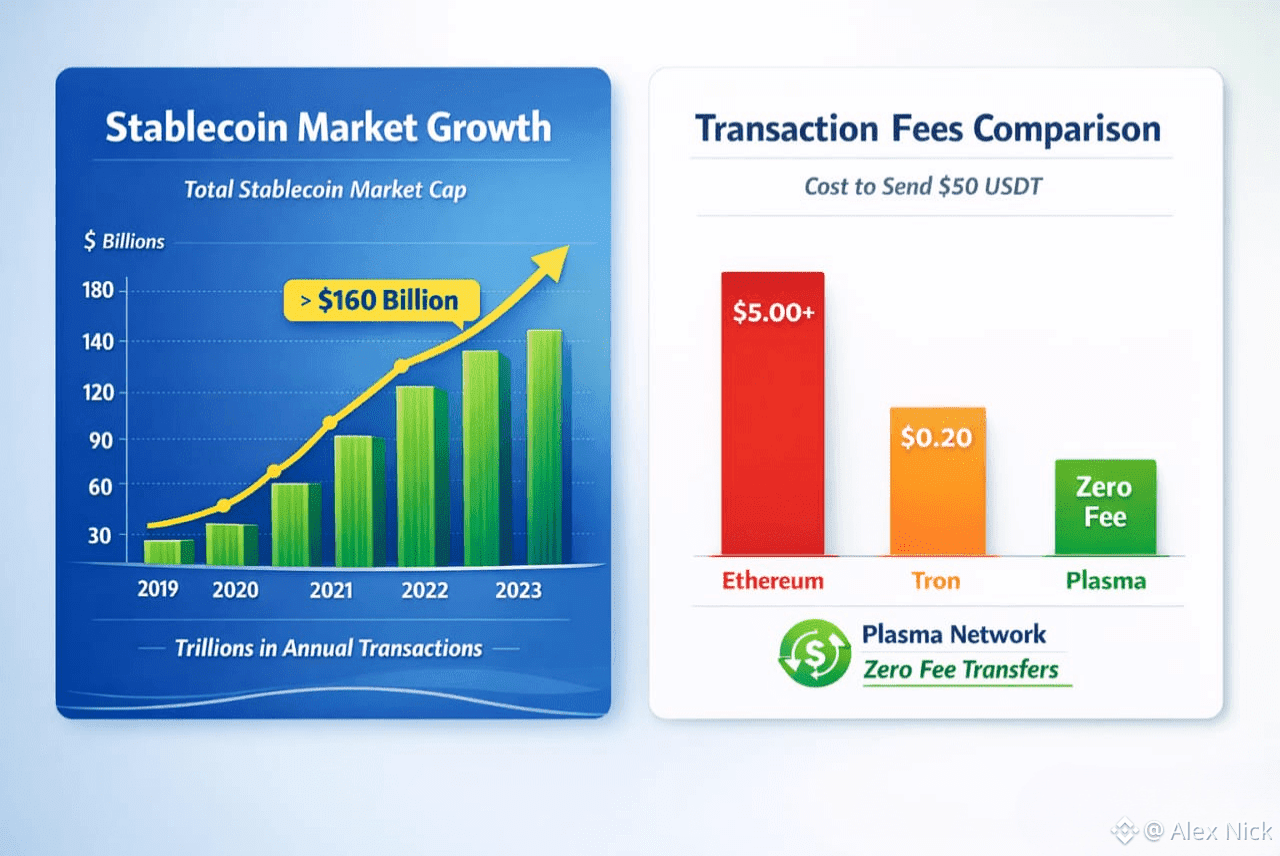
Plasma’s thesis is that if you build the network around these realities, stablecoins can finally function like dependable cash equivalents. Fast settlement reduces uncertainty. Stablecoin native fees remove operational complexity. And predictable execution allows businesses to plan rather than guess.
From an investor perspective, Plasma fits neatly into a broader shift happening right now. Stablecoins are moving out of crypto culture and into financial infrastructure. Major fintech companies have begun openly exploring or announcing stablecoin initiatives. Reuters recently covered Klarna’s intention to launch its own dollar backed stablecoin expected in 2026. These moves are not ideological. They are practical. Businesses want faster settlement and lower costs. Stablecoins deliver that.
But as usage grows, the rails underneath matter more. You can’t scale payments on systems that behave unpredictably under stress. That is why Plasma’s focus stands out. It is not trying to be everything. It is not competing for NFTs, meme tokens, or experimental applications. It is concentrating on one function and trying to do it extremely well: moving digital dollars reliably.
This is why Plasma’s EVM compatibility also matters. Developers do not need to learn entirely new tooling. Wallets and integrations can be built using familiar standards. That lowers friction for adoption and speeds up ecosystem development. For payment networks, time to integration often matters more than theoretical performance metrics.
There is also a credibility layer behind the project. Plasma reportedly raised around twenty four million dollars in funding led by Framework Ventures, with participation from well known industry players including Bitfinex. Funding does not guarantee success, but in payment infrastructure it buys something critical: time. Time to harden security, test settlement logic, and build real partnerships rather than rushing to market.
Still, the hardest challenge is not launch. It is retention.
Crypto users love trying new chains. Very few stay. Retention fails when the system demands constant attention. Remember which bridge to use. Hold another token. Avoid certain hours. Double check confirmations. Each extra step increases drop off. And with stablecoins, retention is everything. No one wants to feel emotional attachment to a dollar. They want reliability.
If Plasma succeeds, it will not feel exciting. It will feel boring in the best possible way. Sending stablecoins will feel routine. No fee calculations. No hesitation. No second guessing. Just movement of value.
That is the future Plasma is aiming toward. Not louder marketing. Not dramatic narratives. Just infrastructure that fades into the background while doing its job.
For anyone evaluating Plasma seriously, the smartest approach is not blind optimism or reflexive doubt. It is observation. Watch mainnet execution. Watch wallet support. Watch liquidity flows. Watch whether people continue using the network after the first transaction.
Because in payments, the winner is never the chain people talk about the most. It is the one people stop thinking about altogether.
And that is the real future Plasma is pointing toward. A world where stablecoins do not feel like crypto anymore. They simply feel like money that works every single time.

