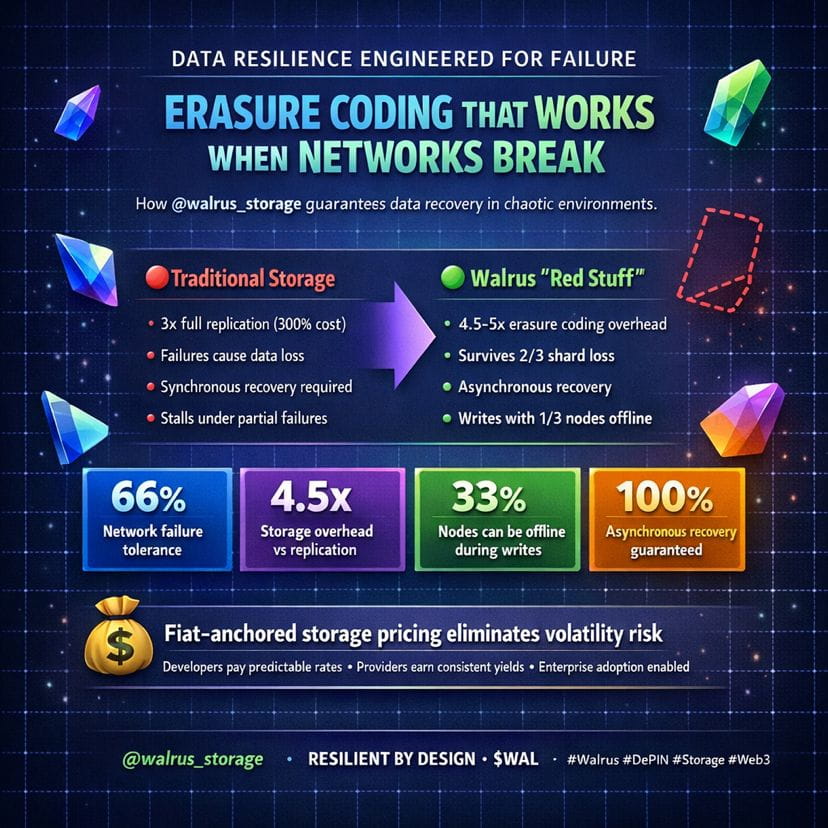
Most storage networks fail silently. A few nodes go offline, some data gets corrupted, and you only notice when you need it most.
@Walrus 🦭/acc is engineered for this reality. Their erasure coding doesn't just prevent failure—it embraces churn as a normal condition.
The Core Innovation:
Traditional replication stores 3 copies (3x cost). Walrus uses "Red Stuff" 2D erasure coding to achieve resilience with ~4.5-5x overhead—not just cheaper, but smarter.
What This Means for Your Data:
Data split into "slivers" distributed across nodes
Recoverable even when 2/3 of slivers are unavailable
Network keeps writing even with 1/3 of nodes offline
Asynchronous recovery without blocking operations
The $WAL Economic Engine:
Storage incentives often fail when token prices fluctuate wildly. Walrus anchors payment in fiat-equivalent stability—users pay predictable rates, providers earn consistent yields.
This isn't just tech—it's economic architecture. Volatility kills infrastructure adoption; stability enables it.
For Traders & Investors:
WAL at ~$199M market cap isn't pricing in the enterprise storage migration happening right now. As AI datasets, RWA documentation, and institutional records move on-chain, the demand for provably resilient storage explodes.
Track these metrics, not just price:
Node retention rates
Storage cost predictability
Real data stored (not just capacity)
Walrus isn't building another storage protocol. They're building the data integrity layer for everything valuable on-chain.
When you're storing millions in digital assets, "good enough" storage isn't good enough. You need mathematically guaranteed recoverability.