
Most privacy chains make you pick a side early. Either everything is hidden, or everything is exposed. Dusk didn’t buy into that framing. Instead of forcing one worldview, it built two execution environments on purpose: Phoenix and Moonlight.
Phoenix is where privacy actually matters. It handles confidential transactions using cryptography so balances, amounts, and participants don’t leak. That’s not a philosophical choice — it’s practical. Institutions, funds, and regulated entities can’t operate if every move becomes public market data. Phoenix lets transactions be validated without turning sensitive activity into a spectator sport.
Moonlight exists for the opposite reason. Some things need to be visible. Smart contracts that rely on composability, shared state, and public interaction don’t work well behind a privacy wall. Moonlight supports transparent execution so applications can plug into open logic, governance, and on-chain workflows without friction.
What makes Dusk interesting is not that it supports both modes — it’s that projects don’t get trapped in one. Real systems move between privacy and transparency depending on the moment. A transaction might need confidentiality at execution, but clarity later for audits, reporting, or settlement logic. Dusk allows that shift without forcing developers to leave the network or redesign everything.
This matters more than most people admit. Finance doesn’t live at one extreme. Some steps are private by necessity. Others must be visible to function at all. Dusk’s architecture reflects that reality instead of pretending one model fits every case.
Phoenix doesn’t promise Moonlight behavior, and Moonlight doesn’t inherit privacy by default. That separation is deliberate. It prevents assumptions, reduces edge cases, and makes rules explicit.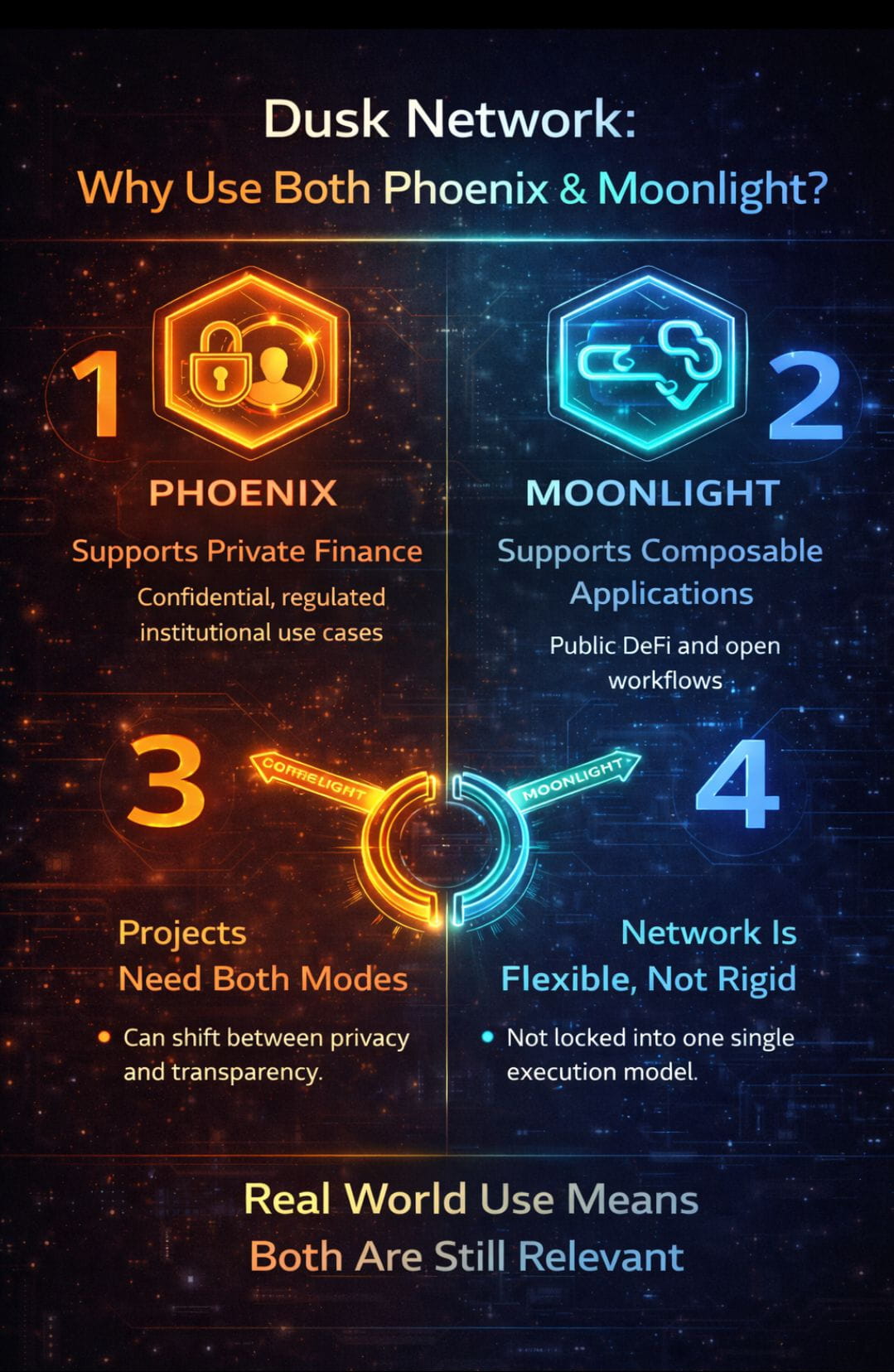
Dusk didn’t add Moonlight to dilute privacy. It added it because serious systems need both discretion and openness — just not at the same time. That balance is what makes the network usable beyond theory.#dusk
